

Baitcasting Reels
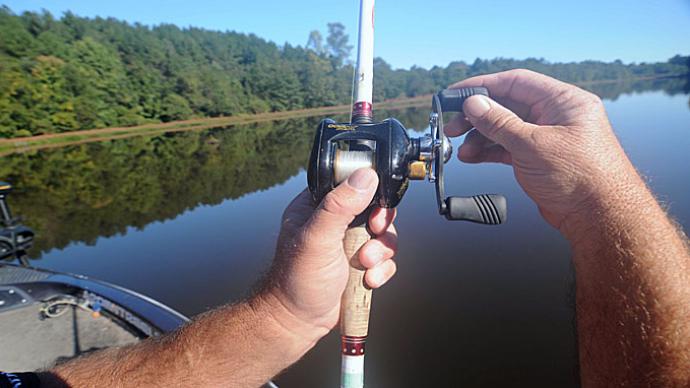
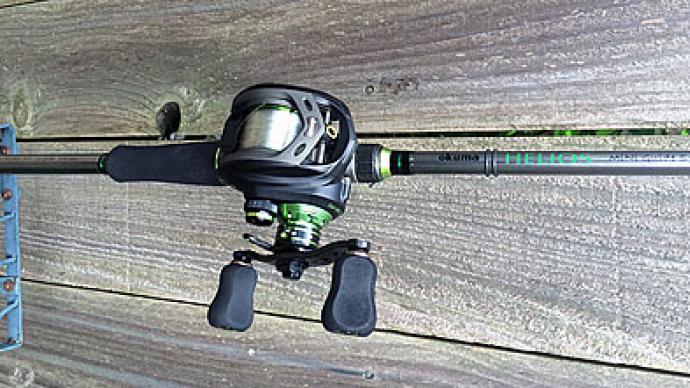
Baitcasting reels provide better lure control and accuracy and are suited for lines testing 10 pounds or heavier. They have a tendency to backlash or snarl when the spool spins faster than line is paying out, especially when casting into the wind.
While magnetic braking features on baitcasting reels do help prevent backlashes, the most important control is the spool tension knob (usually next to the handles). To set it for each lure, hold the rod perpendicular to your body, disengage the spool and loosen the tension just until the lure starts to drop, then tighten slightly.
To cast, disengage the spool and hold your thumb on the spool. Release thumb pressure on the spool when you want the lure to move forward. It is crucial to learn to control spool revolution speed with your thumb.

Spinning Reels
These open-face, skirted-spool reels have a stationary spool. The line is wound onto the spool as a bail rotates around it. Spinning reels can handle practically any size line, but they are preferred for lightweight lures and line lighter than 10-pound test. They also perform better than baitcasting reels for casting into the wind. A disadvantage of spinning reels is that they eventually twist the line, creating loops, knots, and tangles. When these occur, it is best to replace the line. To help prevent line memory and tangles, drop your spool in a glass of water the night before you go fishing and let it soak overnight.
To cast, place your hand on the rod handle with the spinning reel beneath it and with your middle finger in front of the reel "foot." Open the bail and hook the line behind the first knuckle of your index finger. To release the line, straighten your index finger. To control the distance of the cast and make the lure touch down softly, "feather" the line by moving your index finger close to the spool, causing the line to slap against the finger as it unwinds. To stop the line, press your finger against the spool lip.

Spincast Reels
These closed-face "push-button" reels are easy to use because they are relatively tangle-free and provide comparatively long, smooth casts. The spool is housed inside a cylindrical covering and remains stationary as a line pick-up pin rotates around the spool. Do not stint on quality when you purchase a spincast reel; you get what you pay for. While they are touted for beginning fishermen, they also are popular among some advanced anglers.
To cast, depress and hold the push-button, then release when you want the lure to move forward. Various models are made to handle practically any weight of lure; be sure to match the line size to lure weight.
Reel Tips
- My boys love to fish, but they are at the age, where they don't have the dexterity to fish for long hours without their hands becoming tired. As fatigue set in, the hook and weight attached to the business end of their spincast reels can become an uncontrolled missile. To make their fishing more enjoyable, I turned to one of the quality spinning reels currently on the market. Since the trigger replaces the traditional button found on the classic spincast, the boys use their index fingers to pull the trigger. They use a more natural hand motion and point to the spot where they would like the bait to go with that same trigger finger. This has greatly improved their accuracy and control along with being more comfortable for them. If you have young ones who like to fish, take a minute and check out the spinning reels. I'm glad I did. -- Ed Corio
- The most important thing about refilling your spinning reel is to not overfill it. If, when you open the bail, the line "jumps" off the spool, you are overfilled. It's also important to use a "soft" line that still is as strong as advertised. I've used hund of brand names before settling on one. All the others would break when tightening down the knot (polymer). I will NEVER use anything but STREN Easy Cast on my spinning reels. No memory, great castability, great sensitivity, and priced right too. And I've NEVER broken the line while tying a knot regardless of pound test. -- Marty Klapa