senile1
Super User
-
Joined
-
Last visited
Everything posted by senile1
-
Is this a private pond . . . . or should I say lake? If so, and it contains a good population of bass, I would be spending a lot of time learning it. Oh, and the thermocline information should definitely apply in this case.
-
Good point, Roger. It does sound like a strip pit. I have never heard of a pond that deep.
-
The bass won't go any deeper than the thermocline in your pond, once it develops in the summer. A shallower pond fed by a lot of current or stirred by a lot of wind may not develop a thermocline. I suspect if yours goes down to 60 feet deep there will be one. To see a thermocline go out on the pond with a fish finder and turn the sensitivity all the way up. You should see a dark line across the screen at the depth of the thermocline. In a nutshell, the thermocline is created by the change in water temperature of the upper layers of the water column. The colder water is denser in the summer and stays deep. All living things that die end up in this water and as they begin to rot the oxygen content of the water below the thermocline can become anoxic to the point where it doesn't contain enough oxygen for bass and other fish to live down there. In the fall, the upper layers will cool until they reach the same temperature as the deeper layers and the water will mix, thus creating the fall turnover. In the Winter, once the water reaches 39.4 degrees and below on top, this warmer water becomes more dense and sinks below the cooler water. (One of the strange things about water is when the temperature is above 39.4 degrees, warmer water is less dense and floats on top of the cooler water. When it is below 39.4 degrees, warmer water becomes more dense and sinks.)
-
The mouth is the obvious way to differentiate the species, but those bronze bodies with light vertical stripes were a dead giveaway as well.
-
I see the thread for the strip pits and this one. Are there going to be two events? I may try to make it out to Kansas and see you guys if this works with my schedule, though the pits on October 4th probably won't work for me. I'll be at Table Rock September 1st - 6th and September 29th - October 5th.
-
I haven't fished the Mississippi at St Louis, but from what I have read, once you reach the areas above St Louis where the locks and dams exist there are some bass. Most of what I have read suggested fishing around the wing dams, just below the water release of dams, and backwater sloughs. I never heard of bass in the main channel but I guess if there were something for them to use as an ambush point to hide behind, it might be possible. http://www.ifishillinois.org/profiles/Mississippi.php This link describes each pool and they do have fishing reports at the end, including one for pool 26 at Alton which is just north of St Louis on the Illinois side. There appears to be an error in the report because one line mentions catching largemouths up to 15 lbs on stinkbait. I think they meant catfish because both the Illinois and Missouri largemouth records are between 13 and 14 lbs and who uses stinkbait for largemouths. There does appear to be a report for largemouth in there though. There is also a report for Woodriver which is just south of Alton.
-
Man, that's just awesome! Nice looking Smallies.
-
Very nice fish! Congratulations.
-
I'm pretty sure this is at least part of your problem. I know it is sometimes hard to fish a pond and stay away from the edge, but you have to do everything you can to be stealthy. I would crawl up to the bank if I had to with water this clear.
-
I would say my nemesis has been Smithville Lake north of Kansas City though I seem to have figured out some patterns that work for me most of the time. I have had my share of bad days there though.
-
I'm in northwest Missouri and we will be seeing highs from 74 - 78 degrees over the next three days with lows in the 50s which is 20 degrees below normal. I don't think those three days will have a huge affect on the fish that have moved deeper for the summer because it takes an extended change to affect the stability of that water. However, fish in the shallow water areas will notice the change and it may affect them.
-
Very nice pics! I haven't had a 50 fish day in a long, long time.
-
Very nice chunky bass! Congratulations.
-
This would have been a good weekend to night fish with the Supermoon. I think we get skunked more in the summer because we don't find the deeper groups of fish. At least that was the case for me. I get skunked much less now. There are some fish that stay shallow in the dog days of summer, but a large group will congregate in deeper water off the ends of points, around humps, on ledges, in creek channels, etc. Until we discover these groups, it can be hit or miss. With side imaging and down imaging finding these fish has become a bit easier for those who have these tools. Otherwise, you have to spend time with your old sonar learning the lake and learning where these areas are. That can result in some skunks as well. But once you find them, it can lead to some good fishing.
-
Some of that In-Fisherman information is in the book, Critical Concepts 2: Largemouth Bass Location. It is an excellent book and covers where largemouth will locate based on season and other environmental factors. It covers some of the more common freshwater aquatic plant species in the section on the summer season. However, there is nothing like researching the vegetation you see in your local lakes. I have researched Missouri aquatic plant species and there are quite a few more than you will find in this book. I doubt that you will find a book, magazine, app, or other publication that is going to cover every species in every geographical area.
-
It depends on if you fish smaller bodies of water or larger bodies of water the most, I suppose. I have a 19.5 foot bassboat with a 200 horse motor and I have a 10 foot jon boat. Last year I used the jon boat more than the bassboat. This year I have only used the jon boat 3 times while the bassboat is being used the majority of the time.
-
I would recommend rods no less than the $130 - $200 dollar range for techniques requiring sensitivity while you can go lower for techniques like cranking, spinnerbaiting, etc. You can combine some of these techniques into one rod if you want to save money. I provided a choice for each since the question specifically requested a rod for each technique. Frogging rod for throwing horny toads, stanley ribbits, and booyah pad crashers. [7'3" - 7'6" heavy with fast tip and 30 - 60 lb braid. Most use higher than 50 lb braid but I've never had an issue dragging fish out from under lily pads with 30.] Jig/worm rod for pitching and casting 1/4 to 1/2 oz jigs and t-rigged plastics. [7'0" - 7'3" MH or H (I prefer heavy) with fast tip and 30 lb braid with 5 - 6 foot 12 - 15 lb fluoro leader or straight 15 - 20 lb fluoro.] Spinnerbait/buzzbait rod. [7'0 - 7'3" MH with fast tip and 30 lb braid or 12 - 20 lb monofilament when you want to keep the bait up in the water column. For deep spinnerbaiting techniques like slow rolling 12 - 20 lb fluoro can be used.] Shallow square bill crankbait and medium diver crankbait rod. [7'0" medium CB rod with extra fast tip and 10 - 15 lb Monofilament or 8 - 15 lb fluoro. Fluoro or mono is up to you depending on how deep you want to be.] Senko rod for weightless t-rig. [7'0" Medium or medium heavy with extra fast tip, 6 - 12 lb fluoro depending on how far you need to sink it, or 20 - 30 lb braid with 10 - 12 lb fluoro leader.] Drop shot or shaky head finesse spinning setup. [7'0" medium extra fast or fast tip for shaky head, 7'0 medium light or medium extra fast or fast tip for drop shot with 6 - 8 lb fluoro.]
-
Very nice. Sounds like your boy has the makings of a great angler!
-
-
Once the water temperature drops below approximately 45 degrees, threadfin shad start to die off. If your lakes get much colder than that and stay at those temperatures for a while in the winter, you will have a large threadfin fish kill. I have read that threadfin cannot survive water temperatures below 35 degrees, but generally when the water is frozen on top, the temperature at the bottom of a deeper lake is approximately 39 degrees so it is possible that some could survive. (Funny thing about water - in the summer it gets colder as you go deeper because cooler water is more dense, but in the winter after the water reaches 39.4 degrees and below, the cooler water becomes less dense and stays on top. If it didn't do this water would freeze from the bottom up.) On the other hand, gizzard shad can survive in colder temperatures. Here as far north as Kansas City, we have gizzard shad but we don't see threadfins. Our biggest lake, Smithville, gets down to 35 degrees or cooler on the main lake and the coves freeze up and it remains at these temperatures for quite a few weeks. On the south side of the state of Missouri, however, threadfin do survive in Table Rock Lake, Bull Shoals, etc as their water temperatures may only hit the low 40s on rare occasions.
-
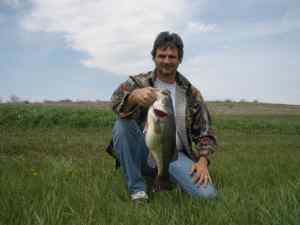 Caught on 1/2 oz chrome/blue back Rat 'L' Trap.
 -
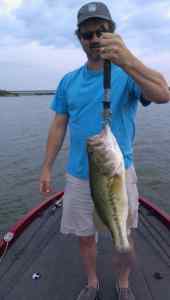 Caught on 5/8th oz Siebert's green pumpkin Big-O brush jig with matching Rage Tail Craw.
 -
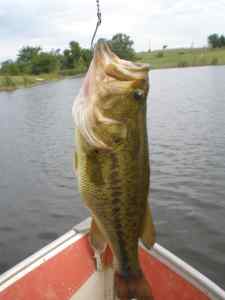 Caught on 3/8 oz white/chartreuse Booyah spinnerbait. Fish was 23.5 inches long.
 -
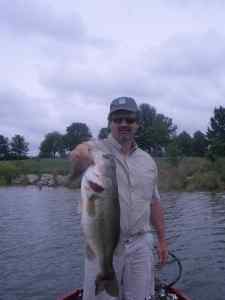 Caught on 1/2 oz Siebert's Big-O brush jig with Summer Craw colored Rage Tail Craw.
 -