


fissure_man
Members
-
Joined
-
Last visited
Everything posted by fissure_man
-
Sounds like the old guard getting defensive when science touches on their beliefs. Nothing new here I think it's more accurate to say that they do play by the rules, we just don't know what all the rules are. If a bass shows a preference for a certain lure/profile/color/size/speed/etc., I believe there is a reason for it, even if I don't know what the reason is. If theory and experience are contradictory, then one or both are wrong (or incomplete, or misguided). This is the core of science, hypotheses are tested by experience (controlled experimentation), and are revised or thrown out if they don't agree. I agree, at least until we learn more about bass behavior and all the factors that might affect color preference. As our understanding of these factors increases, informed decisions can start to cut down the trial and error. History shows everything is too complex to understand, until we understand it
-
Can you elaborate? How do you go about picking lure colors based on those factors? Good point, but environmental conditions and bass physiology can be studied without any input from the bass. It's not the whole picture, but it lays a foundation for understanding bass behavior. If experience shows bass have a color preference in particular conditions, the science can help to understand why, and lead to a hypothesis on color choice in other conditions as well. I'm in the camp that says lure color usually isn't a big deal, but occasionally it's critical. Some of the discussion above has focused on determining which colors are most visible to the fish, but "most visible" often does not mean "most likely to get bit."
-
I'm not saying nobody throws swimbaits, but how many thousands of casts do you think are made with "normal" sized baits in Texas for every one with a big bait? It's not a fair comparison. More speeding tickets are given out to Volkswagen's than Lamborghini's in a given year, does that mean Volkswagen's are faster? lol I agree 100% that location is by far the most important piece of the puzzle, but there's a reason why most dedicated trophy hunters have a place for big baits in their arsenal.
-
The sharelunker stat is impressive, but surely the reason is that in terms of angler-hours, almost nobody is throwing "big" baits. I wonder what percentage of Texas anglers even own a rod that can comfortably chuck a 3+ oz swimbait? If people exclusively fished crappie jigs, then loads of big bass would be caught on crappie jigs... it doesn't mean a crappie jig is the best choice. I'm surprised there aren't more swimbait anglers on here defending their case. I'm not one, but if I spent $60+ on a lure and $300+ on a new setup to toss it, I wouldn't want to be told it has no benefit other than to filter out a few dinks
-
Especially since this is your first baitcaster, I'd recommend no less than 40 lb test braid. The strength is overkill, but the diameter of 40 or 50 is going to be more user friendly (IMO) when it comes time to pick out a backlash. Most 40-50 lb braids are equivalent in diameter to 10-12 lb monofilament, which is perfect for most casting reels. Thinner braid will be tougher to untangle and more prone to digging in on itself unless you keep it spooled really tight. Many disagree, but I think braid is a great choice to learn baitcasting with. Backlashes with braid (for me) are FAR easier to untangle than other lines, and you don't have to worry about damaging the line by kinking it.
-
This is the exact phrasing: Open Seasons – Fishing season opening and closing dates vary depending on the species and the area. Dates are inclusive: all dates including the first and last dates stated in the summary are open or closed. It is illegal to attempt to catch fish for which the season is closed, even if you are going to release them. Fish accidentally caught during the closed season must be immediately released back to the water. Unless stated otherwise, species that are not listed (such as sucker and Rock Bass) have a year-round open season. I agree it is nearly impossible to enforce if the fish are being released. People honestly targeting other species are going to catch some bass, and even if it's obvious someone is targeting bass, it wouldn't hold up in court. CO's/Game Wardens have been known to get sneaky, observing from a distance to "make a case," but it's extremely rare for anyone to be charged with fishing for bass out of season if they don't have the fish in their possession. Still, having the rule in place keeps the honest folks indoors. It's basically an honor system lol. Out of season bass fishing is rampant and obvious, so it's pretty frustrating to drive by a bass/bluegill pond and see folks tossing senkos and crankbaits all through spring. If a CO ever did stop to question them, they'd probably say "I'm just fishing" and that would be the end of it. I've seen some "shaming" posts online, calling out people who should know better. When a fully rigged bass boat is pitching jigs around docks in May, that guy's not targeting pike lol. Same goes for the musky guys; they're even more cutthroat. The good news is that Ontario has plenty of other fish to chase in the spring. If you drive to northern Ontario you can get a (legal) head start on the bass season because it's open all year, and the spring smallmouth fishing is phenomenal. For those close to the border you can drive to Buffalo for world class spring smallmouth fishing on Erie as well. The wait is torture, but opening day is a rush. Favorite day of the year. I will be out before the sun comes up.
-
Agree 100%. I would bump up to 50 lb braid because it will be even easier to sort out backlashes with the larger diameter. When you get a backlash, mono and especially fluoro will kink and weaken significantly, braid does not. As long as you avoid a true hopeless birdsnest, braid will last a very long time and be cheaper in the long run. When you do get a backlash with braid, clamp your thumb on the spool and turn the handle a couple times. Most times you can just pull the backlash straight out after that. (I heard this all from a friend; I never get backlashes )
-
To help diagnose: do the reels feel stiffer? noisier? rougher? Do the problems go away when you remove the spool? What model reels? What did you use to lube the frame bearings? Most (all?) reels come from the factory with greased frame bearings. Grease in these bearings gives the smoothest feel, and can mask some noise and roughness due to a dirty or damaged bearing. Using a heavy oil in place of grease has a couple of advantages: it will be much easier to flush and relube than with grease, and your reel will feel slightly less 'stiff' (freer handle rotation). The downsides are that the oil won't last as long as grease, and any imperfections in the bearings will be more noticeable. If you flushed the grease from your frame bearings and replaced it with oil, I'd guess you have damaged or not fully cleaned bearings that are now more noticeable. If this is the case the handles will still turn freely, but the reels will be noisier and rougher than before cleaning.
-
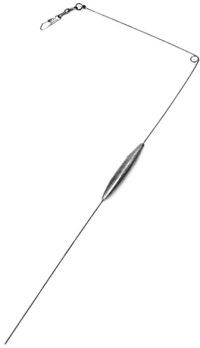
Not quite a carolina rig, but... I've caught some good smallies in deep water on Erie by drifting with a floating jerkbait behind a walleye-style bottom bouncer. It's a clunky rig and lazy fishing but it works. Best on windy days to cover lots of water and provide action (and when you're tired of breaking off tube jigs to snags).
-
Can you explain this a bit more? Cutting off a few (or 10) feet after every good fish or snag sounds like it would get expensive in a hurry, especially with high dollar fluoros. If the line is deforming, why would it only occur in the final few feet? All the line that's not packed on the reel is subject to the same tension.
-
I'm up north as well. I think your ideal set up will be determined more by the cover you're fishing than the size of the fish. Most recommendations from the south still apply. For specific gear, what's your price range? In general: Rod: A medium-heavy power, fast or extra fast action baitcasting rod in the 7 ft range will serve you well in sparse-to-moderate weeds and will be a versatile rod for other techniques as well. For the heaviest weeds, step up to a heavy power/fast or extra fast action. 7 ft will get by, but I prefer an even longer "flippin stick" (7'11"), especially around taller emergent stuff (pencil reeds, cattails, arrowhead...). I find the extra length helps me flip the bait up and into these weeds, and also pull it out with fewer snags (keeps things a bit more vertical). Reel: Any decent quality baitcasting reel is fine for these techniques. A high gear ratio will improve your efficiency a bit by picking up line faster between pitches. If you're pitching light lures (<1/4 oz) then reel choice will become a bit more important. Line: For me, heavy weeds = braid. 50 lb Power Pro or Sufix 832 work for me and don't break the bank. I prefer hi-vis yellow for flipping/pitching because it stands out for line watching. Focusing on a green line against a wall of green reeds, green water, in the wind is tough. Take a sharpie marker to the last few feet to camo it a bit.
-
To the anti-hand-switching crowd: Do you palm your reel during the retrieve? I like the idea of never switching hands, but as a right-hander using LH reels, I've found I need to compromise on a grip that works for both casting and retrieving, but isn't ideal for either. I've settled on using both LH and RH for different techniques. For flipping/pitching I'm using LH retrieve, because switching hands on rapid short casts gets tedious (I think I get more pitches per hour with LH). For chuck and wind lures I like RH retrieve with a hand switch while the bait is still in the air. With a normal cast (not flipping or pitching), switching hands causes no delay and lets you palm the reel however you want. Using both also spreads out the fatigue. Ripping jerkbaits for smallies, my primary rig is a spinning rod (LH retrieve) but I also usually have a baitcaster rigged up (RH retrieve) so I can switch out for a bit when my right arm gets tired. Mainly I'm just trying to justify more reel purchases
-
From the original post: " If I can't snell them do u think it will affect my hook up ratio? " Clearly some debate on this topic still exists. Is it closed to discussion? Regarding the rest of his question, it seemed like it had been answered pretty unanimously. Those flipping hooks were designed to accommodate a snell knot, so yes, it works. Admittedly, I haven't tried using 25+ lb mono or flouro on a Trokar so I'll trust your guidance on that. When I tie on a hook like that I'm using 50 or 65 lb test braid and have experienced no problems with running out of space.
-
Expensive hooks and weights aren't an investment in the snell knot. The same allegedly faulty logic can be applied to cheap hooks and lead, just like Trokars and tungsten can handle palomars.
-
Those guys' eyes must be too old to tie it too! ( I jest ) But really, it's not a super hard knot to tie, at least not the version I'm familiar with. Check out the Ike video posted above. If you can get past the kindergarten tone ( I jest again ), he does do a good knot demo. He's talking through it super slow and it takes about 30-40 seconds. In reality it would be half that time. If we're talking heavy braid around weeds (punching), I won't be retying THAT many times through the day, and it won't take much improvement in hookup % to justify the extra time. If there was actually some reasonable way to prove that it made a difference, what percent improvement would it take to make someone switch? I'd guess for the typical person reading this site it wouldn't take much. Knots are free. (hmm... maybe we need to ask Ike where the 20% figure came from in his video lol) Even if the hook is sideways, wouldn't an increase in the hook's "effective bite" (due to pivoting) still be a benefit? There's stuff to hook on the sides of the mouth too I think a possible flaw with the pivot theory that I haven't seen mentioned is this: The outward cam action can (in theory) push the hook point away from the line of pull, improving (in theory) the likelihood of grabbing some flesh. But at the same time it causes the hook point to no longer lie parallel to the line of pull, which would decrease the efficiency of penetration (is it like setting the hook with a circle hook?). In summary, none of this matters. Or does it?
-
Would a fat impact work on this rig?
-
If this applied to every hook set, no one would ever miss a fish! Obviously there are occasions where a sharp hook point manages to escape the bass' mouth without hitting any meat. That tells me there was at least a little space around it. Perhaps a bit of pivot action would have put that hook point in a better position to hook up. We're not talking about prying the bass' mouth open, just closing the gap if a bit of "space" does appear. That space could come from the bass opening its mouth when it decides not to swallow 1.5 oz + plastic, or when that same big weight is popped violently out of its mouth. There are a lot of great flippers that swear by the pivot; and I don't think any of them have a knot sponsor At best, the improvement is small. But the downsides are miniscule - the snell is plenty strong and it's a cinch to tie ( )
-
Braid is touted as the "most sensitive" line because it doesn't stretch, but on a semi-slack line it's not line stretch that causes loss of feeling. Braid is so limp that a bump on your senko will be very poorly transmitted by feel until the line is pulled somewhat tight. Line watching is key, but the limpness of braid hurts it in that category as well (a stiffer line will transmit a more obvious "twitch"). Any decent copoly, fluoro, or plain old mono will transmit bites better in this scenario IMO.
-
I'm from southern Ontario, Canada. Fishing for bass in my area is illegal for half the year because governing agencies aren't sure that allowing year-round bass fishing would be harmless to populations. I don't think there's strong science behind the idea that it would have significant impact, but the problem is that there isn't strong (applicable) science proving that it won't. And it seems that the folks in charge aren't keen to take the chance. If you can provide TPWD (or any) studies that conclusively show, in a controlled, applicable, and scientifically sound way, that extending our fishing season to include the spawn would have no impact, I'd be EXTREMELY grateful. I'd love to target bass year-round, and I have no issue with bed fishing where it is demonstrably sustainable. A year-round bass fishery could improve license sales, and would almost certainly have economic spin-off benefits. It would be hard to find a downside, and with reliable and applicable studies/data in hand, a strong case could be made. The problem with the current studies I've seen is that there are so many caveats that they are quickly dismissed as inconclusive or irrelevant. But again, I'd love to find some studies that aren't. The few local, active researchers in this field will disappointed to learn that TPWD already has the answers they're burning through their funding to find, but that's easily worth it if it means more fishing opportunities.
-
I truly don't mean to come across as negative toward Texas's fisheries management practices. Clearly what they're doing is working for them. If you look through my posts you won't find criticism of TPWD's work (I'd say my last post even implies they're too good; preventing us from seeing any impact of bed fishing ) The only points I'm making are: Observations on the population-level impact of bed fishing are likely to be skewed if stocking programs are underway at the same time (ie: would David Whitaker's study be valid if the scientists had dumped a few thousand baby Share-a-Lunkers in the bed-fished pond?) Even valid observations showing no observable impact of bed fishing are not necessarily broadly applicable to different fisheries, which might have drastically different environmental factors, and probably inferior management
-
Have a look at these stocking reports (Lake Fork and Toledo Bend): http://tpwd.texas.gov/fishboat/fish/action/stock_bywater.php?WB_code=0433 http://tpwd.texas.gov/fishboat/fish/action/stock_bywater.php?WB_code=0734 Sharelunker fingerlings make up a tiny fraction of the stocked fish each year. Are all the others coming from 13+ fish as well? Even if they are, the way it relates to my point is the same. IF bed fishing could impact fish populations by reducing the numbers of young bass, then a bass stocking program could directly offset the effect. Even in 40+ years, it might be hard to detect any impact of bed fishing if ongoing stocking is erasing the evidence. Is TPWD tracking success of natural reproduction vs stocking (genetics or fin clipping or something)? That would be one way to investigate. Texas' enviable stocking programs are just one factor. How about: climate, bass species, age of bass to sexual maturity, spawning habitat, duration of spawn, portion of bass spawning each year, angling pressure relative to bass population, nest predators, forage base, etc. With so many variables in play, it's a stretch to say that because no impact has been observed in Texas, fisheries everywhere have nothing to worry about.
-
-
-
The basis for concern is that bass defend their offspring to increase survival rate, and angling disrupts them from doing that. Increased predation/mortality of young offspring when a guarding male is removed is well established, but the extent to which it occurs is highly variable. Survival rates of young bass through the nest guarding period may or may not significantly affect adult populations down the road, but it's not unreasonable to suspect that egg/fry survival is a limiting factor in bass recruitment in some circumstances. The few population-level studies that have been performed do not (can not) control for all possible environments and variables. My point is that what works in Texas may not have the same outcome everywhere else, and the harmlessness of bed fishing in a general sense isn't thoroughly backed by science either.
-
I'm not sure a blanket statement like that can really be backed up. If an angler removes the bass guarding fry or eggs and doesn't release it in the same area, those fry/eggs aren't going to make it ("hurting the spawn"). Maybe if that bass is released somewhere else it will find another partner and have another chance, but not always. I would think that's even less likely further north, where the spawning window tends to be shorter. Whether or not the cumulative effect of anglers pulling fish from beds will impact bass populations (quality and quantity) down the road has to depend on a long list of variables. Lake Fork is clearly not the same as a 5 acre pond or the goby-infested great lakes/St. Lawrence (etc). Certainly there are examples of fisheries that have thrived through constant fishing pressure (including the spawn) for decades. Many even benefit from the "herd thinning" that sport fishing provides. But on any body of water there will be a point where overfishing takes a toll, and if we're talking catch-and-release (especially delayed release), the spawn is the time when potential for impacting bass populations is highest. That said, where it's legal and sustainable, sight fishing for bedding bass is a ton of fun (IMO)! I have no reason to feel guilty about it if the fishery can sustain itself and thrive under the pressure it's subjected to. It's the same lack of guilt I feel when I harvest a few cold-water smallies for a meal, or enjoy a venison roast. I'm not looking to participate in decimating a species, but my ability to responsibly enjoy our natural resources is something I value highly. Referring back to the original post, I think it could be argued that any kind of fishing could be "somewhat counter productive to the proliferation of the species" if left unchecked. Science-based, local fisheries management is key, and in some places banning bed fishing is probably a good idea. Nope.
