

Hey folks, this is Glenn May with BassResource.com and I want to talk to you a little bit about how to select colors for your plastic baits. Color selection is a big topic that I always see on our forums and a lot of people have a lot of questions about it. So I want to walk you through a real simple easy way to choose the colors for the conditions that you are fishing.
It's quite simple, you're matching the color to the visibility of the water in the lake or river that you're fishing; it's that simple. A lot of people over complicate it by say for example, they want to categorize the type of visibility you have. You've got murky and muddy and clear or stain etc and that's from zero to three feet and this if from four to six and blah, blah, blah. When you're out in the water, you're not thinking about that, all right? It's just too much to do; it's over complicating things.
All you're trying to do is match how much your visibility is to the darkness of the lure. Let's give an example. Let's pick purple for example. If I'm fishing in really muddy water, visibility isn't very good, say one, maybe two feet at the most. That bait is going to be almost black; it's going to be really, really dark and dark, dark purple. When you look at it at first you might think it's black. As the visibility gets better, I'm going to lighten it up. Now I'm going to go more towards my junebug colors, maybe more towards the plum and eventually when you get to ultra clear; what I mean by ultra clear, we're talking visibility of greater than 15 feet. You can be in 25 feet of water and see the bottom; I've fished a lot of lakes like that. Those baits are going to not really have a whole lot of color in them at all. They're just going to be translucent, maybe your clear, your smoke color, maybe a little bit of a translucency. But really, you're just going to have some pepper flake in there, maybe some salt and pepper, maybe some copper flake or some silver flake to give it a little hint of color. But those lose all of their pigment at that point.
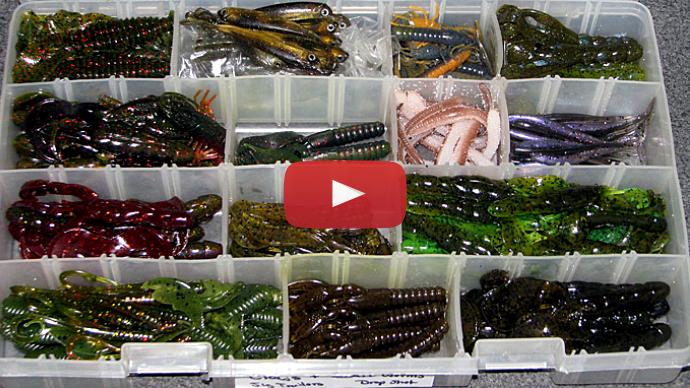
In the middle there, you're looking at 3 to 10 feet, 3 to 15 feet of visibility. As you lighten up with your lure color, you also want to go more natural; more towards your greens, a little more towards your browns, that sort of thing. So, your green pumpkin, your pumpkin seed, you're looking at Yamamoto 176 color which is a brown cinnamon color. Those natural colors, the fish are going to see it a little bit better than that in water that has a little more visibility, so you want a little bit more natural look.
Oddly enough, most lakes and rivers are in that visibility range; that 3 to 10, 3 to 15 foot range which is why those colors, green pumpkins, the browns, are the most popular colors for all plastic baits. A lot of people have a lot of success with those colors and there's a good reason why.
As you get really, really dark, not a lot of visibility. You're looking at your black, black and blue, really dark colors. Again, when it's really clear, translucent, not a whole lot of color.
It's really that simple, that basic. You don't have to over complicate it. Yeah, people are like, "I got chartreuse and I've got reds and stuff." Most of the time on those baits, the chartreuses and the reds are accent colors; it's not the primary color of the baits. Pay attention to the primary color, not the accent colors.
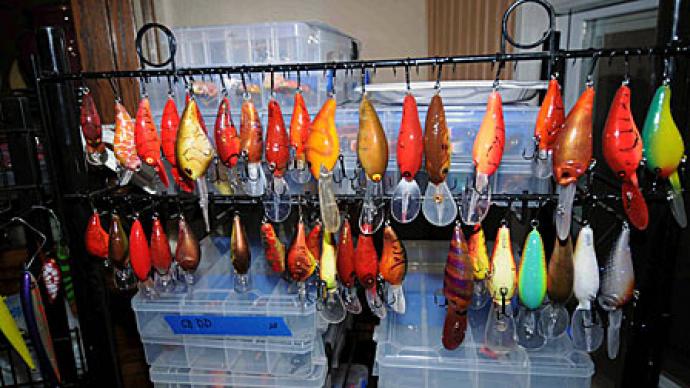
The only time when I will use a bait that is really bright and gaudy, there are only two instances. One is during the spawn. The fish don't seem to care about color at that point; it's something invading their nest, something odd that they're going to attack it regardless of color. So, I use a brighter color, chartreuse, white, pink, something like that, that I can see better. Helps me see when the fish picks up the bait. The other time I'll use bright colors, say for example, chartreuse, crankbaits, fire tiger crankbaits. For me, I seem to have the most success of those in the Fall. I don't know exactly why, but the fish seem to key on that color in the Fall time. I'll use that in my crankbait colors but as a primary color. Other than that though, I use those bright gaudy colors as accent colors.
Hope that helps a lot for you. For more tips and tricks like this, visit BassResource.com