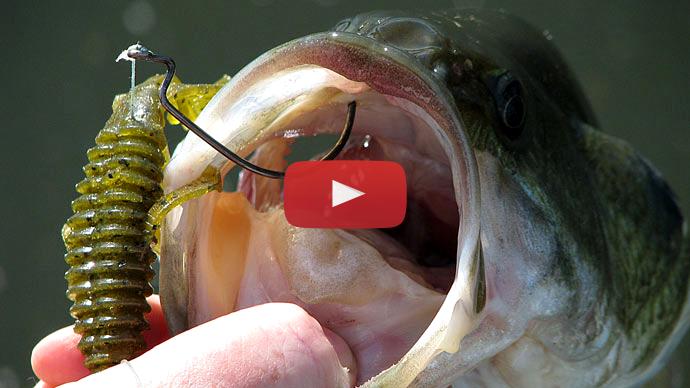
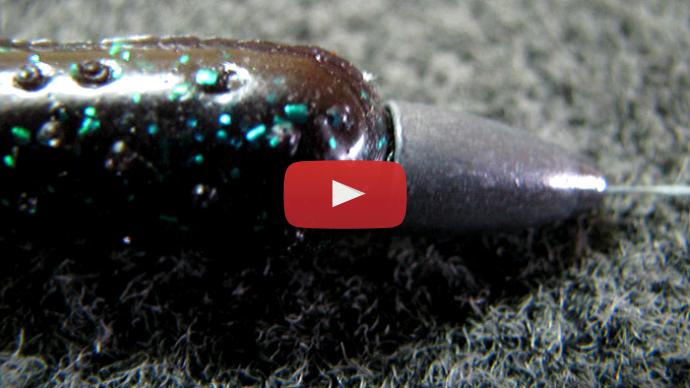
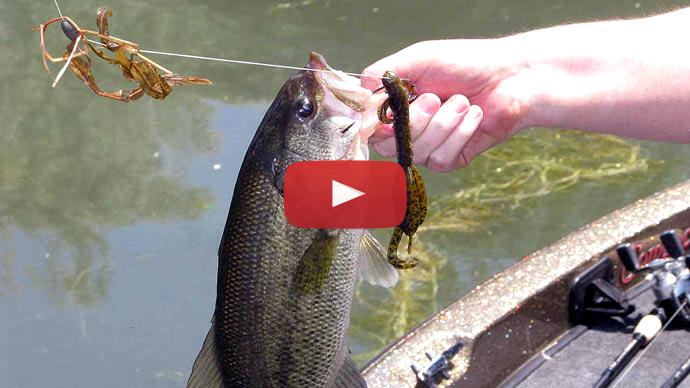
Hey folks. Glenn May here with BassResource.com. Today I want to talk to you about fishing the Texas rig. Yeah, the universal rig that most people throw. This is it. This is the Texas rig in its most basic form. To be honest with you, we're talking about . . . the Texas rig is actually that, but most people refer to it with that, the weight on it. So the big difference is when the Texas rig first came out in the '70s, people put the hook back in the plastic, and that made it- so it was weedless, so you can throw it in the areas where the fish are at. And most people throw it with the bullet head sinker on the front of it. So when you hear people talk about the Texas rig, this is most often what they're talking about. Although sometimes you'll hear people say, "Oh I'm fishing the Texas rig, Carolina rig, or Texas rig drop shot," or something like that, they're actually talking about that as opposed to that. Just so you know.
Anyway, we're going to talk today about some of the gear you use for fishing the Texas rig plastic bait, and then we're going to go out and I'm going to show you how to fish it this style. So to start off with, this bait for the most part, I'm throwing the Texas rig bait, I'm throwing it in the heavy cover - bushes, submerged trees, thick vegetation, that sort of thing. So we're going to heavy up on this.
I'm using a stout 3/0 hook. This is an extra wide-gap hook. If you're looking to buy these things, you'll see they're called like a super line hook or a flipping hook, but it's a thick wire hook. If you're in the tackle store, you can compare them and take a look, and look for one that's got a real thick wire to it.
We got that tied on with a quarter ounce tungsten weight. That's a good starting point by the way. A quarter ounce is a good place to start. You don't have to buy every single weight that's out there, but 1/4 ounce, 3/8 ounce, and 1/2 ounce are the one's you're going to use the most. That's going to cover most of your situations. You don't really need to get into the heavy duty 3/4 ounce, 1 1/2 ounce weights, unless you're punching through matted grass. That's a specialty technique so we're not going to talk about that here. We're going to talk about this universal rig. You can throw in just about anywhere.
I got that tied on to a 50 pound braid line. Again, we're throwing the heavy duty cover so you want a line that can come through that without being nicked and breaking off if the fish wraps you around in there, and that's why we've got that stout hook. You need that stout hook to hold up to the pressure that a braided line will put onto it without it bending or straightening it out.
And I have that matched with a really strong rod here. This is a medium heavy action rod. Actually it's a heavy action rod. So medium heavy to heavy action rod is what you want with this, with a fast tip seven foot or longer. You want that leverage to pull that fish out of that cover. So 7'0" to 7'6", that's a good range. If you don't have a rod like this yet, that's a good one to pick - 7'0", 7'3", something like that, medium heavy or heavy action rod with a fast tip, this is the set-up you're going to use most of the time for fishing plastic baits.
Now, you can lighten up. If you're not going to be fishing that heavy cover, you're just going to be fishing what I call soft vegetation - lily pads, open reeds, sparsely patches of weeds, that sort of thing - then you don't need all this heavy duty gear. You can use a medium heavy action rod with a 15 to 20 pound copolymer, monofilament line. Works just fine. You don't need to have the heavy duty hook in that case, but still use the tungsten weight, low-profile weight. Those work perfect in those situations. Oftentimes I'll have multiple rods on the deck and they're set up for those different conditions. If I come across the sparse weeds, that's the outfit I'm going to pick up and throw.
All right, so that's it. Basically the gear you use and how you rig it up. Oh by the way, if you don't know how to rig it this way, I've got a video that shows you how to do that. It's linked underneath this video. You can go check that out after watching this one. But right now, let's go fish this.
Okay. So with the Texas rig bait, what you want to do when you cast it out there is let it fall on slack line, but pay real close attention to that line where it entered the water. Look for it to jump, twitch, pop, move, do anything unnatural that you didn't do. That's an indication that the fish probably picked it up. So what you want to do is reel up all the slack, get that rod pointed down towards the water, and set that hook. And when you set the hook, you want to make sure you have a little bit of slack in the line before you set it, that way you power set it. Instead if you have it really tight and then set the hook, you turn the fish's head a little bit more than on a power set. So you want to drive that hook into the fish's mouth, so make sure you get a little bit of slack in there. If you're bringing it back . . . I'll get to that in a second.
So first thing you want to do when you cast it out there, like I said, you want to watch it. So we're going to cast it out there, let it fall. We're going to watch it all the way down, and then when it hits the bottom, which I'll tell that in a sec. So the line just went slack on me, that's when you know it hit the bottom. Reel down to it, and then you want to just use the rod, I'm not using the reel at all, use the rod and drag the bait on the bottom. And now bring the rod tip down and reel up the slack. That's the only way you're using the reel, is just to bring up the slack. Then you just drag it on the bottom. And again, just reel up the slack. That's all you want do, is keep that bait on the bottom.
Now like I said when you're setting the hook, if you're bringing it back like this and suddenly you feel the fish, drop, reel, and then set. And you'll have a little bit of slack in your line and you'll snap set it that way, and that will pile drive that hook into the fish's mouth. So remember that when you set the hook.
I'll give you another way to fish this. I'll throw this out there, I'll let it fall. Now this works on the creature type bait, where it has appendages or maybe a ribbontail worm or has that movement in it when you move it through the water. This works great for that type of bait. You have it on the bottom, now what you want to do is lift it up off the bottom. So lift it up and reel down. Same sort of thing, but now you're bringing it up quicker, so now you're not dragging it, and then you bring your rod tip down about the same speed that the bait is falling while you reel up the slack. That's what's known as letting it fall in a semi-slack line. The reason you want to do that is so the fish when it bites it, you'll be able to feel that bite much more easier if you're letting it fall in a semi-slack line. So I'll show you that one more time, just so you know what that looks like.
And then I'll show you one more way to bring it back in. Let it fall, and then you just lift it up off the bottom, and now we're following that line with the rod tip, bringing it back down, ready to set the hook. Bring it up, and now we reel up that slack while we're bringing the rod the tip with the bait as it falls straight down.
Okay. One last way to fish it, and this only works on creature type baits like this one - again where it has lots of appendages - lizards, those types of things - you throw it back out there, you can swim it and try to make it look like something swimming through the water column. So I'm bringing it back before it even hits the bottom, and here I'm just pumping it. Letting it come up, letting it drop, come up, letting it drop. You can do it that way. You can bring your rod tip down and just do a straight retrieve like you would a crank bait. You can pause it, so as you're bringing it back, reel it, reel it, reel it, reel it, then kill it, and let it fall. And bring it back up and reel it, reel it, reel it, reel it along, and then kill it.
Lot of different ways to fish this bait. And there's no wrong way to do it, just experiment. Figure out what the fish want for that day. Sometimes they want it moving and want it fast, other days you got to drag it on the bottom and they'll only pick it up that way. The only way you'll know is just by experimenting and playing around.
Places I'll want to fish this is in the summer and the winter. That's when the fish are out in the main lake channels, out in the main bodies of the lake, so that's where you want to fish channels, creek channels, main lake points, rock humps, drop-offs, ledges, that sort of thing, that's what you want to fish during the summer and in the winter time. And then in the spring and fall, when the fish are shallow, that's when you want to fish backs of coves, protected bays, creeks, backs of creeks, flats, secondary points. That's the kind of stuff that I'll be targeting during those times of the year. If you fish those areas using the techniques I just showed you, you're going to catch a lot of fish. For more tips and tricks like this, visit BassResource.com