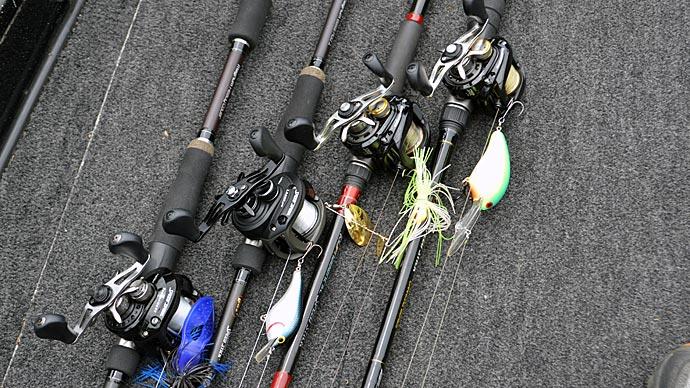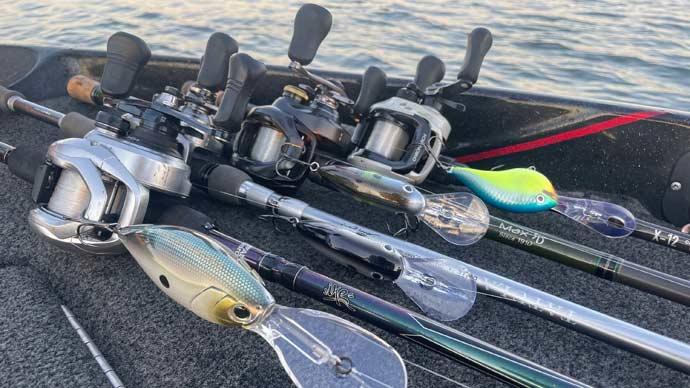


Sit down with a cup of coffee, tea, or soft drink, and take a close look at your equipment. Determine which rod and reel is your favorite, then ask yourself why you like that combination. Each rod and reel has a particular function. You can't use a heavy-action rod to cast topwater baits and expect to get the reaction needed from the bait to catch fish. Examine your rods carefully. Are they the correct type of rods for the way you fish?
First, are all your rods a comfortable length for you? If you are built lower to the ground than 5'5", a 7-foot rod will be difficult for you to use all day. Try downsizing to a shorter rod and you will find enjoyment in flipping, casting, or spoon fishing. And when the day is over, you will not feel as tired.
Let's start by defining the action of the rod. Action refers to how long it takes for the rod tip, once it's under load, to come back to its full straight position. Meaning, the shorter the distance it moves, the faster the action is. So think about speed. How short a time does it take, or how long a time does it take, for it to spring back to its natural state, just a straight rod. So there are a couple of different ways that it's defined, ranging from the shortest amount of time, which would be extra fast. Then there's fast, moderate, and then slow. Slow is on the other end of the spectrum. Slow would be a rod that can bend the entire length of the rod, almost down to the handle. Because it's bent an awful lot along its entire length, it takes longer to return to its resting state once the load is removed. Hence, it's slow, right? And then in between, the moderate and the fast action are the two incremental steps between it and extra fast. Extra-fast, meaning just the tip of the rod, just the short amount of the rod actually bends, and, therefore, it has the least amount of travel back to its straight position. So it's extra-fast.
Power, on the other hand, is how much force it takes, or the resistance it takes to bend the rod. And that's determined by the taper of the rod and the wall thickness of the rod. Think of an oak tree when the wind blows. The outer limbs of the tree move easily in the breeze, and the trunk will sway when the wind is strong. The roots only move when tornadoes hit or they're dug up.
Rod power can be where a rod takes a lot of effort to move, and that would be an extra-heavy, sometimes referred to as heavy-heavy by some rod manufacturers, but extra-heavy on one end of the scale, which means it doesn't flex very much at all to the other end of it, which is ultra-light. So the whole spectrum of it is from ultralight to medium, medium-heavy, heavy, and then extra-heavy or sometimes referred to as heavy-heavy. Extra-heavy and heavy-heavy are interchangeable; they are the same thing. So that's your spectrum in terms of how much force or power it takes to bend the rod.
Light power/action rods are generally not used to fish for bass, mainly because you need the strength of the blank to move a bass out of cover.
When the blank has been assembled, i.e., the guides and handle have been attached, the result is called a fishing rod. Thus, whether you fish with a baitcasting or spinning rod, the power and action of the rod refer to the blank. This information is meaningful when you decide what type of fishing you will do.
The number of guides (eyes) on your rod is important. They help transmit line signals to the rod, so it is easier to feel the fish. The types of guides available today have changed. Some guides have ceramic rings inside the outer metal frames. Other guides have silicone carbide, aluminum oxide, gold aluminum oxide, carbon fiber, titanium, or chrome-plated insert inner rings. All of these types are claimed to help reduce the friction that causes fraying or nicks in your line. Again, it is your personal experience or preference as to which type of guide you want.
The handle length is essential to consider before you purchase a rod. Also, the material of the handle, whether cork or foam, should be thought about. Will your wet hands slip off, dropping your rod into the deep blue?
Baitfish will chum, pop out of the water, and make frantic moves to avoid being eaten. You want to duplicate this live action with your bait, so you use an extra-fast action tip with a medium or medium/heavy action rod. This particular combination gives you the backbone needed and the flexibility to catch fish using topwater baits. With the flick of the wrist, the rod tip will move the line quickly, pulling the bait over the water. The handle of this rod is important, too. It would be difficult to use a long-handled rod when attempting to flick the bait on the water, so try using a shorter handle when topwater fishing.
Medium or medium/heavy power rods with fast tips are used when fishing crankbaits, spinnerbaits, and, depending on the structure and vegetation, some plastic baits. The pulling of the line under water requires more power than topwater fishing, but not the horsepower of a heavy-action rod. Use a handle on this rod that touches a spot between your wrist and elbow when held in your hand at the reel.
Heavy-action with extra-fast tip rods are used when fishing dense cover such as reeds, bushes, deep grass beds, or heavy timber. This rod allows you to set the hook and get the fish out of cover with more strength. The handle of this rod should be long enough to reach your elbow. The reason for using this type of handle is to give you the leverage you need when you set the hook and control a fish.
The guides on your rod are essential. Be sure to check them before you go fishing. If any are bent, straighten them out because the line will not flow through them correctly. Take a Q-tip and turn it inside the circle of the guides. If any cotton sticks to the circle, have the guide replaced before you use the rod again. If you do not, the line will fray or have nicks in it and will break when you set the hook on a fish. When purchasing your next rod, pay particular attention to the wrapping that attaches the guides to the rod. If the wrapping is not sufficient, the guides will become loose and need replacing.