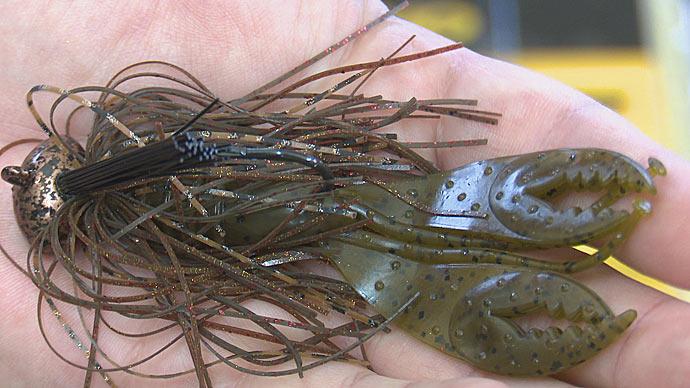


Jigs are among the most productive baits today, especially in water clarities from slightly murky to clear, in water temperatures below the sixty-degree mark, and when bass are in an inactive mood and buried in deep cover. Jigs are presentation lures. The key to fishing them is to make them look as alive as possible. This is accomplished through a slow presentation.
A jig is a heavy, lead-headed bait with a single hook. An attracting skirt or trailer is added to the hook. With a good weedguard, they can be fished effectively in dense cover where big bass live. They are subtle and discrete and move into big-bass territory without making a lot of commotion, as would a live crawfish or baitfish. And once hooked, the bass has a harder time throwing the single-hook jig than a treble-hook lure. A pork or plastic trailer is often added to these baits.
Jig Weight
A tremendous variety of jig weights are available. Learn the importance of jig sizes and how to fish each. For clear water, lighter weights that can be effectively combined with light line and spinning tackle are recommended, especially 1/8 and 1/4 ounce. For murky or deep water and dense cover, heavier jigs, 3/8 to 5/8 ounce, can be fished on stout baitcasting tackle with heavy line. When the wind is blowing a bow in your line, it's hard to maintain contact with the jig to detect strikes. Go to a heavier jig.
As a general rule, fish the lightest jig weight you can get away with -- the lightest one that permits you to feel the bottom and any cover it contacts. Keep a supply of different weight jigs, ranging from 3/16th ounce to 3/4 ounce size for different water temperatures, water clarity, and type of cover.
Fishing Techniques
Use the jig as a "drop bait." Cast to the bank and engage the spool. Let the jig fall on a tight line. When it hits the bottom, drop the rod tip, reel up the slack, and draw it back slightly to move the jig and cause it to start dropping again. A strike may be detected only as a line twitch. Set the hook immediately.
Jigs can be used as casting lures. Cast them around stumps, logs, grass, or other cover and retrieve them like a Texas-rigged plastic worm, allowing the bait to fall on a tight line. A weedguard may not be needed on a jig in open water, but a weedguard is recommended in water with plenty of cover.
Jigs can also be fished by "swimming." Simply cast out and begin a slow, steady retrieve with the rod at 10 o'clock. The jig will flow smoothly through the water like a swimming baitfish. Fishing a jig this way is especially effective on flats in the springtime.
Colors
Light colors (white, chartreuse, green) work best in clear water. Transparent jig skirts and transparent crawfish-type trailers cast less of a silhouette and are less threatening to spooky bass. In murky water, black, brown, purple, and contrasting dark colors often produce the best. The trailer (plastic or pork rind) color can be altered to change the appearance of the bait quickly and economically.
Tips
- Remember that jig fishing demands lots of concentration.
- Fish jigs slowly during all seasons but extremely slow in cold water.
- As a rule, smallmouth bass prefer hair jigs, while largemouths are more often taken on the bulkier rubber jugs.
- To improve your feel and maintain your maximum pounds of hook setting pressure, use a fast action medium-heavy to heavy rod in the 6 1/2 foot or even longer lengths.
- Jigs are excellent night-fishing lures. Many fishermen use a heavier jig at night that can be fished on stouter tackle, even in ultraclear water.
- When bass aren't hitting more attention-getting lures such as rattling crankbaits, a jig fished in or close to cover is often the answer to getting bass to strike.
- Keep your hooks sharp. Sharp hooks penetrate more easily, and they're harder to dislodge.
- Check your line and knot periodically.
- When fishing jigs in a bush or submerged tree limbs, hang-ups may occur. Instead of violently pulling and shaking to dislodge the jig, give the line some slack and shake the rod tip gently. Often the jig will fall free and get struck by a bass.
- When swimming or dropping a hair jig in clear water, you can make the hair "breath" by gently squeezing the handle of your rod (a slight wrist movement)while keeping the rod position still. This just barely moves the tip.
- Stay alert, have patience, be motivated, and think positively.