

Humans and other mammals identify the directions sounds come from by comparing difference between the times sounds arrive at one ear and then the other. Fish can't determine the direction of sounds this way. Their inner-ears are located too close together. Fish don't have separate ear drums, and sounds travel so much faster in water than in air that they arrive at a fish's ears almost simultaneously.
In the past, when researchers tried to test directional hearing of fish, results were indecisive. Fish seemed to know the direction of only nearby, low-frequency noises and pressure waves. As a result, many biologists questioned whether fish could use noises to locate prey or lures. They felt fish received all directional information from their lateral lines, which detect only low-frequency sounds. Lateral lines are hollow tubes along a fish's side which transmit information directly to the brain.
However, Dr. Richard Fay* and other researchers have shown goldfish, cod, and a few other species can determine direction of sounds by comparing differences in the way sound waves vibrate their ear stones. This discovery shows fish likely can tell the general direction sounds come from. But, so far there is little indication that fish can precisely locate sources of sound by using only their inner-ears.
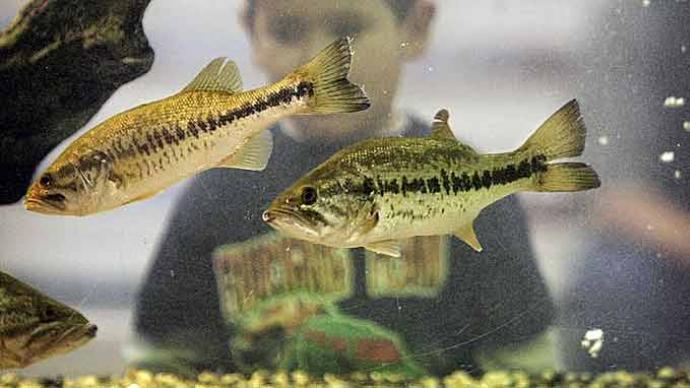
It's unlikely that sight-feeders like black bass feed by sound alone. Rattling lures and noisy top-water baits likely draw their attention and bass may move closer out of interest or curiosity. But game fish probably don't strike until they see baits, sense them with their lateral lines at short ranges, and/or touch and taste them.
*Fay, R.R. 1988. Peripheral adaptations for spatial hearing in fishes. InAtema, Fay, Popper, & Tavolga (Eds.). Sensory Biology of Aquatic Animals. Springer.