

Bass are sensitive creatures that can be injured more easily than you think. Tips for handling fish before you put them in your livewell include the following common sense items:
- Keep the fish in the water as much as possible. Bass can only hold their breath as long as you can. Wind and other elements can damage their skin, too. Wet your hands before touching the fish, so you don't remove the slime coat that protects the fish from infections and fungus. Don't handle the fish any longer than you have to, and be gentle, don't drop the fish if you can keep from it. Bouncing off the carpet also destroys their protective slime.
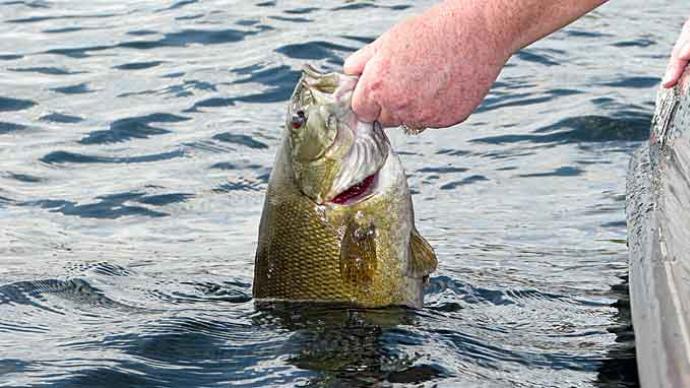
- Never hold fish through the gills or stick your fingers in their eyes. Lip the fish gently and do not bend back the lower jaw as it can break easily, particularly in larger bass. For larger bass, give support to the body under the wrist of the tail so that you are not holding the fish's weight balanced on its jawbone.
- Do not rip or tear out hooks. Gently remove by backing off the barb or using needle nose pliers. If the fish is deeply hooked, remove the lure portion (lizard), cut the line, leaving about 18 inches off the hook, and release the fish. The hook will eventually come out. There are ways to remove deeply embedded hooks but only do this with a demonstration beforehand. The barb has to be backed off by applying pressure back against it, and on small fish, this is tough to do as you can't get both hands in their mouths. Not all hooks deeply embedded can be removed, but they don't necessarily kill the fish. However, if you see dark-colored tissue or entrails coming up through the throat, you have gut-hooked the fish and should clean it for dinner. If the fish is not legal size, you will have to cut the line and release it anyway due to state law.
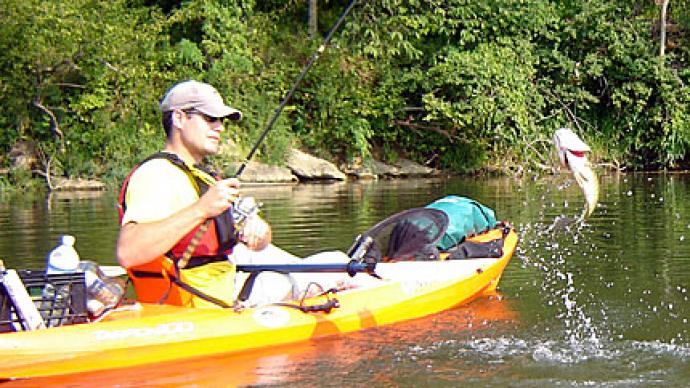
- Try to land the fish you catch quickly, don't wear them out by making them fight longer than they have to, as this expends so much energy the bass can not recover and has no chance for survival if released.
- If you must use a dip net, try to purchase one specifically designed for fish. Nets can remove the slime coat and leave the fish open to infection.
- Gently release the fish back into the water. Do not throw or toss the fish.
- Don't use stringers for fish that will be released. Just as sticking your fingers in the gills is terrible for them, stringers can destroy their gill filaments. Regardless of where the stringer is placed in the fish, there is no good way to use one. All do damage to lips, gills, etc. How would it feel if someone stuck a stringer in your lungs? However, if fish is bleeding a little from its gills because of a hook injury, you have not necessarily killed that fish. Hold it in your livewell with Catch & Release treatment in the water for several hours until the bleeding stops. Like you pricking your finger, a little blood does not signify a death in all cases.
- Once you have the fish in your livewell, use the information provided in this package to properly care for that fish while in your possession. Don't just fill your livewell and forget about it.
- Treat the fish in your care as you would want your children treated, and always use Catch & Release year-round. Never be without it. This product carries medicine to save the fish you catch from disease and death. It replaces slime knocked off during the catch, treats antibiotically to reduce fungus and infection that can occur after you have released the fish back into the lake, and it calms the fish so that it doesn't do more harm to itself in the livewell.
- If proper catch and release is your goal, follow these steps and others discussed in this package to the best of your ability. Delayed mortality is not generally seen by those who cause it, but shows a lack of respect for the bass by those who see it after you have gone. Live catch and release requires more than just the act of doing so.
In the Livewell
Bass placed in livewells become stressed due to several factors. Improper livewell handling, being caught in deep water, or shock from being "played" for an extended period can all affect fish. This information outlines livewell operation and the care and handling of stressed fish. Occasionally fish will die regardless of how they are handled, but with a little extra care on the part of anglers and tournament directors, more fish can be saved. Survival of fish begins with their care in your possession.
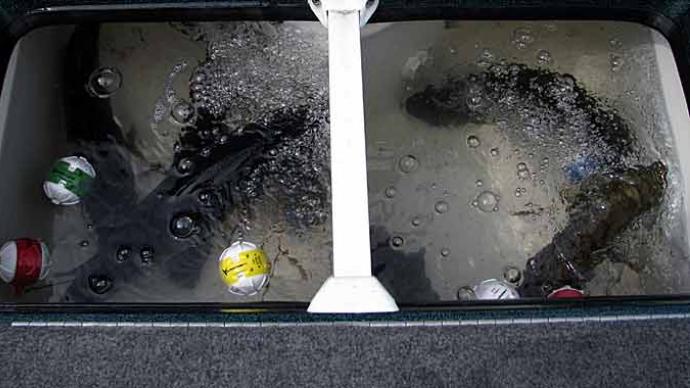
Keep the water in your livewell cool. Five degrees cooler than the lake is preferable during hot months. Ice blocks, made with hot water or water that has had the chlorine removed, one-half gallon in size, will cool water approximately 8 degrees. Put the ice in the livewell as you fill it or as water is replaced with fresh from the lake. Small (one quart) plastic soda bottles are best. If you're using larger bottles, remove them after the well is full. Replace the ice bottle in well as the water is changed or for short periods. An inexpensive thermometer can be purchased at aquarium shops to check the temperature in the livewell.
Aeration and fresh water are imperative. Make sure your livewell is functioning correctly. Don't simply trust your automatic livewell timers. For less than seven pounds of fish in the livewell aerate every eight minutes, and supply fresh water from the lake every three hours. For more than seven pounds of fish, constantly aerate and supply fresh water every three hours. Cool water slightly as it comes into the livewell, but do not overuse ice. Only use ice if surface temps are above 70 degrees.
Livewell additives are a must. Catch and Release by SureLife is best. DO NOT OVERDOSE. Follow the directions on the package. Keep water treated throughout the period fish are held in livewell. Replace Catch and Release as new water is added. This product also removes chlorine if you use ice made from water without the chlorine removed. Recheck the temperature after changing and re-treating water.
Lack of oxygen and the presence of carbon dioxide and ammonia are deadly. Oxygen is added, and carbon dioxide is removed by aeration. Ammonia can be lessened by supplying fresh water to the livewell or using Catch & Release. Check the fish in your livewell regularly to see how they're doing. If they're not looking well, supply fresh water and Catch & Release and aerate constantly. Fish excrete ammonia from gills and urine, which builds up very quickly in the livewell.
Some tips from Steve Magnelia, Texas Parks & Wildlife biologist, include adding a recirculating system to older boats. For $10, a 350-gallon per hour bilge pump hooked to a piece of automobile heater hose and a homemade PVC spray bar can be easily mounted in the livewell. This pump can drain the livewell by pulling the hose off the spray bar and putting it in the overflow.
At the Tournament - The Hospital Tank
A hospital tank should be ready at tournaments before anyone comes to weigh in. It's best to fill the tank just a few hours before weigh-in and treat it with Catch & Release. Only unwell fish should be held for observation, possible air bladder relief, and treatment as necessary for about 30 minutes to an hour. If the fish appears normal, return to the lake immediately. If not, continue to hold and treat. This tank must also have aeration when possible. If fish appear normal, they can be returned immediately to the lake, but should they not take off for deeper water, return fish to the hospital tank. Return all healthy appearing fish to the lake immediately, do not hold them, nor handle them more than necessary.
Regardless of the reason for the fish's ill health, if the gills are pale pink, no longer bright red, that fish cannot be saved. This fish should be removed from the hospital tank as it will put more ammonia and carbon dioxide into the hospital tank and harm the other fish. Be sure to maintain a temperature check on the hospital tank and don't fill it too soon before weigh in as the water temperature will change. Using water from the lake to fill the tank is preferable, pumped in by bilge pump. Have an extra treated tank (Catch & Release) for anglers to fill bags before returning their fish to the lake because every moment of treatment counts. Fish not being held in water cannot breathe.
Shock and Stress
Fish can develop livewell shock easily. If the fish appears stressed, rolling, or turning over, change the water in livewell, treat with Catch & Release, and hold the fish horizontally until it can hold itself up. Or take the fish to the prepared hospital tank immediately and hold it horizontally by giving support under the tail with one hand and under the chest (in front of front/bottom fins) until the fish appears better. You may have to hold this fish up for 20 minutes or more, but being in the correct position can help them. If the fish continues to roll, tries to go down, and cannot, or swims in a nose-down position, the fish may need air bladder relief to survive. Sometimes fish just become disoriented in livewells and don't know "up" from "down." Holding them helps them regain their balance.
Air Bladder Relief
Though it is only my theory, not proven scientific fact, fish caught in deep water are not the only ones that suffer air bladder expansion. Fish can inflate their air bladders when stressed, like human adrenalin increases upon stimulation. A fish can be determined to have an expanded air bladder when: the fish is trying to get deeper in the water but cannot; the fish is rolling over and over or swimming in a nose-down position with the tail elevated. Relieving the air bladder of these fish is controversial. It has yet to be thoroughly studied, and even TP&W personnel differ on its procedure. Sometimes it won't be necessary if you treat with Catch & Release and hold the fish horizontally until it can hold itself up. Air bladder relief procedure is done only when it's obvious the fish will perish without one last effort to save it. TP&W has done no studies on the practice I use to hold fish upright, but in six years of fish care, I have seen it help fish. If allowed to lay over in an unnatural position, I firmly believe that fish will give up. We have had success with fish unable to hold themselves up by holding them in a normal position for 20 minutes to one hour, and in some cases relieving the air bladder.
It's preferable, especially with the larger bass of five pounds or more, to have someone hold the fish for you on a smooth wet surface or place it in a large landing net just under the water's surface in the hospital tank. If this procedure is done in your boat, do not hold fish on the carpet, but place it on a wet weigh bag or other smooth surface. Place the fish's head on your left, as this side presents the best location for the air bladder. It's best to have the person holding the fish "lip" it with their left hand and hold the wrist of the tail with their right hand. Small fish can be done by one person more easily than larger ones. Once the needle is inserted, the fish must be held under water so you can see air bubbles escaping, preferably by the side of the boat rather than in the livewell.
A large biopsy or spinal tap needle is needed for this procedure, with an insert that can be removed to allow air flow. A single hollow needle will not work as it will immediately become clogged with scales and skin. Use a spinal needle no smaller than 18 gauge. Your veterinarian may be able to help you get these in an inexpensive disposable form, But do not dispose of it after use. It's reusable. They cost a lot less than the one's vets or surgeons use. Your needle must be 16 to 20 gauge and at least two inches long. Spinal tap or biopsy needles are best, do not use anything else.
The Procedure
You must push the needle under the skin. This is best done at an angle between scales. Back the needle out until just the tip of the needle is under the skin, and redirect the needle straight into fish about half the length of the needle. Remove the plunger and allow air bubbles to escape for a count of 8 to 10 seconds. Do not remove all air. This is important. Remove only a small amount of air, then wait and see if the fish is better. You can always remove more if you need to. Allow the fish to go free and observe its behavior. If the fish resumes regular swimming, all is well. If the fish goes to the bottom and lies there, do not worry. It's usually just tired from trying to get down and needs some rest. If the fish recovers in 30 minutes, hold it for another 30 minutes, then , release it into the lake. You've given that fish the best chance for survival.
Personal Notes On Fish Care and Air Bladder Relief
Distinguishing air bladder inflation from livewell poisoning can be challenging. Fish appear to be doing the same things in some cases. With livewell poisoning and disorientation from being in the livewell for hours, fish will respond to being held in a correct position in fresh, oxygen-saturated water until they can maintain balance. Fish that need air bladder relief show much more severe symptoms of distress.
The main difference for the fish in need of air bladder relief will be the reactions of the fish. This fish will appear extremely stressed, rolling, or trying to get deeper in the water without being able to, or in some cases, will be "finning" while lying on its side. The fins behind the gill plate are trying to move, but the fish is not in the correct position to swim. They are very vulnerable if left to lie in an unnatural position.
My technique begins with observation of the fish. Once it has been placed in the hospital tank, I allow it freedom of movement for about five minutes. If the fish begins to attempt to roll, swim nose-down, or cannot seem to gain balance, I hold the fish for about 10 to 15 minutes in a position that would be correct for swimming. Sometimes they need to rest and get revived from the oxygen and fresh water. Sometimes they are just disoriented from being in the livewell. If, after 15 to 20 minutes, the fish is still struggling or lying on its side, the air bladder relief procedure is done.
Retrospect
Steve Magnelia and I don't agree on this one subject. He is the biologist; I only know my gut feelings on some of these applications and that a fish in this condition will surely die without something done. My own experiences have been that I have used the techniques described herein with success since I have treated numerous fish in the same manner during big bass events at Lake Fork. At least three of these fish are recognizable by marks or deformations of the body, and I have seen them more than once. What I do may continue to be controversial, but until studies are done to show me otherwise, I believe I have saved many bass that would have otherwise died. The question of delayed mortality is still an unknown entity. However, my experiences at Fork give me a reason to believe that my procedures should be studied further by the department. The last known study of air bladder relief as of this writing was done in 1992. More should be done again and in a broad spectrum. TP&W has no data on fish needing air bladder relief caught in less than 30 feet of water. Magnelia does have information on a weigh-in kit used by some tournament directors. Everything you learn about fish care enhances the chances of survival for tournament-caught fish.
(Editor's note: Many of Debora's observations and conclusions have been confirmed by biologists since the publication of this article. Her procedures are now commonly used throughout the world.)
Both Steve Magnelia and David Campbell are respected biologists. My opinion of both these men is one of admiration. It should be understood that my fish care techniques may differ slightly from their own. I have used the knowledge I gained from both to further educate myself on fish care. My position is such that I have the opportunity to try new ideas and am willing to do so in regards to the fact that with certainty, some bass will die regardless of what's done to them or for them. Campbell told me years ago to go with my feelings, which is what I have done. I try new things because when you get to the point that some of these fish will most certainly die, it may be the only chance they have.
If catch and release is important to you, and you wish to believe you are genuinely practicing it, then it's up to you to assist the fish in your care as much as possible. Things like supersaturation with pure oxygen are now coming into question as anglers find new products for use in their livewells appearing on the market. But oxygen doesn't have to be used in massive quantities to help fish. Smaller amounts are preferable at this time because oxygen poisoning is even worse than doing nothing to help the fish. Use of ice or any other product such as Catch & Release must be done with moderation in mind, not overdose. You don't necessarily accomplish good by using more because something is good. Too few anglers realize that simply being out of the water is hard on fish. See how long you can hold your breath, then figure how long bass must hold theirs when removed from the water. Delayed mortality is the shame left behind as fish die days later. This, too, can be corrected with just a bit more care on the part of anglers. Common sense will help fish and help anglers truly practice catch and release.
Fizzing Diagram & Additional Procedure Notes
David Campbell, Texas Parks and Wildlife biologist and head of the new hatchery and fish study center in Athens, prefers a different location for air bladder removal than shown in the department's charts. I use his method on all large bass but have used the other location on some smaller bass in colder months.
David Campbell's Recommended Location for needle insertion
Draw an imaginary line from the fourth spline (dorsal fin points) straight down to meet an area even with the point of the gill flap and straight with the center of the tail. This is your starting point. However, some fish differ just like some humans, and you may not hit your mark the first time, but feel the rib cage, push the needle in no farther when you feel bone. Remove the needle, count one or two scales down and back and try again.
I prefer David Campbell's method because the rib cage is a less dangerous area than the lower spot used by some biologists. David uses this method because sometimes an over-inflated air bladder does so from the head down, causing the intestines to become misplaced. Also, a fish that just had a large meal may have misplaced intestines, especially with an over-inflated air bladder. Vital organs in the lower area include kidneys; the fish can be killed immediately should you hit them. Below is a diagram of both David's method and department standards. This procedure is one of the most important ones you'll ever learn, but remember it's only done as a last resort, not simply because you want to do it.

TP&W Standard Recommended Location for Needle Insertion
The point of insertion with this method is to draw an imaginary line from the notch (A) separating the spiny-ray and soft-ray portions of the dorsal fin down to the anal opening (B), insert the needle along this line approximately midway between the lateral line (C) - not the coloration line, but the actual lateral line, and along the anal opening 3 to 5 scales below the lateral line.
Fish Care Trouble Shooting
Here are some questions that may arise in your fish care.
Q. I inserted the needle just where indicated, but when I let out the plunger, no air bubbles came out; what happened? What do I do?
A. All fish are different; if you feel you hit the air bladder, but no air comes out, try pulling the needle out just a half or quarter of an inch, then watch for bubbles. The fish must be completely under water for you to see the bubbles. If no air comes after trying this, remove the needle, count two scales back and one down, reinsert the needle and try again. Air bladders can be somewhere other than where diagrams show them to be, especially in winter when fish are colder and they seem to tighten up. Too, if the fish has not been allowed to relax and has been treated with Catch & Release, its muscles won't allow freedom of air removal. Wait 15 minutes, and try again. If you feel rib cage bones while inserting the needle, stop immediately and move back to locate the insertion point further down the fish's body by a couple of scales, over and down.
Q. I did the procedure just as shown, but when I let go of the fish, it just went down to the bottom and laid on its side. Will it die?
A. This reaction comes from either too much air being let out or, as in some cases, the fish is simply exhausted from being caught, then held in the livewell all day, then run across the lake, then handled through the weigh-in procedure. Allow fish to rest, but find a way to prop it up where it's not lying on its side. A fish that is allowed to lay in an unnatural position for too long sometimes will give up. Again, I can't stress the importance of not letting out too much air. The fish must have some air in its bladder to assist it in remaining upright. Sometimes the fish would die anyway, much like CPR used on humans, "living" humans do not need CPR, only those who are not breathing, basically not alive. Only let out a small amount of air, you can't put back the removed air, but you can always remove a little more if needed. Usually, a count of eight to 10 seconds is enough to remove plenty of air to reduce pressure without it being too much so that it harms the fish.
Q. The fish started bleeding when I stuck the needle in it. Will this cause the fish to die?
A. No more than when you cut your finger. Fish bleed when cut, or in this case, having a needle stuck into their skin. Typically there won't be any, if much, blood during the procedure. But, sometimes, there is. It usually isn't serious unless that blood comes from an organ, which only happens if you miss the air bladder. Sometimes a scale or two will come off during the operation, but if you gently push in the needle from behind the scale, even this won't occur.
NOTE: Air bladder relief is like CPR. CPR classes teach us that the only person who needs CPR is a dead person. It is much the same with air bladder relief. Only fish that will die need to have the procedure done for them. Fish in distress will die if it is not done for them.
You will not save every fish that is distressed. That would be impossible. However, learning the procedure and performing it correctly, only when necessary, will save the lives of many fish that might otherwise have died.
The only fish I do not try to save with these procedures are fish that have light pink gills or have been mortally wounded in the gills by a hook or those severely gut-hooked. The gill filaments are sensitive, but fish have survived with slightly torn gills. However, gills lightening to pink from red signal death. A deeply hooked fish can be saved if the tissue and intestines have not been pulled out or damaged by the hook. Cut the line and remove the lure portion leaving the hook in place. The fish will eventually discard the hook. There are ways to remove the hook without harming the fish, but this is a very tricky procedure and must be "seen" to be learned.
I wish you success with your fish care.