

We had just finished Sunday dinner at Grandma and Pep Pa's when Dad hollered, "Okay, boys, let's go to the river!" So my cousins and I shot out the door and started gathering minnow seines, trotlines, minnow buckets, rods, and reels. We all knew a tow sack was already loaded in the '58 Ford. It was there from last week's river trip. It was there for the mud holes we hit on the way to gather crawdads.
I can say that some of the best times of my life were spent on a river. I pray I can write well enough to make you appreciate rivers as much as I do. They're glorious places that need to be protected forever. They are a significant part of our ecosystem.
If you think about it, rivers are the arteries of our lives. They come in all sizes and are scattered all over the country. The bass that live in them are pretty predictable. When you fully understand a river and how it works, it is key to all other bass fishing.
Several different species of bass inhabit rivers. In the US, we have largemouth, smallmouth, and the Kentucky spotted bass, which I believe was discovered in Alabama. We also have a shoal bass and Suwanne bass, which are found in the Suwanne River in Florida. In Texas, river bass are called Guadalupe bass. This is because they are named for the river in which they live.
No matter where you find them, bass are still bass. Whether you're fishing a river in Canada or Mexico, bass have pattern characteristics and behaviors that we can use to our advantage when fishing for them. The most important ones to remember are their use of outside and inside curves, creeks feeding into, sloughs going off, and current breaks.
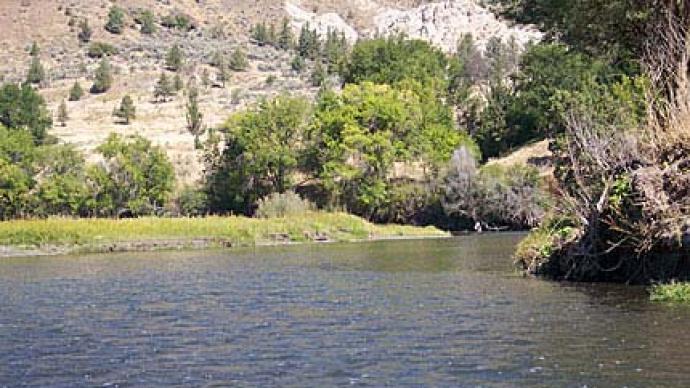
First, we'll talk about the inside and outside curves. As a river flows, the current cuts deep banks called outside curves. It deposits gravel, sand, and debris on the inside curves. Outside curves primarily consist of deep water, fallen trees, root systems, and bigger rocks. Inside curves include sandbars, smaller pea gravel, and shallow water flats.
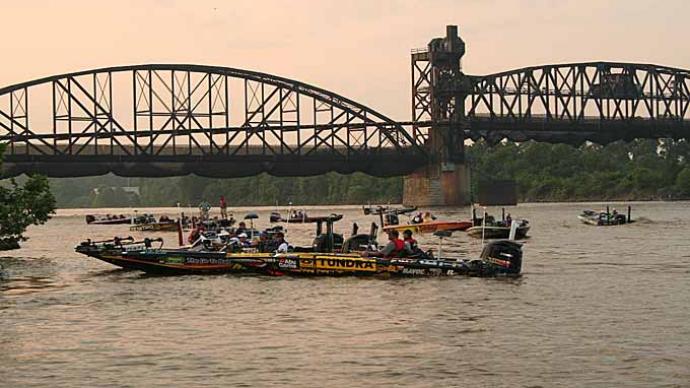
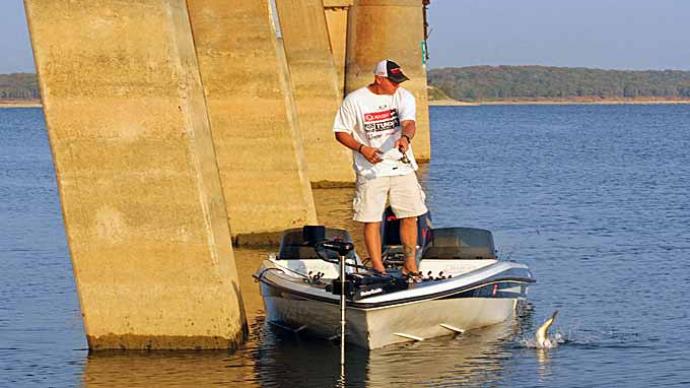
Current breaks can be any type of object that substantially reduces water flow. This can be a man-made bridge, a tree lodged in the sand in the middle of a river, a log jam, large boulders, or fallen trees along the bank. One thing you have to remember is that fast-moving rivers are more challenging for bass to live in.
Medium or slow-moving rivers are best. The key to fishing rivers is finding "peeper" holes. This hole might be 10 feet deep and 30 yards long on larger rivers. However, it can also be 20 feet deep and run for a quarter of a mile or more. I would say that most of the time, bass live and stay near these deep pools. However, there is an exception to this. During the spring, they will scatter and travel up sloughs and feeder creeks to spawn.
And remember, creeks and sloughs are also good areas with enough depth. You want to find water that is seven to 10 feet. This will usually hold fish year-round. Creeks and sloughs will be at their best in the spring as bass travel to the backs of these areas. Fall can be another peak time for these areas, but fall also usually brings lower water levels, and bass don't normally venture too far from the main river.
When you run out of depth, you'll run out of fish. Most sloughs have dirty or tea-colored water. This factor alone will hold fish shallower throughout the year. Many of these areas have flooded hardwoods such as oak trees, which causes the water to have that color. Tannic acid is the main reason. As this acid seeps out of the bark and roots of the trees, it will settle to the bottom. Most bass will be located up against the roots or around logs in 1-1/2- to 4 feet of water in these areas. If the center of the slough is eight feet deep, most bass can be found above six feet to avoid tannic acid.
To compensate for this fish positioning, it's always good to raise your rod tip a little higher than usual to get the bait some distance off the bottom. Also, lighter jigs work well because they fall through the strike zone slower.
Now we'll get back to the river itself. As I said earlier, bass will usually hold in deeper pools during the day. Therefore, you must fish shallower water in the late evenings, at night, or early morning. The inside curves will have sandbars and small pea gravel points. These are excellent places for bass to ambush bait. Two other prime feeding areas are where the river is coming into a deeper hole and where it's going out.
Most of the time, a river will be wider with shallow water just before a deeper pool. As it flows into a hole, it will compress or get smaller. Bass love to feed just at the front of these holes. If the water is relatively clear, you'll see the bottom as it falls into the hole. Another indication of a drop-off is a small line of tiny ripples on the surface. Any place where you find drop-offs of some significance are ideal ambush places for bass. Another area where bass will be feeding is on the lower end of a hole, where the river starts to widen back out.
If you think about it, the river itself is not that complicated. You have two banks that are not usually very far apart. The number one place I always rely on is a deeper bank, where drifts have fallen trees and brush piles. These banks will have root systems, rocks, and undercut banks. They will always hold a good number of fish.
One of the most important things to remember about the current, whether in a river or creek, is that bass will always hold on the downstream side of current breaks. With this in mind, most of the time, the bass will be looking upstream or just to their sides. This should give you an idea of the best way to approach fishing a river. I'm always going to slip upriver and fish ahead of myself. If the water is moving pretty well, I move out at about a 45-degree angle from where I'm fishing. What this does is give me more control over my bait. If you get directly behind a shoal or sandbar, the current carries your bait toward you too fast, and you can't feel the bait.
Always pay attention to what's going on ahead of you. It may be a raccoon on the bank or a crane standing in the water next to a drop-off. The coon may be digging for crawfish or searching for frogs or grasshoppers along the grassy bank. The thing that needs to click is that bass also eat all of these things. What the coon is not catching, he's flushing. I have seen it all my life. Animals use each other to catch their prey. That crane is not standing there looking up at the sky, thinking it's a pretty day. He's there for a reason. There are minnows or some type of prey right there close. These things can tell you what's going on under the water.
Since I just mentioned minnows, you should also realize that they are the mainstays of many rivers. When I was 17, an older man told me about how the minnows migrated up rivers in the fall. We all know that shad do so, but as early winter arrives, they move back toward deeper water because they have a low cold water tolerance. Minnows, on the other hand, go as far as they can. Some travel hundreds of miles. One day in October, as I stood above a river and looked down into the water, I saw what the older man had told me about. It's like one of those pictures where you stare at it for five minutes. Then it jumps out at you. First, I could see the sand. Then the sand was moving. It was minnows, a huge line of them as far as I could see. There must have been millions of them. I have only seen this migration twice in my life. Many people never see it, so I feel fortunate to have witnessed it.
Now we'll talk about baits for fishing rivers. I won't tell you to use any particular bait at a specific time of the year. The best thing I can do is teach you how to use your instincts. This starts at the tackle store. I may see something hanging on a rack and know before I buy it that it will catch fish. You may look at this same bait and not be impressed. That's why it is so crucial for you to use your judgment. When you've purchased the lure, you already have confidence before you ever tie it on.
When fishing rivers, there are a few guidelines that I live by. First and foremost, downsize a little. The primary forage in rivers are minnows, crawfish, freshwater shrimp, grasshoppers, and worms. Use any minnow-type imitations. In-line spinners work well, and crawfish imitations, like small hair jigs or spider jigs, are always good. I've also had success with wacky worms when drifting down the current. You'll need to pinch on a couple of split shot weights about 18 to 24 inches above the bait when using this technique.
The main thing is to be creative and open-minded. Try different baits until you find something that works.
I usually start on a shallow sandbar or maybe at the front of a drop-off hole. As the day goes on, I move toward deeper holes, especially if it's sunny. I'll continue to use smaller baits because I know, on average, I won't catch a lot of huge fish. Bass in rivers generally range from about two to four pounds. This is because of their environment. River bass constantly swim against the current, they have to chase their prey more, and their prey in the river is smaller. I also believe that bass, which live in rivers, are younger. As they get older, they swim down the river to slower water and on into lakes. I don't mean they all do this. I just feel it contributes to their smaller size.
There are exceptions to this rule. Deeper sloughs, off the main river, where little or no current can hold larger fish. Older bass in rivers can grow quite large; during the spring, large females will migrate up from lakes downstream. So there are some bigger bass in rivers. Oxbow lakes are one consistent place to find larger bass in a river system. To picture an oxbow lake best, draw a picture of a pear without picking up your pencil. Your start point is the top left. As you get almost to where the stem would connect, turn out to the right and draw another pear lying at opposite ends of the one you just drew. Now, where the lines are closest together, draw a line between them. This whole pear-shaped lake is cut off from the main river to form what is called an oxbow.
Sometimes it takes years for the river to eat into the bank until it eats its way to the other side and creates the oxbow. When it is formed, a lot of things start happening. First, the current is cut off. This allows nutrients to fall to the bottom instead of being washed away. Rains wash in some topsoil, leaves fall and start to rot on the bottom, and in three or four years, you can have a pretty fertile piece of water. Algae blooms and plankton growth increase, which causes an increase in the numbers and size of baitfish. Aquatic vegetation, such as lily pads and cattails, can also grow here. These are all factors that will equal larger bass.
River lakes are probably the most difficult places to pattern bass. This is due partly to the fact that residential traits have slowly been phased out. Twenty-five years ago, I could go to an old stump next to a creek channel and catch a five-pound bass. Then I could do it again the following week. Instead, a sow bass roams the river channel and only moves up to that stump to lay eggs. What do you think her babies will be? That's right, they'll be roamers. They're going to inherit the behavior traits of their mother. Through genetics and fishing pressure, we now have roaming, schooling-type bass that are hard to figure out.
Bass that roam are following the bait. As shad swim along and feed on plankton, the bass follow. As the shad scatter when attacked, this adds to fish dispersal. It's a continual movement effect. This is precisely why, if you locate fish on Saturday, Sunday can roll around, and by 1:00 p.m., you decide that somebody has poisoned your spot at night. You decide they just aren't hitting today. But if that's the case, why did the team three-quarters of a mile up the bank weigh in 23 pounds? I'll tell you why. They caught fish out of the same school you found Saturday.
Most people don't realize how far a bass can travel in 24 hours. The simplest way to think of it is to compare it to your survival instincts. Forget you know about McDonald's and think about how far you would go to find food. Four or five miles wouldn't be anything; you could probably walk that in a couple of hours. I know this may sound silly, but it's the truth. We have very similar instincts to animals, but we have lost touch with some of ours because of modem society. They haven't. Sometimes you just have to think like they do to find and catch them.
Rivers are great places to fish and enjoy. Understanding rivers can help your fishing be more productive on lakes as well.
A river is like a good woman. You never stop discovering her. Every time you're around her, you catch little glimpses of beauty you never realized existed. Always remember to treat her like a lady.
Now, I think I'll kiss my good woman and go to the river. As always, keep a bait in the water.