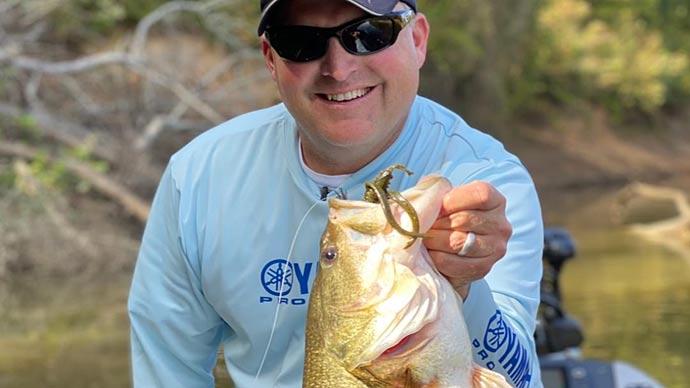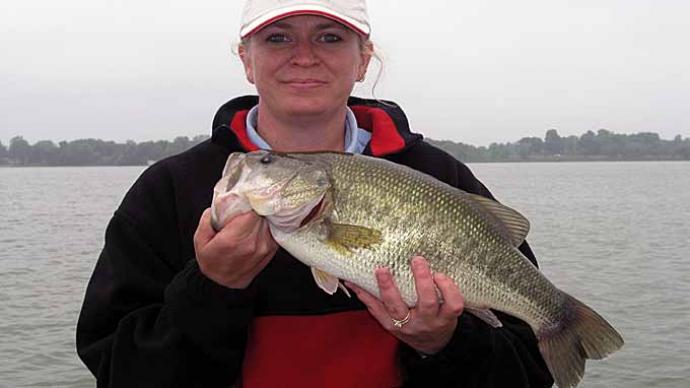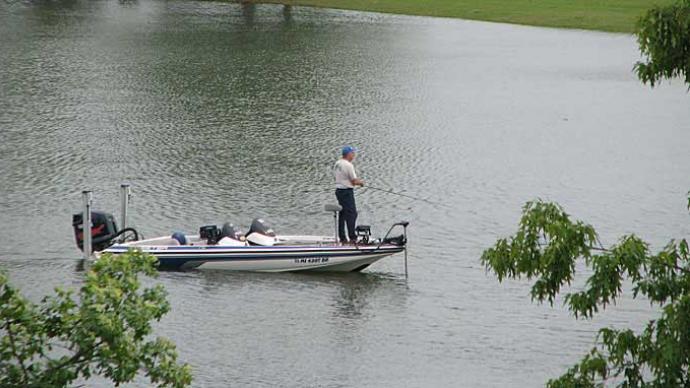


No matter where you live, flats play a significant role in spring bass. Whether bass are staged waiting to move up, actually up spawning, or back out recuperating in a post-spawn mode, you'll find them somewhere in the vicinity until summer temperatures and patterns kick in. Productive flats typically offer the best bottom composition for spawning habitats, such as firm or gravel bottoms with wood or vegetation cover. Once located, it's a matter of using the water temperature and prevailing weather as your guide to where bass are relating to each flat. Here are some examples.
In April, at a Western Invitational at Elephant Butte, New Mexico, bass should have been up on the flats and spawning areas in relatively shallow cover, ready to spawn if not spawning. But a severe cold front and record-setting low temperatures changed all that. Water temperature plummeted to the high 40s low 50s. Except for local angler and winner Dennis Hoy who knew the lake well enough to find a flat holding shallow bass, the majority of the field struggled to get a bite. Bass that were up shallow during the prior week's warm weather were now backed off in deep water, waiting for conditions to stabilize. The most consistent pattern for some of us was catching bass on points adjacent to deep water leading to spawning flats. Carolina rigging a lizard in 15 to 30-foot depths produced enough weight for 14th place during an extremely tough bite.
One May on Potholes Reservoir in eastern Washington, I found the main lake around 54 degrees, and most of the bays in the Crab Creek arm running 56 to 58 degrees. We caught bass in protected bays up Crab on spinnerbaits, crankbaits, and plastic lizards, fishing tight to steep willow tree edges in four to eight feet. But better catches were made on the lake's west side in the Winchester arm, where water was around 60 degrees. Bass were cruising the flats, not as tight to cover and more aggressive. This was a classic example of how flats with warmer water hold more aggressive bass.
Denny Brauer's win on Richard B. Russell Lake, Georgia, is worth noting. Quoting the B.A.S.S. press release,
| Brauer fished a baylike area with a visible island in the middle and two humps on its riverside. To the left of the humps was a shoal point. "The fish were on these three areas, two humps and one shoal point," he said. "I was fishing post-spawn bass, and these humps were near shallow water. They were the first spots the fish could relate to after spawning. The top of the humps was 3 to 4 feet deep, surrounded by 18 to 20 feet deep." |
Denny used a 1/2 ounce white/chartreuse spinnerbait for most of his catch. The press release also noted water temperatures dropped from the high 60s to the high 50s during the week. Denny's winning pattern is typical of what to expect during post-spawn. I found a similar situation in a B.A.S.S. tournament I won years ago on Clear Lake, California. Again, fish were in the vicinity of spawning flats.
Lures For Flats
A variety of lures work well for fishing flats. The trick is adapting your choice to fish position and prevailing conditions. Spinnerbaits and crankbaits are excellent for quickly covering large areas and are a top choice when you're unsure exactly where the fish are holding. They work best when fish are neutral to aggressive in pre-or post-spawn conditions. In a tournament, this last weekend in April, all our fish but two came on crankbaits at the edge of spawning flats. The crankbait bass were all smallmouth at Banks Lake, Washington, with water temperatures between 48 and 52 degrees. And the other two? Largemouth caught on a spinnerbait.
For neutral to negative bass, or those deeper than the range of crankbaits and spinnerbaits, Carolina rigged or split shot soft plastics and jigs are a top choice. Jerk baits and topwaters are excellent when fish are shallow enough to react. And for shallow, finicky bass, small plastics and precise presentations are the tickets to success.
It's more than a coincidence what Mark Davis did to finish second at the Russell Lake tournament, which Denny won. According to the press release, Mark started the tournament catching fish on spinnerbaits and floating worms. As conditions deteriorated with dropping water temperatures, he switched to a jerk bait on the final day. And when the sun shut down the jerk bait bite, he relied on a spinning tackle, 8-pound test, and a watermelon French Fry to fill his limit.
That's a convenient example of what it takes and how to adapt to catch bass on the flats. It works in Georgia, New Mexico, Washington, and your home state. Fishing the flats is not just for bone fishermen. It's where you need to be this spring. Hope to see you out there.
Nine-time state champion Jeff Boyer is a two-time Bassmaster Classic finalist and the only three-time B.A.S.S. Western Division Champion. He competes professionally for Ranger Boats, Mercury Outboards, Normark Lures, Storm Lures, Kalin's Lures, Shimano Reels and Rods, and Lowrance Electronics on the B.A.S.S. Western Invitational circuit and other select tournaments throughout the West.