

The most common misconception with the topwater bait is that it's only a bait to fish in the morning and the evening(low light). The second most common misconception is that it's only a bait to fish when you want to have fun because the hits are so exciting (It has always been misplaced as a tool for tournament fishing). Well, let me tell you both those are false. The whole family of topwater baits is tools like spinnerbaits, jigs, and crankbaits. They each have their strengths and weaknesses but are not just fun baits to throw at low light.
Probably one reason I have such a love for topwater baits is that I can vividly remember catching my first bass ever on a topwater plug. I remember digging through my grandfather's tackle box when I was around ten years old. I found a minnow-looking plug, which I now know as a 9S Rapala Floating Minnow. I tied that thing on and flung it out there off the dock. I can still remember the bait as it hit the water and lay on the top motionless. The rings and ripples dissipate further from the bait. I didn't know what to do with the bait, so I gave it a twitch. The bait rose back to the surface, a bass came topside and sucked it down. This early learning experience showed me that a topwater fits perfectly into a category that I call a "two for bait." It represents something very natural: dying, struggling, or moving across the surface. It appeals to both the reaction and hunger-type strikes of bass simultaneously. THIS IS KEY!
Topwater As A Tool
The topwater can be an effective tool anytime the water temperature exceeds the 50-degree mark. Remember the commandment, though. It shines from the post-spawn period (the mid-60s) through the early fall period (high 50's).
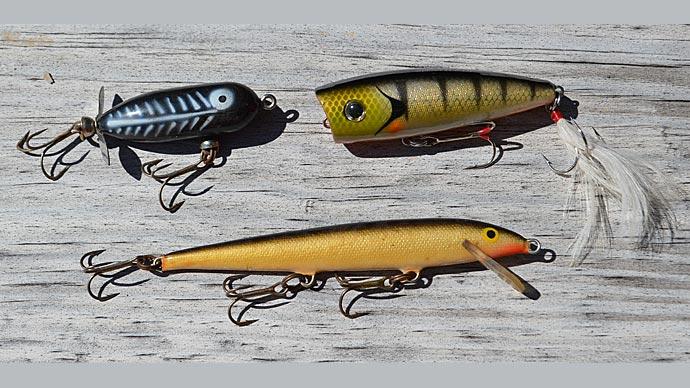
Post Spawn - is probably one of the best times for topwater. After the bass finishes the spawning ritual, many fish get into a limp, non-active feeding mode. The females are tired and want to recoup. These fish are looking for an easy meal, something they don't have to work for. I target the actual spawning flats themselves (usually male bass) and the first deepwater access near the flats (the bigger females will be the first to leave). These first deep access areas are often secondary or main lake points, with a channel swinging by them. I generally have two preferences for baits and one general cadence for lure selection. Because it is post-spawn for the bass and many other species, I know that there is a ton of fry in the water. I will use very small topwaters, like the Pop-R, Zara Puppy, Disco Dog, and Rapala Minnow, especially in clear water. I will generally use a slower than average cadence because I am trying to imitate a straightforward meal. As a second choice, especially for larger females and the first deepwater breaks, I will use a large topwater, like the Chug-N-Spit, Zara Spook, or two-bladed buzz bait; again, work them super slow.
Summer - there are two vital topwater deals in the summer. One is to fish up on the flats and shelves during periods of feeding activity. Low light, clouds, and rain are prime examples. Remember, the fish's metabolism is way up because of the high water temperature this time of year, and the bass are wired. They must feed more and move shallow and eat up top when conditions are right. I look for flats or small shelves right near deep water. This fish must have the ability to move up and down the ledge with relative ease. I choose medium to large topwaters like the Chug-N-Spit, Supper Spook, Devils Horse, and buzzbaits. I will also throw weedless frogs and rats in the slop. The second deal during the summer is fishing for schooling fish. This is especially true in reservoirs with clear water. The critical deal here is finding the bait. Suppose you can find the bait near main lake points or humps. For topwater choices, I'm often forced to go with the ultra-realistic Japanese baits like the Rico and Splash Its, Disco Dogs, and Sammys. I'm trying to match the forage. This pattern extends into the fall feed.
Fall - The third period when I like topwaters is when the bass go on the fall feed. They will specifically target schools of bait in the fall. Many times, pods of baitfish will begin to migrate into the creeks and pockets. The bass will follow. I like looking for creeks with a direct influx of water. I also like main lake pockets where minor sand break secondary points are formed. Like in the Post Spawn Phase, I like two types of topwaters. For the clearer impoundments, where I see more young of the year shad than adults, I like the smaller baits like the Pop-R, Rico, and Tiny Torpedo. For the more stained fisheries, and when I see a lot of adult shad or bait, I'll go back to the larger topwaters like the Chug- N-Spit, Chug-Bug, and Zara Spook.
Topwater Categories
- Poppers and Chuggers - Pop-R's, Chug-n-Spits, Chug bugs, Rico's, Splash It's, Hula Poppers, ideal for clear and stained water with a light chop.
- Stick baits and Darters - Zara Spooks, Disco Dogs, Sammys, ideal for clear water with water conditions ranging from calm to choppy.
- Prop baits - Torpedos, Devils Horse, Wood Choppers, ideal for water with a chop of more stained to muddy water.
- Minnow Baits - Rapalas, AC Shiners, Ideal for clear water and calm conditions. Colors - I always select lure colors based on primary forage and water clarity. As a general rule, I'm either trying to imitate some form of shad or minnows, bluegill and perch species, insect, or amphibian. I try and keep it pretty simple. Shad/Minnows - white, silver, pearl, translucent Bluegill/Perch - something with chartreuse in it, firetiger, Insects - blacks, darker colors, and translucent Amphibian - greens, yellows, browns
- Frogs and Rats - Mann's and Scum Frogs. ideal for slop fishing! (White, Char., Brown)
- Other - can include buzz baits, floating worms, Sluggo's, and weedless spoons.
Buzzbaits are super versatile. By changing blade style and lure weight, you can fish in various conditions. I use an aluminum two-blade to slow down when I want a faster retrieve and go to a plastic 3 or 4 blade version. I'll generally throw black under low light, white for clear water, white/char for stained, and chartreuse for muddy. I always use a trailer hook! Weedless spoons for slop.
Floating worms and Sluggo's are ideal as follow-up baits for missed strikes! Cadence is Key - the general rule of thumb is the clearer the water, the faster the cadence, the more stained the water, the slower the retrieve. Think about forage. Are you imitating a fast-moving shad? Are you mimicking a slow zig-zagging snake? Know the forage—smallmouths by competitive nature like a fast-moving bait.
Delayed Hook Set - the most common problem with topwater fishing is missing the strike because you react to the sight and sound rather than the feel. It's exciting, but you have to force yourself to delay in addition to a glass-type rod. I use a sweep-step type of hook set. This allows me first to feel the fish then follow through with the set. If I begin my sweep and do not feel the fish or visually detect a miss, the bait will remain in the strike zone for another chance. Using a monofilament type line also aids in the delay.
Ultra Clear Water - think about really natural-looking baits. Here the fish often feed on a hunger strike. Japanese Baits are perfect here. You can draw them up from extremely deep water.
Topwater Tricks
- Hook Size - by changing the size of the hooks, you can get the bait to do certain things. I usually use a bigger hook on the rear to get the back of the bait to point down. If I can't get the bait to do that by hook size alone, I will use strips of suspending strips on the rear of the bait.
- Use of RED in the rear hook - especially in clear water. Just use red sewing thread and a wrap-around rear hook. Leave about an inch hanging and finish off with a clear coat. You can also use paint markers to add natural shad dots or red gills.
- Notch the line tie of walking type baits to get them to perform better.
- Using a fly fishing float enhancer on the line section directly above the bait helps the bait's action and keeps the nose afloat.
- Sound and Weight to Frogs - jam a cat bell in a frog for added weight and sound.
- Clear Baits/Black Baits - use the silhouette factor. Suitable for low light/clear water.
- Cup the blades on a prop bait for a noisier and slower retrieve. Same on a buzzbait.
Tackle and Equipment
I use about four different styles of rods:
- 6' Short twitching Rod - This rod lets me gain wrist control for walking baits and spitting poppers. The rod has a lot of tips. My primary rod!
- 6'6" Long Twitching Rod - Same action as the 6' but slightly longer and a little more backbone. I step up to this bigger rod primarily when fishing the bigger type of baits.
- Custom Glass Spinning Rod - I use this 6'6" glass spinning rod when fishing smaller topwater bait. Great for clear water presentations where precise casting accuracy is critical.
- Frog and Rat Rod - A 7'6" Telescoping. This rod lets me heave these baits in the middle of the slop and have the power to get them out. As for reels, I use medium retrieve reels.
LINE- I generally use lines ranging from 10 to 17, depending on the conditions. Remember, a heavier line is more buoyant. I use a braid for fishing topwaters and fishing frogs and rats in the slop (zero stretch).