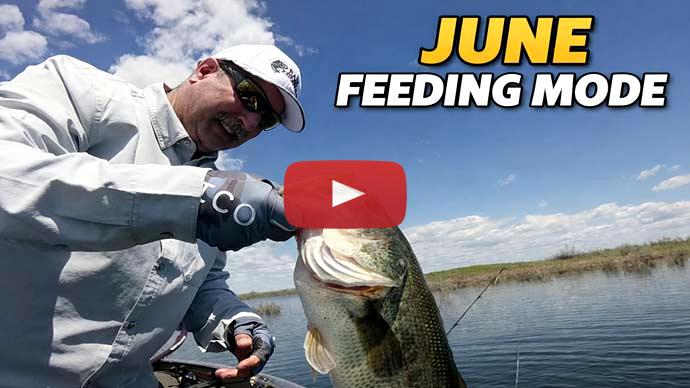
June is a transition period for bass and that's because they've done their spawning thing. They stay up shallow for a little while after the spawn and then they start feeding up and then they start working their way out deep.
Now I want to preface that by saying not all bass go deep and they stay deep. There's some that do stay shallow. So this is where it gets to be real tricky is the bass scatter. They were all concentrated shallow during this pre spawn and spawn and now they start to scatter and this is why it makes it difficult to find them people. Like where did the bass go?
Well, here's here's how you find him guys.
Let's start off with the at the end of the spawn, the bass start feeding up again. They're getting hungry and they stay shallow for a while. Provided that there's forage and bait fish around Shad are spawning right now in the in the bluegills are spawning right now.
Now shad are first thing in the morning. I mean early morning. So get out there crack of dawn and you can have yourself a heyday while the shad spawns on and you just don't shad imitator baits. It could be paddle tail baits. It could be crank baits top water. Whatever.
And then the bluegill are spawning too, and you can find bluegill spawning. It looks really cool. Looks like a bunch of craters. Just a flat area and a whole bunch of craters all over pot Marks and you know, there's that's a bluegill beds and those bass will be patrolling around there feeding on the bluegill. So any bluegill imitator or a Pop-R, a top water lure, that sort of thing can work to catch those bass.
But as time goes on, the bass start to migrate and move out deep. And so what you need to do is kind of understand like where they were spawning and where they're going to be in the summertime and then what's the route they're going to take to get there and a lot of times.
There's a lot of stopping points along the way to deeper water. So it could be a point or secondary point, could be a brush pile, rock pile and what you're looking for like creek channels, ledges, weed lines, those are the things that bass will follow on their way.
And as they follow and they find these rock piles and ledges and humps and whatnot, they're going to stay there and feed for a while. And some will stay there for a long time, if not throughout the summer if there's forage.
So you get progressively less and less fish that are making the deep water, but eventually there's a bulk of fish there's. An abundance of them that end up deep.
So this transition period is you've got to follow them out and figure out where those those spots are.
So one of the key things to look for is right after the spawn is I look for creek channels that swing up near the shoreline that are near a spawning area. Like that's a place they're going to go to the next deeper area adjacent to spawning flats, like the 10 to 12 foot drop.
Maybe it might be the ends of docks. Or it might be just a hump or just a drop real quick, a weed line. Maybe there's a point nearby, they'll go to that if this, especially if it's got scattered vegetation or chunk rock, that sort of thing.
Watch your depth finder. Look at the topographic map on that. If you're fishing from the bank, grab yourself a topo map. Sometimes there's little humps or little points that come out under the water that you wouldn't even know was there if you looked at the bank. But if you study a topo map, you might find that.
Little small thing, it's just a little point, maybe goes into a creek channel that could be a hot spot. So pay attention to those things because that's the best will set up on that as they migrate out to deeper water.
How how to catch them, what kind of baits to use?
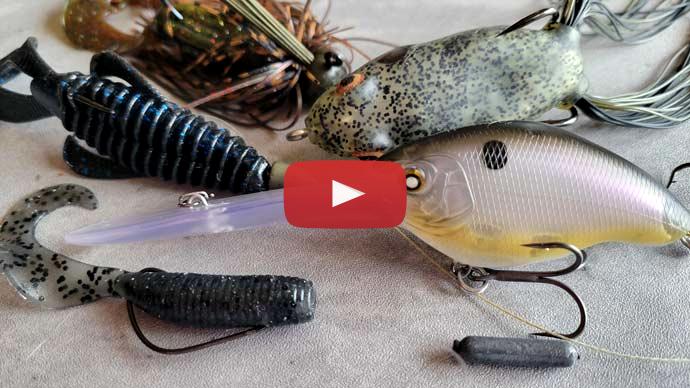
Well, I mentioned a couple of them already and top water is a great time. This June is a great time to be throwing top water. So I'll be sure you've got some poppers handy with their around bait fish. Zara Spook works really well and you know same with the Sammy. It works. That's a great lure to use this time of year.
Buzz baits if you got a lot of milfoil and grass just covering water, just casting and winding and covering water. A lot of times those bass are up in the up in those weeds chasing baitfish and you can call them out with running a buzz bait or the top or a frog if there's a lot of maybe Lily pads or if the weeds have topped out, a frog will work really well or toad. Excellent baits to use this time of year.
Probing the depths a little bit. If you want to get up under the docks, you want to get, you know, along the edges of the weed lines, then a shaky head can work really well skipping it under docks or working deeper, working those brush piles, working those rock piles. Working the points.
A 10 inch worm. Larger worms work really well. You know, ribbon tail worm.
So does a Senko, just a weightless Senko. For those fish that are up shallow, up to 10 foot deep a weightless the Senko can be very, very effective. Green pumpkin works really well or any kind of forage color. So if you've got bluegill, we can get some, get some Senkos in the bluegill color or shad type color and you can you can fish those up to 10 foot deep.
If you want a little bit deeper, you can do a Neko rig. A Neko rig works really, really well. Wacky Rig is also an excellent way to fish those Senkos.
You know if. Or a Missile Baits 48 is another great bait to use this time of year. Any of those can be very, very effective.
And finally, and when they're a little bit deeper out there, you know, 15 foot deep or so than a football jig and I put like a grub on the end of it or put a little creature bait on the end of it or a tube and drag it around those points, those humps, those ledges. It's also a really good area.
One thing that I didn't mention is there's a there's a period of time when they may not be on those specific pieces of cover, but they'll be on a on a straight bank.
Can just be a straight bank and you know they'll be the ends of the bank where it transitions to. Maybe it's a steep bank. And on the ends of it, it starts to taper out. It's a little bit shallower of an incline or maybe there's some boulders or chunk rock on the end of it. Those can be hot spots.
But those long straight banks, they often use that as a transition. And if you've got docks on them and the docks gonna be the hot spot, you know, boat docks, those type of things, boat houses, what have you can be really good hot spots to to hit during this time of year.
So don't hesitate or don't leave those or you know, skip around those. Make sure you fish those those long. If it’s a steeper bank, man, that could be really good with just the baits that I mentioned.
So that's how you find those Baas and keep tracking them into the summertime.
Hope that helps.
For more tips and tricks like this, visit bassresource.com.