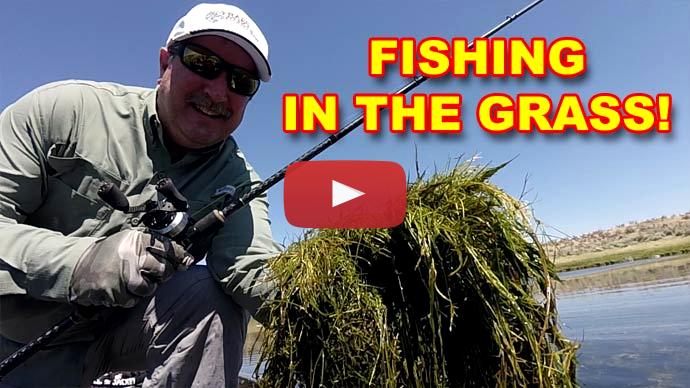
Alright, let's talk about fishing weeds for bass. Wow, that's a huge topping.
So I'm going to break it down, try to make it a little bit easier to understand because weeds, there's all kinds of different weeds out there and depending on the time of year changes the way you fish it, so.
I'm going to talk about a lot of when it's warmer out, when the weeds have grown and it's, you know, spring, summer, fall period. But we'll get into the winter a little bit too.
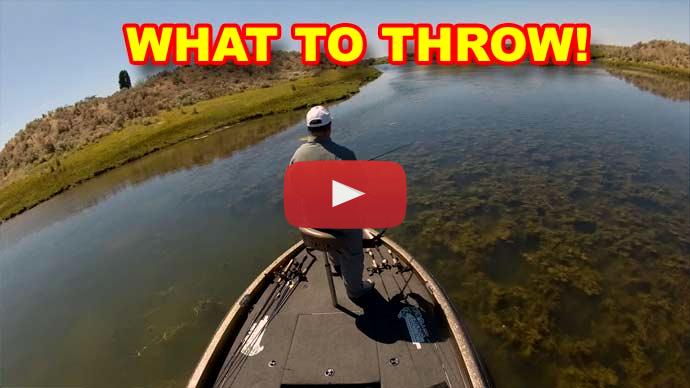
Here's the thing. Weeds at times can be daunting because like this whole expanse, I could get this huge Bank of reeds or a huge Bank of Tullys or milfoil, whatever. So how do you go about attacking it?
Well, first thing is to kind of pick it apart by just looking at it. What you're looking for is irregularities and anomalies.
So you go along the bank and you'll see that it cuts in, cuts back in, out, and there's a point and it's, you know, kind of a jagged edge. There might be a hole or an area where they get sparse and they get thick again. Maybe the depth changes and they're a little bit different. You've got lay downs in there, stumps, rocks, boulders, docks, things that can break it up a little bit.
All those areas, those are hotspots. If I got a big vast area with weeds and there's really little or no change to them at all, I tend to avoid that. Not that there won't be any fish in it, but those areas I just mentioned are going to be hot spots. So I seek out those irregularities and anomalies first.
Now, if I'm fishing let's just say Millfoil or Hydrilla, the first thing I'll do is I'll break out a spinner bait, my favorite bait, and I'll fish that on the outside edge 1st.
And it's a lot of times the fish are roaming along those edges and you the active ones especially, and they're looking for bait fish. And a spinner bait mimics a bait fish really well. So that's a really good way to start off as fish in the outside edges of those.
You can also fish the inside edges of them too, the inside edge meaning that's. Weed line that's between that and the shoreline, there might be a gap there. So there's that inside line and weed line, that's the inside line. And then the outside line is that weed edge that faces to the main lake and off to deeper water.
So I'll fish it with the spinner bait on the edges first and then over the top if I can. Over the top works really well, especially in mill foil. Those fish will be right up in there and you can, you know, you'll hit a pocket, you'll bring it across an open pocket or a little point that comes out and bam, you'll get slammed.
For reeds and Tully's, they work really well, especially in the pre spawn and spawn. They grow on hard bottom and that's the kind of area that bass are seeking out to spawn.
So throwing a spinner bait through all those tullies and reeds and all the edges of them, that can work really well. You can catch a lot of fish that way. Sometimes you get a little bit of weeds in there that snag, but you know get caught in the blades can be a hassle sometimes, but it's worth it because you can catch a lot of fish that way so.
A spinnerbait is like the first thing I do. Second is a buzzbait over the tops of the weeds and again in between the tullies. In Lily pads again in the spring when the Lily pads are first growing, they're first coming up. A buzz bait over the top of that and the spinner bait will work as well, can be very, very effective now.
As the spawn happens that inside weed line is going to be. The area where they're going to spawn the most, they're going to be up shallow. So work those areas more.
And sometimes those fish aren't ready to bite. Or maybe after the spawn, the fish just aren't in the mood to bite.
That's when I break out of Senko and a Slugo. A Sluggo is underutilized bait, guys. But man, it's been around since about 1990. I could say 1990-91. Check my, check me on that, Fact Check me.
But that bait, holy moly, that works really well, especially in those Lily pads and in those reeds I just mentioned.
And you throw it out there weightless Texas rig and just let it saunter through and glide through the weeds.
And if you don't know how to use it and work it, I've got a video right up here goes into great detail on everything you need to know about using a Sluggo. There's some tricks in there, guys. So put put that on your watch list and watch those.
But a Sluggo works exceptionally well in that pre spawn spawn period where you've got these scattered weeds and you can work that Sluggo through it all.
Senko works really well. A lot of guys like to throw them a wacky rig. Problem with that is you got an exposed hook and when you're throwing around weeds, you're going to get snagged a lot.
So I don't use wacky rig in the situation I Texas rig it, but it can be very, very effective.
Drop it in those pockets and those openings and along those anomalies and different edges. Senko can work very, very well for catching those fish and those weeds.
Another bait that I like to use sometimes when these fish are buried in the weeds and don't want to come out, then you got to go. Going after him so I'll Texas rig a lizard or say a Rage Bug that kind of imitates a bluegill.
Maybe just a Texas rigged worm, you know, ribbon tail worm. And depending on the thickness of the weeds, it depends on what the weight I'm going to use, but I start off typically with 1/4 ounce or 3/8 ounce tungsten weight.
If it's really thick, I'm a heavy up going 1/2 ounce. Or if you've got this thick, thick cover, then you're going to go to like a three quarter oz to 1 oz and do some punching.
That's when you throw the bait up in the air and let it fall boom and it penetrates that cover. And and gets to the fish underneath that is a more streamlined bait. Works better for that. Presentation.
It doesn't get hung up in that cover, that canopy. But that can be really effective, especially in the later summer, later parts of summer when the there's a canopy over it.
But if it's just thick cover, you can flip and pitch in those opening pockets and those stumps and those rocks.
Scattered weeds on a long tapering point is a great area to fish a Texas rig plastic bait. You can just drag it through it and you're not going to get hung up. And you can catch a lot of fish that way.
Now, as time progresses and you get into the summer months and into the fall, break out that crankbait, the outside edge of those deeper weeds, those weeds that grow in 10 feet or deeper, you get a wall sometimes milfoil does this a lot. You get a wall and you throw that deeper diving crankbait right along that edge and you can catch a lot of fish.
You know, crankbaits work really well in the fall.
And the thing about is the weeds start to die and when they die, they die in the shallow waters first. If you see that brown color, the weeds are starting to turn brown. Now they're dying off and consuming oxygen, not providing it.
So the fish are going to vacate dying vegetation, and they're going to move out to the deeper vegetation, and that's where that crankbait can really play. And you can catch a lot of fish doing that.
I've got some monster fish doing that in the fall. All the way until you get in the winter time, you just keep following it out. You find that green weeds as it gets colder and colder, and those fish will congregate around those weeds.
And this is what brings me to winter time. There's not a lot of weeds left. But in the winter, if you can find green weeds and deeper water, man, you'd be better fish them because that's going to attract bait fish and forage and the bass are going to be there.
So I like to target main lake points. I like Bluffs, steep drops, channel swings, points, main link points. Humps.
Sometimes you get a hump or a Ridge that's got a clump of weeds on the top of it and. You can throw a crankbait over the top of that and just tick the top of those weeds and you know, there's fish there. They're going to whom it, but that is how you fish weeds throughout the year using a variety of different techniques.
Hope that helps, but more tips and tricks like this, visit bassresource.com.