Alright, believe it or not, spring is approaching. I know it's really cold still some you may still have ice on the water. So let's start there. We're just the fish are just starting to move up. They're starting to make their transition. Towards their flats and towards where they're going to spawn. They're just beginning to do that.
So one of the different baits to use right now, that's going to work well, the king right now is the suspending jerkbait. That's like well known, not hiding any secrets here, Everybody knows that. But the suspending jerkbaits, you know, something like this. They're long and slender, they get down to 10 feet or deeper. Got a good bill on them and they just they're designed to kind of hold in place and most of them do a good job of that. But understand as the water temperature changes and maybe from lake to lake, even the water density is a little bit different and so it may rise a bit faster or sink a little bit faster than you want. You can make some subtle adjustments to help with that.
You can, for example, on the hooks if you. Move a size up on the hook, weight it down just a little bit. Start with a front hook to keep that nose down attitude. And if that's not enough, then go to the back hook. And then lastly the middle one if you still need to adjust. And that's going to help change that sink rate. And if even though I'm doing all that isn't enough, you can put like little lead dots on the underside on the underbelly here and to help weight them down a little bit. Just know that every time you go out to fish, it's going to change because the water temperatures are changing. So you're going to. Need to readjust that and dial it in again each time you go out.
Another thing that's really important too is the bass are moving day-to-day. They've got fronts coming through. They're go up shallow one day and they're going to be deep again. So you're going to need some baits that dive a little bit different. So like here's two of them you see that they've got. Basically the same body shape, right? But look at the bills. They're totally different, right? Really different. So this one's going to go a lot shallower than this one. So that's some ways, you know, get some, buy some different manufacturers, a couple of different brands have yourself a good arsenal, these different suspending jerk baits so you can get down to where the bass are without going underneath them or without overshooting them on top. You just that's that's a key variable that you're going to have to work out each day you go out fishing. But once you do, just a straight bait fish pattern is all you need. And you're gonna have yourself a good day.
Now another bait that really shines this time of year is the spinner bait. And there's two different kinds of spinner baits I like to throw right now. One is the double. Indiana blade, spinnerbait, three quarter Oz. And the other one, I don't have a skirt on this right now, but the key component here is this big Colorado blade, big thumper Colorado blade. Typically, I put a white skirt on here and I use these for two different scenarios.
The one with the big thumper Colorado blade. That's what I like. When the water temps are still in the 40s, maybe just cresting over the 50s, you can throw this out here and it'll helicopter down like this. It'll fall horizontally and this acts almost like a parachute as it spins in the water. And a lot of times you can fish Bluffs, steep banks near creek channels, over the top of rock piles where the bass would be holding those transition areas. And. It can be deep. 12 foot 15 foot water even deeper and just let it fall straight vertically on a semi slack line. Watch that line because this bite a lot of times the line just jumps and pops and you see that twitch reel up and then set the hook and I've caught a lot of fish doing it that way. It's just kind of like a vertical drop bait, but also you can slow roll this too get it down towards the bottom and just slowly reel and it doesn't take much to get this blade to turn. Trust me. As a matter of fact, if you do it too fast, you're going to lift. Up off the bottom. So sometimes what you need to do is you reel it a little bit, then pause it and see if you're still near the bottom. Sometimes you lift it up more than you thought. So work it slowly, give it a little pause and it sink back down. Work it slowly, give a little pause, and a lot of times you get bit with that retrieve, but keeping it down near the bottom and the bass are a little bit inactive. That works really well with this kind of bait.
But when the fish start to get active and they start to move up shallower. That's when I move to the one with a double Indiana and this works exceptionally well through all kinds of cover, surprisingly weedless. So when the bass get buried up in those brush piles and lay downs and some of the weeds that are beginning to grow. You can bring it up and around all that stuff at a relatively quick pace, but you can also slow roll this too and you get a lot more vibration and movement out of it with the two blades and a lot more flash. And it works really well in semi clear water, translucent water, that sort of thing. Works really well for the springtime.
So the cool thing about it too is that you can change skirt colors and trailer colors depending on the forage. Usually straight up white works for me, but if the bass are just chasing it. And they're nipping at it, or they're not taking it, or you see them follow it up to the boat or to the bank in the quick little change. Sometimes it's throwing on a chartreuse trailer is all you need, or maybe changing the skirt to a white chartreuse or just subtle changes in color often is all it takes to get them to commit. So that's the cool thing about these baits is that you can quickly modify them to adjust the conditions.
Another bait you gotta have this time of year is the square bill crankbait. Now the ones that work. In the summertime, those round bulbous ones, I got a lot of wiggle action to them. Those don't work quite as hot right now. What you want is a little bit tighter wiggle and so something like a speed trap. Like this one here, right, this is from storm see it's a little bit narrow a body and the bill is is doesn't even get as big as the body. So it gets a real tight, tight wiggle. And that tight wiggle is is what's key to right now in this cold water. This is what triggers them. Not that lot huge action because the bait fish they are starting to get more active, but they're not as active as they're going to be in the warm months. So they don't have those exaggerated movements yet. So something with that lot of movement. It looks out of place. So a tight one, you're going to get more bites out of it.
Now, one of the keys about square bill and what it's designed for is for bouncing off of objects. So make sure you're hitting those rocks on those stumps. A lot of times fishing on points is the area you want to go, the first, secondary and primary points. And areas that they've got stumps on them or logs or maybe a lay down on it and you want it to bounce off that a little bit different though. In the summertime, you bounce it and you keep on going. A quick ricochet and it dives off into another direction. It's pretty wild action this time of year. When you hit it, you want to give it a pause and let it sit there for a little bit and you want it to suspend. So going back to the suspended jerkbaits, if this crankbait that you have floats a bit, you can readjust that floating just how you do with the jank, the jerk. It's just what I told you about. Adjust them that way, changing the hooks, putting the suspend dots on it, that sort of thing using fluorocarbon line. Also make sure that you've got a combination of square bells that have rattles and square bills that don't have rattles. That often can make a big difference, especially in the clear water. The ones that don't have rattles tend to do a little bit better, and you can get them both in plastic and in balsa or cedar, and that sometimes has a difference too, and the way that they move in the water and how deep they go. So just have a good array of those, mostly in bait fish color. You can do the crawfish color too, if you want to dig along. Bottom in crawfish color works really well and you can get them to dive in different depths and such. I mean, you can go hog wild with these, but don't go too crazy. But really the bait fish and the crawdad colors are really what you're going to need for the square bells.
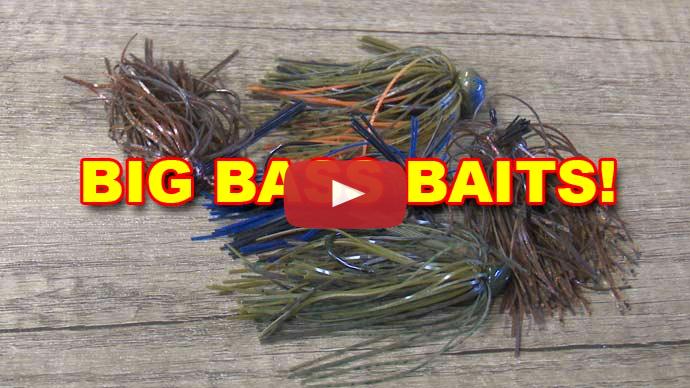
OK. Another good bait to be thrown this time of year is the swim jig. And also you want a jig that can go in the weeds. Now, some of us don't have the budget to buy a bunch of jigs and others don't have, you know, one rod for a swim jig and another rod for a jig to go on the cover. And sometimes it's just, it's easier when you're swimming a jig, if you go to open cover or spot this next to cover, you want to drop it down into the cover. What I like to do is get a jig like this. This one if you notice the weed. The head. Is the eye tie line. Tie is built into the head. And it's kind of narrow body like you would have in a narrow head like you would have a swim jig, but. It's also designed with a weed guard and everything to go into weeds. So I will tie this on and use it as a 2IN1 approach. Just put on a craw trailer or a boot tail trailer, either one and you can swim it along and then when you get to an opening or to a weed edge or along a dock piling, drop it and let it flutter down into that hole and work it like you would a jig and and cover. This works really well around lay downs for example. It's just it's a great little 1-2 punch all in one rig and you start with a 3/8 ounce jig and you can go down to 1/4 ounce or 8 oz or move up to 1/2 ounce depending on the depth of the fishery in that day. And this can be a real killer technique. It's one I don't think a lot of guys like to do. In addition, I added some rattles to it. I don't know if you could hear it or not, it's real subtle, but I added these little rattles on. You can buy these extra. I don't know if you can see it or not, these little extra rattles that are hanging off the end here. Can you see that? I don't know if you can see those or not, but. Just to give it a little bit of sound. So that's the cool thing about these jigs. You can play around a lot and you don't have to get a whole bunch of jigs. You can get a multipurpose 1 like this and it works really well.
OK. Now I would be remiss if I didn't mention the tube. The tube is been a staple in my arsenal for decades. And the reason why is it just keeps on catching fish. It's like the fish don't get tired of it, they don't get used to it. And year after year after year I continue to catch fish on tubes. And especially this time of year when again you're really cold, the temps are still in the 40s water temps. Some is just getting up to the 50s and you can use a jig in many different ways. So one of them is let's just say we're getting closer to the spawn and they're shallower. We're up in the mid 50s, low 50s water temp. You can use it. Take the tube and rig it on a jig head where the. Is at the very top. See that? Yeah, the eyes at the top. And with this, what happens is it's a straight up eye and when it falls, it kind of does this death spiral. Right. And there's no other paid out there that does that. And you can throw it up along docks. You can skip it under docks, bridge pilings and over nests during this spawn time. And that slow spiral fall right alongside of a dock or an object man. Catch a ton of fish and the water temps can be again in the 40s or 50s and this spiral action dropped is really the ticket. A lot of times it's just real slow moving and the bass just don't get tired of it. It's the original way how we used to fish these tubes when they first hit the market in the 80s and it still works today. It's that effective.
However, there's another way to fish them and that's to get them to glide a little bit. And with that I use here's the tube jig. I don't have the tube on there. See. That's got a 60° eye on it right up here at the front. It's a 60° eye that sticks out instead of it's straight up. And what that does is it changes the way it fishes now. Now the bait glides through the water. Instead of circling and you can cover a lot of water this way, you can go along in its any depth too. I fished in 20 foot of depth this way. You just cast it out there and it will glide and let it fall to the bottom. Lift it up and let it glide some more. Lift it up and let it glide. Or you can give it a little pops just to kind of up and down. Let it fall up and down and it just does this kind of erratic gliding motion and man the bass will just pop it and be ready for the hook set because I mean those bass sometimes will just. Highlight it. I don't know what it is about it, but they really like it when it's doing. Sometimes when the vast a little more aggressive, a little more active. That gliding action is what's killer. Just I fish it on spinning outfit. On 8 lbs, sometimes 6 LB fluorocarbon line because I want that fluorocarbon line to sink and go with it and to flow with it. And so a real light pound line that kind of sinks is ideal for the situation. If you're using the braid, braid it just it just kind of inhibits it. It dampens that action whether it's spiraling or gliding. The braid tends to dampen that action a little bit. Just cause of the composition of braid versus fluorocarbon is a little more fluid with fluorocarbon. And a 7 foot 1 medium power, medium light power fast action rod is what you need on a reel. That's a 20 size 2500 reel. Smooth drag is key because those light hooks, it doesn't take much to set the hook, but you want to keep that fish pinned and so a good drag system on it when the fish surges and runs, especially when you've got a good fish. That's what you want to kick into play.
The key thing, guys, don't reel against the drag when that happens because that's how you introduce line twist. OK, it's not the bait, it's not because you're using spinning gear, blah blah blah, but if it's. Guys complain about line twists and that's because when the drag starts to peel off and you're fighting a fish, they keep turning the handle and that that line isn't moving, but the real is and you just twisting that line. So stop reeling against the drag, let the drag do its job, or if it's peeling off too much drag, tighten it up and then continue to fight in the fight the fish. That's just a side note there.
But with all those baits I just mentioned this perfect time to be throwing these right now. And with those you're going to catch some fish right now. So I hope that helps for more tips and tricks like this visit bassresource com.