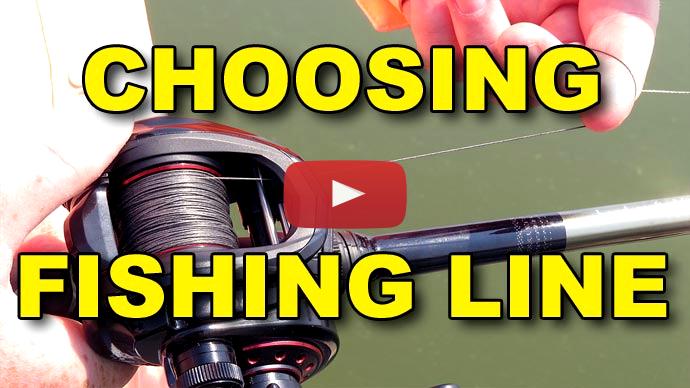
Choosing which line to use for what pound strength and what application, it all starts with understanding the different lines that are available to you. The three main line choices out there right now are braided line, monofilament, and fluorocarbon. So let's start with braid. Braid, it's got synthetic fibers. It's woven very tightly, hence the name braid. And they come in a variety of pound tests, all the way from 5-pound up to 65-pound-testing, even higher. But for bass fishing, those are the ranges that you're going to find and need.
So you have a whole bunch of choices, plus, they come in a variety of different colors for different water clarities. It's very strong, very durable. You can use this in the thickest of cover. You can use it in areas where you're going to be pulling it through a lot of different objects. And the braid's going to hold up pretty strong. It's also very sensitive. Sensitive meaning that it transmits every movement, every little tick, and nuance, any change that happens in your bait, all the way up that line very well. Telegraphs it all the way up to your hands.
So this works really well for slow moving baits like jigs and worms, where even when you have slack line in there, it still transmits vibration and you can feel those subtle bites and pickups. It also doesn't have any stretch to it, which is great for those strong hook sets that you need to wrenching fish out of the cover.
I mean, braid is really good for flipping and pitching. I mean, if you read in between the lines, I love it for flipping and pitching for all these reasons. And it cuts through all that vegetation, whereas other line might get wrapped up in it. It does a very good job. Braid is also easy to cast. It just is easier to cast super light lures using braid. So a lot of guys do that.
However, braid does have its downfall. Like I said earlier, it has no stretch. That can be a bonus. But also if you're using it, say for example, for crankbaits, braid, because it's unforgiving, it puts all the pressure on those little hooks, and it makes it easier to rip a hook out of a fish's mouth and lose them. So braid might not be the right choice for that situation. Braid also absorbs water. And when you're fishing in icy conditions, that attributes adding ice buildup in your guides. So braid is not really a good choice for that.
And the cheaper braid that doesn't have...is loosely woven, isn't as tight or woven, it can actually get grit and pick up dirt and debris off the bottom. And that can wear on your components of your fishing gear, your reels and your rods, that sort of thing. Braid also is very visible. It's opaque. It doesn't matter what diameter you're using. You can see it. And that becomes a problem, especially, in clear water situations with slow moving lures, like finesse applications. Braid is very visible, and that can be a detriment for the fish. They may be able to see it, and that may cause them to be wary of what you're offering, and they might not bite. So that's important to understand.
Braid also can be expensive. It's not a cheap line. Even though it's durable, it can last you multiple seasons. So you have to kind of weigh that out. It's kind of six of one and half a dozen of the other. You pay a lot more upfront, but you can get it to last a couple seasons. And also, what braid does sometimes is at the end of the line, it starts to lose its coloring. It starts to fade and becomes almost white, which looks like a rope underwater. Well, you can use a felt tip pen and color it back in. That works really well.
But one of the things about braid is you can also...it doesn't have a lot of memory to it. So when it starts to get faded on that end, you can reverse it. You can spool it off one reel onto another, reverse wind it, and now, you've got the newer line or unused line that was buried at the bottom of the spool. Now, it's in the front, and you can continue to use that. That's how you can stretch your dollar a little bit, make it last a bit longer. You can take care of that fading issue as well. But just understand braid has those unique characteristics. So it takes a little bit of work to get the most out of it.
Next is monofilament. Monofilament line has been around for decades, and, in fact, it used to be like the only game around really, as far as bass fishing is concerned. I used monofilament as a kid, and all the way up through my young adult years it was always available, and it worked. Monofilament has a bit of stretch to it, which is good when you're using crankbaits and other lures with small hooks, topwaters, things like that. It has that forgiving quality to it. It gives a bit when the fish lunges, and it helps keep them pinned. That's great.
Monofilament also floats. So that's really good for topwater baits. It's exceptional. That's what most anglers today, when they reach for monofilament, they use it for topwater because it stays on the surface and helps that topwater perform the way it's supposed to. So that's a plus. Monofilament also is the cheapest, as far as cost is concerned, of all the lines out there. It's the least expensive. So your dollar will go a lot farther with monofilament line than buying other types of lines. So if you're on a budget, monofilament can be your choice.
It comes in a variety of different pound tests and different colors. So it's really a universal line that can be used for a variety of applications. The downside of monofilament is, well, one of it is stretch. I mean, with the good comes the bad, and stretch sometimes makes it hard to get a good hook set, particularly, with a thick gauged hook like a jig or a flipping hook, when you're using for plastics.
Flipping hook... And this is when that cross their eyes, hit them really hard hook set came into play is because of monofilament's stretch characteristics. That's when us anglers learn how to just wham and hit them really hard. You don't need to do that with, say, braid because braid is unforgiving. So every little bit of strength that you apply to that hook set is going to transmit all the way to the other end of the line. With monofilament, you've got that stretch, so you've got to hit it really hard. So keep that in mind.
Monofilament also is the least as far as durability is concerned. It gets frayed a lot easier than the other lines, and it gets nipped a lot easier. So you have to be checking your line constantly and re-tying constantly. I remember doing that all the time when I had monofilament. It was just a normal practice. It's not a major inconvenience as long as you're aware of it and you check your line frequently. Matter of fact, even today, the other lines that I'm using, I still check it today just as a habit from my monofilament days. It's always a good practice to check your line no matter what kind of line you're using, but monofilament especially.
One other thing with monofilament is memory. It is some of the worst memory than all the other lines combined. What I mean by that is, say, you have it on a spinning outfit and you throw it out there, if you're using, say, a higher poundage monofilament, gets worse and worse, like 10 pound and up. You throw it out there, and it's slack, you see these coils on the water. The line coils, that's memory. It tends to get to that ... It forms to the spool and retains that form even when you cast it out there. It can cause casting shorten distance because the line's slapping against your guides, and that can be a problem. So line memory becomes an issue with monofilament.
The next type is fluorocarbon. Fluorocarbon line is like the best of both worlds, best of braid and monofilament. It's very durable, it's very sensitive, and it's nearly invisible in the water. There's only one color that it comes in, that's clear, and this is the reason why, it's because its refracting characteristics makes it nearly invisible in the water. This makes it an excellent choice for finesse tactics and slow moving baits or line shy bass could be an issue. They can't really see the line very well when using fluorocarbon.
Fluorocarbon also has a little bit of stretch to it. So that's great for using crankbaits and other treble hook baits or finesse applications when you're using thin, small, light wire hooks. That little bit of give in it...it's not super stretchy, but it's got a little bit of stretch to it, and that enables you to keep that fish pinned on those small hooks. They don't rip free when the fish lunges, or when you're pulling back on them, you don't lose that fish. So it has a lot of great characteristics.
The other thing is its durability. It's really abrasion resistant. In fact, it's actually more abrasion resistant in rocks than braid. A lot of folks think braid is the universal line to use, but, honestly, fluorocarbon is the universal line. I use that for more applications than anything else. Above all else, braid and fluorocarbon in my tackle box have specialty the uses, and I use them for those purposes, but fluorocarbon is like the jack of all trades for me. It's replaced monofilament and braid in my tackle box for pretty much the universal line. And that's because you can use it in all kinds of cover, in all kinds of applications, even in flipping and pitching, you can use fluorocarbon.
There's some downsides to it, though, one of which is that it does absorb water. So it does sink a little bit. That is good and bad. If you're using, say, for example, a slow falling bait like a Senko style bait, or you're using finesse tactics, you want that fluorocarbon to go with that bait or stay with it and not lift it up or change the way it acts underwater. Fluorocarbon is really good for that, but because it sinks, it's terrible for floating topwater baits. It, actually, pulls the bait down under and changes the way that it works and makes it less appealing to the bass. So fluorocarbon is not really a good choice for topwater baits.
Fluorocarbon is also expensive. This is a key thing, guys. Some people shop by price, and that's where you can go astray here. Fluorocarbon, especially, when you get to the larger diameter lines, they become a little bit unruly, coming off of spinning reels. The cheaper ones, especially, have a real memory problem, like the monofilament. The cheaper fluorocarbon lines in the thicker diameter, what happens is it tends to explode off your reel.
Even baitcasting causes these big bird's nests and blows up and wind knots. It's really because you're using cheaper fluorocarbon line more than because you're using fluorocarbon. A lot of guys blame it on fluorocarbon, and they go, "Oh, I hate fluorocarbon." Well, you use a cheap brand, and you use a thicker pound test, especially, a thicker pound like the 15 and larger size on a spinning spool. Yeah, don't do that. I use 10 pound and smaller on spinning outfits, and then I use the larger diameter on baitcasting.
Also, I use quality fluorocarbon, which comes at a price, but it lasts a lot longer and it works like a dream. I use Seaguar fluorocarbon lines. The Seaguar InvizX line, that's the jack of all trades. I can use that on virtually every type of outfit, and it works very well. But I like to use Tatsu for the smaller diameter finesse tactics. It's really limber, and I use it for crankbaiting as well. It just gives that bait a lot more action, and I can get it down deeper, and I still have that sensitivity. On the other end, I like to use the heavier fluorocarbon lines. For example, the AbrazX, that's used for more flipping and pitching and around heavy cover. So fluorocarbon line, definitely you got to have that in your arsenal.
Now, no matter what line you use, there's a couple things you can do to get the most out of it. One of it is to use backing. A lot of baitcasters out there have deep spools, and you're never going to use that line that gets down, probably even past halfway down the spool. Even those shallow spools, there's baitcasters that are coming out nowadays of a shallow spool that allows you to put less line on it. But if you're using really small thin diameter line like those 5-pound, 8-pound braided line, you could use an entire spool of braid on that little shallow spool, and you're still not going to get to use all that braid. So backing can really help make your line go farther.
You don't have to use a brand new spool to fill up the entire reel. You can put backing in, like, a monofilament line and fill up that spool about halfway, use a blood knot, and then go with the rest of your line from there on out. You can save a lot of line and make it go a lot further that way. Plus, if you're using braid, braid slips. It doesn't matter if it's on spinning gear or if it's on baitcasting, it's going to slip. And sometimes you're turning your reel and the line isn't moving, or it's barely moving, and it's because that braid is just slipping on that spool. So using backing is going to give that braid something to grip and bite into and enable you to use that reel without that slipping problem.
The other thing is taking care of your line. Man, a lot of problems people have with line, they blame it on the line, but really it's how you cared for it, how you stored it, right? You guys, if you've got it on the deck of your boat all the time, make sure that the rods and reels that are on the deck of your boat, or you have out laying next to you when you're fishing on the shore, those are the ones you're going to be using in the immediate future or if not right now. Don't just put everything out there because it's the sun beating down on the line. It deteriorates it. That UV rays, just like it gives you sunburn, it's bad on line.
So you don't want it sitting out there on the deck of your boat. Say, for example, it's a rod or reel that you're not going to use that day, put it in the rod locker. And then when you're done, when you're storing your rods either at home after bank fishing or when you bring your boat at home, don't leave your rods out there in an area where the sun can get it, put it in the closet, put it in the rod locker, put it somewhere in a dark space. That makes that line last a lot longer.
Monofilament and braid, fluorocarbon line, will deteriorate, become brittle over time, and will even fade because of the sun. So keep it out of the sunlight, and also moisture, things like that can deteriorate the line too. So a nice cool dry area, keep it out of that heat. Those go a long way in making your line last a lot longer, and you're not going to have break offs or problems with line because of storage issues. You spend a lot of money on this stuff so make sure you care for it properly, so it can do what you need it to do and you can make it last a lot longer.
So with that in mind, now you know what types of line to use and where to use it and how to take care of it. I hope that helps. For more tips and tricks like this, visit bassresource.com.