Jerkbaits have exploded in popularity over the past few years, and that's because more and more bass anglers are realizing that you can throw them year-round. It used to be jerkbaits were limited to just early spring fishing, but a lot of guys have figured out that you can throw them year-round with great success. The key is picking the right jerkbaits and also matching it with the right gear.
Let's talk about the jerkbaits first of all. They come in a plethora of different design styles and a lot of different manufacturers out there. Because you have a lot of different situations and scenarios where a jerkbait will work, depending on the season. Most of them are three to five inches long and they dive to about five or six foot deep, maybe a little bit deeper than that. That's the average jerkbait. But then you throw into it, you've got ones that dive deeper, you've got longer ones, you've got some that have different actions, and it becomes pretty clear that there's no one perfect jerkbait out there. So a few different sizes and styles are what you need.
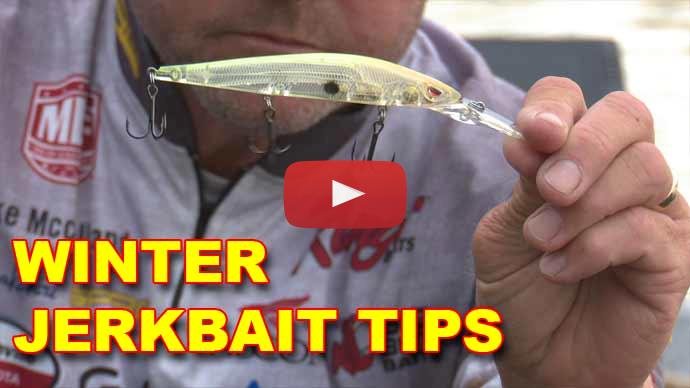
First of all, with a regular-sized one, those work medium diving depth. A suspending type works really well when the fish are inactive or during the winter months, the colder months, a suspending style jerkbait works really well. The floating type work a little bit better in the warmer months, and then a seeking style actually can work well in the fall as well. It imitates a bait fish that's dying. So you want to have a couple of different variations of that.
The larger baits, those work really well, particularly in the fall and in the spring, and you can get them in plus sizes, the plus one, plus twos, those dive even deeper. And suspending ones that are like a plus two work really well in the fall and in the wintertime. So you want to make sure that you have some suspending jerkbaits for that season, even in early spring, those deep diving suspending jerkbaits are, like, critical to have. But there's other jerkbaits that they have, like a cupped lip and give a lot more wider action, wobbling action that works better in warmer water than colder water. The ones with the thin, narrowed bills, those work better in colder water. So just kind of keep those in mind for your different scenarios that you're coming up against. You have different depths and different presentations.
And then sizes. Sometimes in the fall, the bass are keying on smaller bait fish, those three to four-inch-sized bait fish. So a smaller jerkbait can be the key to getting more bites. So having different sizes is also critical in, you know, filling out your jerkbait arsenal.
One other thing to consider is color. We always talk about shad because that's all down the south, southeast, and that's predominant forage the bass feed on. But if you don't have shad in your area, if you're living in the northern climate, perch and bluegill, that is going to be your mainstay. So make sure you've got the right colors for your water. And then water clarity. If you've got really dingy water or if you have smallmouth in your water, then those brighter colors work well. Get some stuff with chartreuse, fire tiger, that can trigger bites from those species. And if you have really clear water, then those translucent type baits that have a little bit of clear, you know, you can see through them, those work really well in super clear water. So with that in mind, you can kind of build out your arsenal for the bodies of water that you fish.
Let's talk about your gear. Now, jerkbaits can be fished using either spinning or bait-casting outfit. And again, it depends on the scenarios to which one to use. If you're throwing those really small, lightweight baits, that's when I break out the spinning gear because it's easier to throw lighter baits. The larger baits, I'll use bait casting.
Line choice becomes a key thing here. Typically, you're using 12-pound line. That's like the standard. 12-pound fluorocarbon line in this instance. Fluorocarbon line's clear. It's got the sensitivity that you need, and it has a little bit of stretch to it. You've got these little tiny treble hooks on these baits. It's easy to rip those hooks free if you're using a non-forgiving line like braid. So fluorocarbon is the key here. I like to use Seaguar Tatsu. That's one of my favorites, or Seaguar InvizX. You can go up and down in line size. The bigger the line, say 15-pound line, it's going to inhibit the diving depth. And that might be a good thing. If you've got some weeds, you've got some other obstacles that you don't want to dig into or get hung up on, going up in line size will keep that bait shallower.
Conversely, if you want to get it down deeper, you're fishing with tapering points or bluffs, you want to get that down and deeper in the water column, go down a 10-pound or 8-pound line, even 6-pound line can get that bait to dive down deeper. So using those line diameters can make a big difference in the action and the depth of what those baits run.
With your rods, it's pretty much the same thing, whether it's spinning or bait casting, you want a medium power, fast action rod. That's like the standard go-to for fishing these baits. It's got the flexibility to throw it out there. It's got the backbone to set the hook, but it still has that flexibility to help keep the fish pinned while not giving it too much of a backbone and allowing that fish to rip that bait free.
The other thing is you want it to be a 7-foot, maybe even a 6'10 rod. That makes it easier while you're working the bait. You've got the rod tip pointed down. It's not going to hit the water and interfere with that. It's easier to work the bait with a shorter rod. So keep those in mind, and you're going to have yourself a great time fishing jerkbaits this year. For more tips and tricks like this, visit BassResource.com.