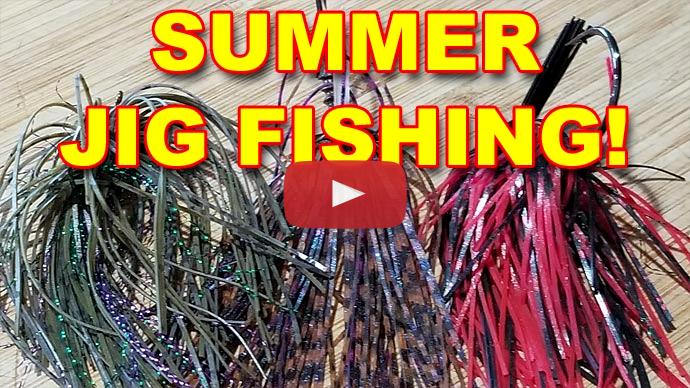


The Baits
Casting Jigs -- https://bit.ly/40nG8eu
Football Jigs -- https://bit.ly/3Wuk2WC
Flipping and Pitching Jigs -- https://bit.ly/3C5I6It
Swim Jigs -- https://bit.ly/42lyVhq
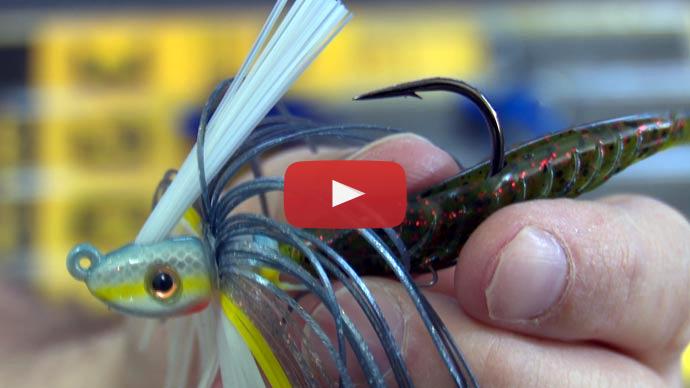
Finesse Jigheads -- https://bit.ly/42lKdSP
The Baits
Casting Jigs -- https://bit.ly/40nG8eu
Football Jigs -- https://bit.ly/3Wuk2WC
Flipping and Pitching Jigs -- https://bit.ly/3C5I6It
Swim Jigs -- https://bit.ly/42lyVhq
Finesse Jigheads -- https://bit.ly/42lKdSP
Let's talk about jig tactics you can use to catch bass. There's quite a few different ways you can do it, but I'm going to talk about the most popular ones. Let's talk about, first of all, swim jigs. Now, swim jigs are relatively new to jigs overall, mainly because, you know, what happened back a couple decades ago, doesn't seem that long ago, but a lot of anglers were noticing is...and maybe this has happened to you, you're fishing a jig and then you're done working that spot and you reel back up to make your next cast and as you bring it up to you, there's a bass chasing it and then, you know, he darts off. Or, you're reeling it back in and wham, you get hit and now, you've got a bass on. Well, it didn't take too long for us bass anglers to figure out like, hey, maybe I should just cast it out and reel it in and see if I can catch a fish. And that worked.
And now, you've got this whole cottage industry for swim jigs. Swim jigs are designed to fish through cover, so the nose is, where the eye is, and also the head is more tapered and it can slide through weeds and aquatic vegetation without getting hung up. Plus, it gives a little bit of a wobbling action to it. There's a couple of different type of trailers to put on it. One is like a paddle-tail type trailer. It could be a 3-inch or 4-inch paddle tail, gives a swimbait kind of look, gives a minnow action to it. The other kind is a small creature bait to it, you know, like a rage bug.
Typically though, what I do is, like, here's your jig, a lot of people, they put a craw on at the back like this horizontal to the jig. But in this instance when you're fishing it, you want it vertical because now, when you look at it sideways, it has more of a bait fish profile and the tails on the end of it now do this, they kind of kick and it looks like it's swimming through the water. It looks like a rear tail fin of a bait fish. So, that really helps enhance the appearance and the appeal of a swim jig for bass.
What you do is you cast it out and just reel it back in. Don't do anything fancy with it, which is odd because with crankbaits for example, you want it bouncing off things. You want to do a stop-and-go retrieve and speed it up or pause it, impart some kind of erratic action to it to get a bite. But with a swim jig, if you do that...have you ever noticed this? You got a bass following it and you're like, "Oh, he's not biting." Your instinct is "I'm gonna pause it or speed it up or give it a pop, something to elicit that bite." When you make that move, the fish almost always goes [vocalization] and he's gone. I don't know why that is. It's like the exact opposite of a crankbait.
So, for swim jigs, casting and giving it a steady retrieve back is the best presentation to get bit. You can control the depth two ways. One, speed of retrieve. The faster you reel it in, the higher up the water column it's going to be and vice versa. Also, the weight of the jig and that's kind of dependent, right? So obviously, a heavier jig is going to sink and it's going to get down there further. But if you really want to reel it back fast, here's a tip. You can burn it back to you just under the surface of the water without it breaking the surface. You can use a heavier jig. The heavier jig you use, the faster you can reel it back in that situation and keep it from breaking the surface. So, not always is the weight of the jig going to keep it shallow. It has to be combined with the speed of the retrieve, but that's how you can figure out what depth to keep it at. And that's it, man. Swim jigs are really easy to use. You can catch a lot of fish.
The next kind of jigs are shaky heads and round ball jigs, you know, these Finesse-type jigs. You can rig them Texas-rig or on an open hook. And these work really well, especially in the summertime when the bass are a little bit lethargic, they don't really want to bite because of all the pressure and it's the dog days of summer, lots of boating activity, it kind of shuts the bite down. That's where these jigs work really well. You put a little 4-inch Finesse worm on it and go to town. You can fish in the outside weed lines or deep aquatic vegetation, you know, these humps, offshore humps. This works well in the wintertime too when the fish are all deep. You can fish these jig heads in those situations.
Here, what you're doing is you're fishing it on spinning gear and light line, like 6-pound fluorocarbon line. And the name of the game is slow. Get it down there deep and just work it slowly off the bottom. Don't impart a whole lot of action to it and the fish will suck it up off the bottom. And so, you're waiting for that subtle bite. So be a line watcher and feel. After a while, you'll feel the hardness of the bottom. Typically you're fishing in rocky areas or solid bottom, there's not a lot of weeds down there. And so, you can feel it ticking across that bottom. Then it becomes just soft and mushy. A lot of times, that's a bass. They just pick it up and they stay there in place. You just kind of got this little tug of war going on with the bass. So, just be on point. It can be a boring way of fishing, but you've got to stay alert for that subtle bite because they're going to be few and far between under those conditions. But that's a shaky head and a ball head jig work really well for those situations.
Now, the next kind of jig is a football jig. Now, there's two different types. One is the skirted type that has a football head and the other kind is just the jig itself. On those, I typically rig a hula grub on it, you know, a spider jig. That works really well in the summer months and into the fall, particularly. The bass love that jig. And the way you fish them is basically the same. Here, you're typically using about an 1/8-ounce to 3/8-ounce size jig. You cast it out, get it on the bottom, and here, you're not doing hopping and dropping. You're crawling it. You're imitating a crawdad. So with the kind of the skirt on it, you want to put a craw trailer on them to give it that crawdad-like appearance. And you crawl it along the bottom and when you come up against a rock or something on the bottom, pause and just lift, lift on the rod a bit. And what you're doing is you're rocking that...you know, here's the rock or stick or whatever, and you're rocking that jig like this and wavering in place and waving those crawdads up or those appendages and making that hula grub dance. And you're imitating a crawdad here. And that's a staple of a bass' diet year round. This works all year long.
And fish it in deeper water. Typically, you're not in weeds because you need the fish to see this action. So, you're fishing rocky areas. You're fishing riprap, long tapering points, rocky humps and rock piles, creek channels where the creek swings in close to the shoreline, steep shoreline, especially in the wintertime. A lot of different places here is where you can fish them, but typically, void of weeds. And I'm using a little bit heavier equipment here, usually a 7'1", medium-heavy fast-action rod with 15-pound fluorocarbon line. Not braid, because fluorocarbon is more abrasion resistant than braid when it comes to rocks. And here again, we're fishing rocky and hard bottoms. So, the fluorocarbon does a better job in this situation. And, you know, that's about it. You just work it nice and slow and you'll feel the fish pick up. A lot of times, especially if it's in the summertime, it's an aggressive bite. They don't just pick up and swim off with it. [vocalization] You feel them. And just reel back and set the hook and you got them.
Now, this next technique is probably what jigs are known for best and that's flipping and pitching, right? If the fish are in any kind of cover, if they're in thick vegetation or they're in the, you know, flooded bushes, brush piles, trees, any kind of cover they can be in, you flip it pitch it and you can go and get them out. I love flipping and pitching. It's great. You don't have to necessarily get it all the way back into that cover. You can just get on the outside edges of it. But a flipping jig works great for this situation. You can either get into the cover and then you got to wrench them out or, you know, get them on the outside and entice them to come back out or put them in the pockets of those big weed flats. You're looking for those open pocket areas or those little irregularities on the edges. Just flipping and pitching your jig up there and let it slowly fall, typically, the bass hit it as it's falling. So, I'm using a 1/4-ounce or 3/8-ounce jig most of the time, not a real heavy jig.
And I like to take it out there on heavy... This is not for the faint hearted. You're using some heavy duty gear, especially if you're throwing it into that thick cover. You got to be able to pull the fish out. So this is hand-to-hand combat. So we're using heavy power, heavy action rod with 50-pound braid. All right. We're not holding back here. We're using jigs that got stout 4/0 and 5/0 thick hooks that can be able to stand up to the pressure of this gear. Usually, a 7'2" to 7'6" rod is what you want. It's got that leverage that you'll need to wrench those fish out of that cover. And flipping and pitching works especially well really spring through fall. Anytime those fish are up shallow and can be buried up in that cover, especially if you've got a front that's come through or there's not a whole lot of other type of vegetation or cover for them to get into and they'll bury up in that stuff, you got to wrench them out. Great time to flip and pitch.
The last technique is a variance of that. Now sometimes, especially when cold-front conditions come by, these fish will bury up into those weeds and flip 'em and pitch 'em. Now, they don't want to bite it as it's falling. This is kind of a key indicator when you got to go to this next technique is if they're not hitting it as it's falling, you got to force them to bite. Now, this is one that sometimes is elusive to some bass anglers. You can force them to bite by triggering a reaction bite. They may be reluctant to bite, but sometimes you can appeal to their instinctive behavior and you do that by forcing a reaction bite. And how we do that, we use a heavier jig, a 1/2-ounce to 3/4-ounce jig along those weed lines or even on the inside weed lines or inside the weeds a bit, you know, the thick cover. Again, we're using the same heavy duty, hand-to-hand combat gear. But in this instance, what I want to do is you get it on the bottom, pause it, let it sit a while, 30 seconds or more. Okay. You got to have patience. But wait, reel down, get that slack out and then pop it and boom. I mean, it's a hard yank. Get that jig to pop up off the bottom and then it falls quickly back down to the bottom because it's a heavier jig. That fast movement out of nowhere, if a bass is nearby, sometimes they just react to it and they just bite it. You force them to bite. That is really a deadly tactic that's not used very often. When the bite is real slow, we tend to slow down, weigh down and wait for the bass to come around and want to bite. But sometimes you can force them to bite it by this quick reaction, you know, compulsive bite and you'd be surprised how well that works sometimes.
So, try that technique out and these other techniques with those jigs, they work year round. Give it a go and you're going to have yourself a blast catching a bunch of bass. Hope that helps. For more tips and tricks like this, visit bassresource.com.