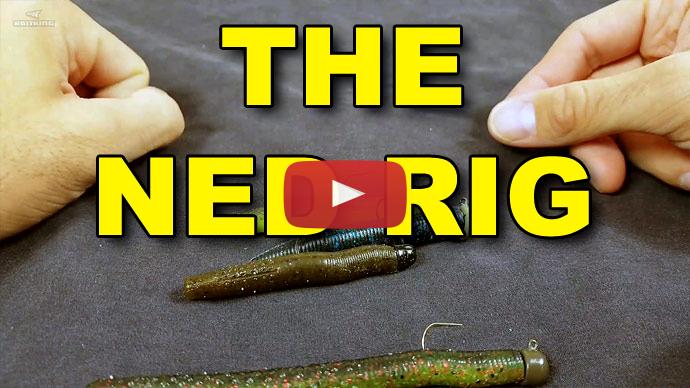
All right, let's talk about the Ned rig, more importantly advanced tactics and techniques about it because you know you guys need to understand something.
The Ned rig is not new. It actually was originated from the Midwest. Midwest anglers were using these little tiny mushroom head jig heads and there are rigging 4 inch ringworms on them and they were using back in the 70s and 80s.
Catching fish in tough conditions, cold front conditions, situations where there's high pressure. And they've been doing it for decades, ever since it was until recently that it really hit the national stage.
You know, Z man made a big deal out of it and made it seem as though they're the ones that came out with it, but they're not. They were just piggybacking on this thing that Midwest anglers have been doing for a long time.
So I just want to give a nod to the Midwest anglers. Thank you. Thank you guys for coming up with the Ned rig, you know, and and Ned Kahle all who's the one who, you know, came up with it. Those are the guys who designed it.
But since then, since that hit the national stage. There's been a plethora of stuff that's come out. All the manufacturers have come out now with their own jig heads and their own baits and so on and so forth. So their options are really expanded since it first came out. Plus new techniques and stuff are coming out. So I wanted to talk to you about that stuff.
So let's talk about the jig heads first.
The jig heads, now there's a bunch of different styles out there that are, I think in my opinion, better than the ones that Zman are offering.
You know the Zman, you know they’re really light great and they have that thin wire hook. Designed specifically for finesse rigging, but. That thin wire hook is, you know, it can be improved upon and so there's other jig heads now that have longer and stronger hooks, which means you can expands how many different type of baits you can use.
They can also they have different weights and different styles.
So you could use like a there's a couple different styles out there that do a better job of standing up the bait, for example, and standing up the bait. And you can get those in a couple different manufacturers make them, but they're designed.
It's almost like a shaky. But you can. It's designed to stand up and. That does a better job because sometimes, you know, my experimentations with the original Z Man is that it falls over on its side, but and that's because of the jig head really more than the bait.
So you can use different jig heads to get to stand up better. I'll talk about some other techniques in a second to to get it to do that.
But the other styles of jig heads, there's some that are more weedless and designed more designed to come to rocks a little bit easier so you don't get hung up as much.
I like to use the jig heads that have a weed guard on them because typically Ned rigging has been done in open water. Without a bunch of weeds, because it's an open exposed hook.
Now you've got a bunch out there that have got weed guards on them and you can put those in the weeds.
Here's the here's the thing that I like to do. I like to use round ball jigs, just your regular round ball jigs, not even a special Ned rig, and that works really good, especially around rip rap rocks and things like that where you typically can get hung up and get stuck and lose your lure.
The round ball head jigs with the eyelette on the top, those come through rocks a lot better. And if you do get stuck, it's a little bit easier to get out, but you can get the weedless version.
And this is what I like to do. A little quick tip here.
I'll take a 1/16th to a one ounce jig head with a weed guard on it. A round ball jig head and I'll throw that in the weeds.
The goal here is not to get it to go in the weeds. You want it to kind of sit on top of the weeds, kind of settle on the surface of it. And then give it a quick pop with your Rod and just pop it out and let it settle back down.
A lot of times that quick pop. Is what elicits a strike. It looks like a bait fish that's come scurrying around has been flushed out of the weeds and those bass that are out there patrolling the weed edges and around the weeds, that's what they're looking for.
And out pops this bait fish and bammo, they smack it.
So that's a quick way to to get a limit really. So check out your different jig heads and expand your horizons.
And Speaking of that, you know, yeah, there's the elaztic baits from Z man, but Strike King makes elaztic baits as well.
And one of the things you can do is get their elaztic bait, stick bait kind of, you know, Senko basically and now you can cut it to length, whatever size you want. You know, with the three inch you can do that, 4 inch, you can do that whatever. But now you can get different lengths and you can even go with the full 5 or 6 inch with those bigger jigheads with a with a longer shank hook and it's elaztic and it'll stand up and this gives a different view, a different profile, different thickness, puts out different amount of vibration in the water than your traditional stubby ned head, or ned rig, so try that.
And you know, Strike King makes a bunch of elastic baits. Who says that you have to stick with something that looks like a little nub?
Think about it, you can do a variety of different baits out there plus not just not just Strike King, but any other bait manufacturer out there. So for example, Zoom Fluke, get that Zoom Fluke junior, the small one and rig that on a ned jig and now it looks like a bait fish thats nose down foraging on the bottom of the lake, not paying attention to predators around it looks very vulnerable. And that's an easy snack for bass.
So try that with one of those jig heads that stands up. And you'd be surprised a lot of guys aren't doing that.
And you can pick so many different colors in that Zoom fluke, it's insane. But just pick like a shad color or perch white, just straight up white, Peal white works really well. You don't need to go hog wild with different colors.
You can also do crawdads. The Yum Craw. The Yum crawdad, it's it's a little small. Hollow body craw rig that on one of these jig heads in the jig heads that stand up. You know, it can stand up and look like a fighting craw, but as a little tip to you guys, it's hollow in the middle.
So slit it open with a little exacto knife and put like a little Corky in there from Yakima Baits, like a size 10 or size 14. Or you can put a, you know, piece of Styrofoam or some kind of foam in there to get it to float.
Now it'll really stand up for certain and it looks like a craw that's in the defensive position. That's perfect. That's what the bass want. They want it in that position so they can golf it so. It really becomes an easy meal, just a quick little trick.
And those again come in a lot of different colors. Whatever crawdads, you know, color you want to pick, go for it. And that's a great way to, you know, amp up your Ned rig.
What about tubes? Sure, you can do a 3 1/2 inch tube. Standard one works good. You can get it to stand up. Looks like a little bait fish or a craw imitation.
Again, I like the small. Get a little bit smaller here. Use it. 2 1/2 inch tube. Something that looks a little bit different. And again, you can put that little Corky or you put a Styrofoam piece in there.
And here's here's the thing. If you rig it so it goes through the hook, so otherwise it'll come out of the tube and float up, rig it through the hook. And. Get it towards the back.
You know the opening of the tube every time you make a cast. Now, before you make a cast, blow out all the water and shake it out so there's no more water in that tube. Then throw it out there.
What happens is it hits the bottom. The air bubble and the Styrofoam in there helps it stand upright. The bass has followed it down the bottom. It'll go and they'll look at it and look at it and look at it.
Now you just give it a little twitch and an air bubble will pop out of it. That is candy to them.
The bass, they can't resist it. That little something, you know they’re looking for something, you know, some special ones have been caught a lot might be a little reticent to kick bite something that doesn't look natural.
Most artificial baits don't have bubbles that come out of them. So think about it.
You get a little bit of that bubble, they'll come out of it when they make that little movement and that looks real enough to them that they're going to commit.
So that can work really well when the situation is, you know, the the bite is off. They got lockjaw, they don't feel like biting. That could be the ticket of getting more bites.
One more tip I want to give you on it is use straight fluorocarbon line, 6 LB fluorocarbon line in most cases.
Why? Several reasons, several reasons.
I know a lot of you guys like to use braid to leader and I'm going to use a fluorocarbon leader and that will do what Glenn said. No.
Here's the deal. When the bite is really tough, braid is very sensitive and you can feel those light bites, but that also means the bass can feel you too.
And as soon as they feel that, they're going to spit it out before you have a chance to set the hook.
Because you're moving the line very, very slowly and methodically and you're not going to be quick to set that hook set so straight.
Fluorocarbon, a little bit less sensitivity, but also more importantly has that bit of stretch in it.
So when a bass picks it up, they're less apartment to feel you.
And if you're using 6 LB line, even better because that kind of syncs with the bait. It's limber, it's limp, it has a lot less resistance.
The bass is less likely to feel anything unnatural when they bite it, giving you more time to set the hook plus that.
Light line, light fluorocarbon line gives the debate a better presentation. It looks more natural and you're not. It's not inhibited by, say, braid or by monofilament or something else that may be a little more buoyant.
That really light 6 LB line gets you more bites. I'm convinced of it.
I once I switched over to 6 LB line, I was, I was using fluorocarbon. I used 10 LB fluorocarbon. I got bit, I used 8 LB. I got more bites, went to 6 LB. I even got more bites.
So I'm convinced 6 LB fluorocarbon lines to take it. Especially with these finesse type presentations, you're going to get a lot more bites with that and with everything else I just told you.
Hope that helps.
For more tips and tricks like this, visit bassresource.com.