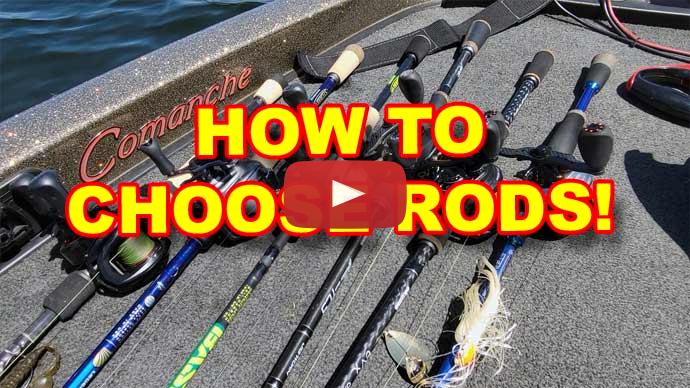


In this video, Glenn May breaks down every component of a fishing rod in simple, practical terms so you can choose the perfect rod for your lures, techniques, and fishing conditions. You’ll learn the difference between rod power vs rod action, how graphite compares to carbon fiber and fiberglass, how to decode lure-weight and line-weight ratings, and how guides, reel seats, and handle materials affect performance.
If you’ve ever wondered which rod to buy for crankbaits, jigs, topwaters, finesse presentations, or heavy cover techniques — this is your complete guide.
Using the right rod for the conditions and the lures that you're fishing is really tied directly to your success. The problem is how to find the right rod. I mean, it is a dizzying array of rods out there and it gets really confusing as to how to choose the right one. So I'm going to kind of break down the components of a rod to help you understand what the manufacturers are trying to trying to tell you to help inform you to make the right decisions for the specific type. Rod that you're looking for so let's talk about rod power first.
The power of the rod is really indicating the weight of the lure or the weight of the line that it can handle it's not the weight of the fish it's just you know how heavy you have a lure or light of a lure and same thing with the line.
And the manufacturers break it down to three main categories there's light power and that's for really light lures like pan fish type stuff and trout and that sort of thing. Then there's the medium or sometimes called moderate power rods. That is a much broader range of lures that it can use, you know, crankbait, spinner baits, worms, that sort of thing. It's it's kind of your all around all-purpose range of rod power. And then the third category is heavy power. That's for things like flipping and pitching jigs and a thick cover, throwing big swim baits or large crank baits.
Now to make things a little bit more confusing is there's hybrids. There's kind of combinations of them. For example, medium-heavy power rods, those for bass fishing covers the widest range of lures that you can throw from top waters to crank baits to spinner baits to jigs. That's really like the Jack of all trades. Most of my rods are medium heavy power, just to give you an example. Not all of them, but most of them are.
You've also got heavy, some are called heavy-heavy or extra heavy power rods. That's when you're really throwing like big swim baits, you know, 3 oz swim baits, for example, 5 oz 6 ounce swim baits. Or you're throwing in super heavy cover, thick weeded weeds, matted vegetation, sunken brush piles, something you need a lot of power using 50 pounds 60 LB braid. Those type of things, you know, for those extreme situations, that's where you're using those heavy power, heavy-heavy power, or extra heavy power rods.
Let's talk a little bit about action. Action is more about the flex of the rod and how far down from the tip to the rod handle that it flexes. And that affects casting primarily distance and accuracy, depending again, on the lures that you're using. And they break it down into three main categories as well.
There’s slow. A slow action rod basically bends from the tip all the way down to the rod handle. And that's used for really light lures, something that we typically don't even use in bass fishing. The next one would be your moderate or medium action rod tip and that's used for basically baits that have light hooks or treble hooks in them, like crankbaits. They have a pretty good amount of flex in them. And then your last one would be fast action and that's where the rod tip flexes about the last couple of eyelets on the rod tip.
And just like power ratings, there's some hybrids of those. So for example, an extra fast rod tip, that's where it bends just at the end of the rod. And those are best for heavy lures when you're fishing vegetation, brush piles, things like that where it's got a lot more hook setting power, you're not casting very far so you don't need a lot of rod tip for long distances, whereas fast action has a lot more rod tip. It's basically the most accurate of rod tips in terms of. Bass fishing so when you fishing crankbaits or spinner baits, usually a fast action rod is what you want. If you've got a crankbait that's got really small treble hooks or lighter lure, then maybe a little bit slower rod, maybe a moderate action.
One of the ways to test to see how much of a bend it has is to put the rod tip on the ground. Gently push down on, you'll see how much of a bend it has. The more flex it has, the better it's going to have at throwing lighter lures for example. Don't wiggle it up and down and try to see how much it wiggles. Like that's not an accurate way of figuring out how much flex it has.
Now what material the rod manufacturers use to make a rod has a big impact on its performance. Most bass rods are made with graphite. That's like the Jack of all trades, and it's used for a variety of different applications. You know, they have different ways of manufacturing the graphite and how many wraps they use and etc. So there are some differences in manufacturing. Don't get me wrong. Really what it amounts to is how much you're willing to pay. The more expensive a graphite rod is, the better it is, typically. It just kind of you get what you pay for when it comes to graphite rods.
Another type of material is carbon fiber that's really expensive, but that's stronger and more sensitive and more lightweight than graphite. So that's, you know, a way to go if you've got the budget for it, that can make an excellent rod. It is a little more brittle, but something to keep in mind.
Another material is fiberglass, fiberglass and all fiberglass rod. You don't see that too much in bass fishing, but it has a limberness and give that a lot of crankbait fishermen like. It just can throw that lure out there and it keeps the fish pinned when he's fighting. That rod has lots of give and flexibility. You give up a lot of the sensitivity because of it and it's a heavier rod.
As with I mentioned the other components, there’s hybrids, right? There's a lot of graphite. Carbon fiber blends, there's a lot of that out there and they're less expensive than the all carbon fiber. The cost a little bit more than the all graphite, but it's a good combination. It kind of gets that sweet spot of power and sensitivity and longevity, durability and can fit in your budget. So those are ones that really look for. There's also. Graphite and fiberglass, your composite rods, sometimes they're called composite and those are great for their budget friendly. They're still sensitive, they still got the power, but you know, they also have a lot of give to them and they're forgiving. If you whack it on, you know, the side of the boat or you're hitting objects, they tend to be a little more forgiving, so. Kind of keep that in mind.
A lot of rod manufacturers help by printing on the side of the rod blank. You know the lure ranges of the weights, you know the line weights that it can use, and sometimes even your technique, specific rods and reels. That helps because if you use too heavy of a lure, for example on a rod that's a lighter power, you're not going to get the casting distance or the accuracy out of it that you normally would. And the same thing if you use too light of a lure or too light of line with a heavy power rod, you're not going to get that lure out there. You're not going to be able to get that casting accuracy. And if you use too light to line with a heavy power rod. Is quickly going to overpower that line and you risk breaking that line.
Everything needs to work in concert together. So the right weight line, the white right weight lure paired with the right power rod and the action of the rod is going to give you the maximum performance for that specific lure or technique that you're trying to do. So don't try to go outside of the ranges that are listed on the side of the rod. That's really going to be a good way of guiding you to using it for what you want to use it for.
But it goes beyond that. Let's talk a little bit about other components. For example, the line guides. That's one that a lot of people don't talk about. Sure, they're made of a zirconium and titanium and, you know, other types of material. It's debatable which is better. Some are, you know. Some are better than others, but the key thing here is really a couple things to look at is the guide seat, you know, is it using 1 foot or two foot? Typically the one foot ones are the ones that are a little more sensitive and you typically see that on spinning reels and spinning rods, excuse me, because they are designed for lighter applications, lighter lures. We need higher sensitivity.
The ones that have double foot seats, those are for rods that are more powerful and you typically see that on the lower section of the rod closer to the reel handle. That's where you get a lot of strength. And then sometimes at the end of the rod, sometimes it goes to single or it'll stay double all the way up, double foot all the way on up. It just depends on the power of the rod. But that's a clear indication of what that rod is designed for. Is it more for a strength and power or is it for light line and sensitivities by looking at that. Also there's besides the standard line guide.
There's mini guides. Many guides and micro guides, those are used to lighten up the weight of the rod and also for increased sensitivity. Mini guides are a step between micro guides and standard guides. Mini guides are super super small and with people using a lot of leaders. They just don't go through many micro guides very well, but mini guides they will, and mini guides, The key thing about them, besides being a little bit lighter, is that the distance between the guide and the rod and that guide seat is smaller, and so it does give you a little bit more sensitivity than a standard guide. Plus the line doesn't move around as much inside the guide, so it gives you a little bit more of an edge in terms of accuracy. It's debatable how much, but some people swear by them. I like them. I like because of the sensitivity and the light. A little bit lighter. I just like them. It's a personal preference to be honest with you.
And then let's talk a little bit about the reel seats. First of all, the components of the reel seats you've got, most of them are graphite in varying degrees of graphite. Some of them almost feel like plastic to you. You'd swear that they're plastic even though they're they are graphite are some of them they call even carbon fiber, but they feel like plastic. You get what you pay for with these. What you want is a single, reel seat, not a split. The split ones tend to warp they tend to crack, they tend to separate and they're not very durable. I like a single reel seat and I like carbon fiber seats if I can afford it They're very expensive, but they're super lightweight they're very strong and they're very sensitive.
The key thing with any of these is that you want them to have a little hole underneath them where you've got an exposed rod blank so your fingers can touch the rod blank and you get that sensitivity that's that's the main thing you use that pretty much in all forms of bass fishing, so being able to have that direct connection really helps detect those bites.
Then you've got the reel handle. Split grip is the most common where you've got a blank of the rod between the reel seat and then right at the bottom, and those work great for most fishing situations. That lightens up the the rod a lot. It gives you increased sensitivity. So most people go with split grip, but there's also the full grip all the way down. It's all one material and those work great for that two handed casting, like crankbait fishing for example. And where bass are going to, they're going to attack the lure and you're going to feel that strike. You don't need ultra sensitivity in that case, you'll know the fish hit it. So a two handed casting or something like that. That full length handle works great for that kind of thing.
And then finally the handle material. There's basically three types of handle material. Cork has been around forever and that's still prevalent and predominant in every type of rod manufacturer out there makes cork handles. They're lightweight, they're relatively inexpensive, they're pretty durable. They can get real dirty over time and get grungy. And a lot of people don't like that. It looks, yes, aesthetically it looks bad, but you can take an SOS pad or you know, a steel wool pad with some soap and water and scrub, scrub that down and it can look brand new again. It doesn't take much effort to make it look brand new. If that bothers you.
There's also the foam handles and those are, you know, typically they're black. They look sleek. They're a little bit lighter weight than cork, and they've offer really good grip, especially when it's wet out. They're really nice. The problem with them is they're not quite as durable. You tend to get little nicks and chunks of foam that come out of them over time. It's aesthetics. Again, it's not a big deal.
As far as cork versus foam. Yeah, you know, there's advocates on both sides of it. Pick, you choose which one you like.
But there's one other one which is it's not as prevalent, but it's a grip that's like on golf grips and that's Winn. Winn grips tend to dominate that area and it's kind of a rubberized kind of grip and that works really well you'd expect. When everything's wet and it's rainy or you get your hands wet from fishing and it's got its advantages and it gives you that extra grip like you would expect from a golf club, you'd get that same sort of advantage in a rod. So you know, it's again a personal preference. Some feel them more sensitive, some people don't. It's something you'd have to try to see which ones you like, but those are the different things to pay attention to when you're looking for a rod that suits your needs. And hopefully I've taken you through enough of it to give you an educated guess at best when you're looking for the rods that you want.
Hope that helps. More tips and tricks like this, visit bassresource.com.