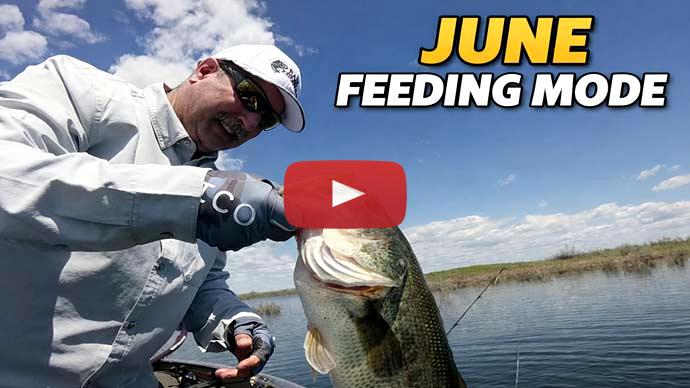
Catching Smallmouth in June can sometimes be a little dicey. I mean, they've just finished up the spawn and it seems like, poof, they're gone. Where do they go? How do I find them and get back on them again? Well, that's what we're talking about today.
So the thing about finding Smallmouth is you need to know where they were spawning and where they're going to be for summer and then map that out, map that transition zone that that trail they're going to take between those two destinations. I call it a bus route.
First of all, they're going to look something like, you know, a weed edge, a ledge, a channel, something that they can follow a route on their way out to the deeper water. And they're going to find little bus stops along the way.
OK, this could be a secondary point or a main lake point, brush pile, rock piles, humps, ledges, clumps of weeds, things like, you know, they're not going to just go from shallow to deep, boom and they're there. It takes a while, this is a multi week process and they'll they'll find these little areas along the way and they'll stay there for a while before they move to the next bus stop.
And the thing about that also is that not all bass spawn at the same time. A lot of people think they all spawn the same weekend, but no they usually spawn over the course of a month or so and they. The first wave will start using those bus stops and then when they move, the next wave will do it and the next wave so they replenish.
So you can have a spot that works really well be a hot spot that you can catch a lot of fish on for several weeks and then eventually it dries up because the fish have been moving out deeper and deeper.
This whole process begins when that water temperature is around 70 to 75 for. Most of your northern states, that's usually in in June. It usually begins in June and ends in early July.
So that's kind of what you want to look for is, you know, check your water temperature, make sure they're done spawning. They feed up a little bit after spawning. There's like a little week or two period where they still stay shallow and then they start moving so that, you know, they spawn around 63° water temp and you get it to about that 70 to 75. You can bet they're they're on their way out.
So fishing these little bus stops is a great way to find and catch them.
Now what's important to note is that not all the small mouth go deep. Some of them stick around their homebodies, so some of them will stay shallow for the entire summer.
If there's bait fish around, like the bluegill in the shad are spawning right after the the, the bass spawn. So there's there's forage there if they're not going to leave the forage. But if that forage sticks around for the rest of the summer, well, there's going to be a percentage of the bass that stay shallow all throughout the summer.
And along the way as they go deeper and deeper, if there's food, abundant food and abundant cover, there's going to be bass that stay there. So it kind of filters on out and then you get this remainder of the population that ends up deep and they set up around humps, ledges, drop-offs, main Creek or main river channels, steep drops or Bluffs, main points.
Some of them they like tapering points, others they like sharp points. It depends if there's other cover on it, like rocks, stumps, weeds, that sort of thing. So they kind of get scattered a bit, but those are, you know, of all the bass, they're pretty easy to find because you find the structure and you find that cover.
You can usually use your depth Finder, look around. If you see any bait fish activity, then you know the bass are around.
The other kind of bass are a little bit more difficult and these are the ones that don't set up on that cover. They actually chase the forage around for the whole summer. They follow it around and so sometimes they can be way out there. Out in the lake somewhere, sometimes miles offshore.
Chasing, you know, schools of bait fish and we've only become recently aware of that with the advent of FFS, you know, forward facing sonar, people are beginning to realize there's, you know, a lot of bats that are just out in the open chasing bait fish. And and they didn't really know it was as a as prolific as as it is.
But those are harder to find because they're nomadic. They're moving around. They literally they're here one, you know, this hour of the day and two hours later they've moved. You know, it can be difficult to stay on top of them.
So that's why I target the ones that are on structure because I can find the structure and stay on top of that. And sometimes those, those pieces of cover will replenish, catch a few bass off of them and then you move on to the next one and you catch a few bass off that and you move on to the next one.
And you know, you know, a few hours have gone by. Go back to the beginning and it's replenished and there's more bass there.
Now catching them, how do we catch them? Well.
Smallmouth and finesse tactics kind of go hand in hand. Tubes are excellent mates to use throughout the throughout the year, but especially in June in this transition period tubes because they mimic bait fish.
So that's, you know, you can make them all different kind of colors and they work for, you know, as long as you match your forage, you're in like Flint.
So if you're in clear water, you want natural colors, the browns, the green hues, the, the clear with salt, pepper or the smoke with salt and pepper colors. You know, the green pumpkins, those work really, really well.
If you get some dingy water, then you want to throw, you know, take some worm dye and put a little bit of chartreuse on the end of it to mimic that bait fish, that bluegill look.
But you put those on a on a split shot rig or on a drop shot rig and you don't have to fish it necessarily slow. A lot of people think finesse tactic is painfully slow because it's a really good tactic to use when it's slow and then you do fish slow.
But this time of year you can fish it pretty fast and catch a lot of fish.
So bringing all the tube bait along the bottom really fast or putting it on a jig and dragging along the bottom, give it a little hops and skips as you go along. Can you cover a lot of water that way?
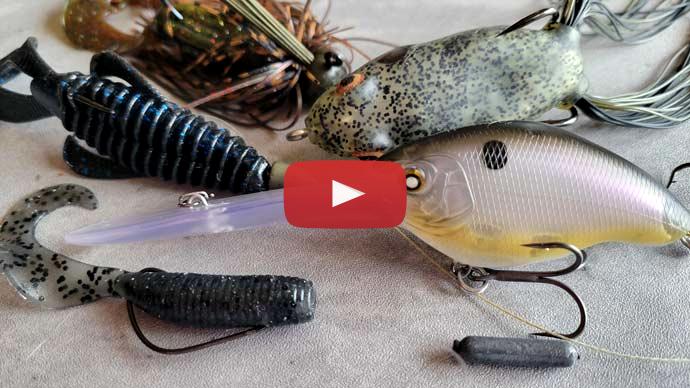
Putting a football jig with a twin tail grub, or a hula grub, or a spider grub. Some people call them. Excellent bait to use man. Sometimes that is all they want and you can't get them off of it.
This is the diet that they want and all fish of all different sizes on this, you know, 3 inch hula grub.
I like to throw the Yamamoto 176 color which is a cinnamon and black flake smoke with salt and pepper in it. I like my 2 mainstay colors I use everywhere in the United States and catch a ton of fish on it.
So excellent. Excellent baits to use and then anything.
One on a drop shot or split shot, say for example a 4 inch or five inch straight tail worm can work really really well like a. You know, Aaron's Magic Roboworm, for example, works really well.
Or the, you know, Missile Baits makes a Magic worm very similar and they go up to 6 inches and you can put them on a drop shot or split shot or even a Carolina rig and drag it around this, you know, structure and different kinds of cover.
I've mentioned earlier, rig them weightless or weedless, and you can catch a ton of fish.
Senko’s work really well too, by the way, Don't discount that, especially those fish that remain shallow throughout the year.
They stay shallow, they're feeding on bait fish. Throwing out there a four inch Senko. A lot of people throw the five inch.
I get a lot of luck this time of year in June with a smaller Senko, a 4 inch Senko rig it. I just rigged Texas rig weightless works great for me.
Some people like the rig and wacky style, but for smallies I find that they're in the weeds, they're chasing the bait fish. So I I Texas rig it and get that bait in the weeds and that way you can get through the weeds without getting hung up.
The key with fish in the small bays and the finesse baits is the tackle and the rigs that you're using, the line that you're using to get the most natural action out of them.
So when you're fishing those two baits and you're fishing the the hula grubs and the finesse worms, I'm always still on spinning gear. I'm medium, medium action, medium power, fast action rod, 7 foot.
And I'm using light line guys. I use 6 LB fluorocarbon lines, straight line, no braid leader or anything like that.
And the reason for that is lots of reasons for that. First of all, braid is buoyant and fluorocarbon sinks. And when you want that bait to act as natural as possible, it's usually falling through the water column really slowly or it's dancing around the bottom slowly.
If you got a buoyant line pulling and tugging on it, it looks unnatural. It the bait just looks way more natural and normal. If you're using fluorocarbon line, there's a huge difference in my opinion.
So I use fluorocarbon straight up 6.
Now 6 lbs seems awfully light and it is took me a long time to get used to that. I started with eight actually with 10 LB and when I got confident with that I moved to 8 and then finally 6 when I realized, you know, you don't get.
Of the Knicks and scuffs and issues with line is you would think with 6 LB line. I've got some pretty hefty fish on 6 LB line, believe it or not.
So it's pretty durable and actually it's more durable in rocks than braid. It's more abrasion resistant, believe it or not.
So I use 6 LB line. I like to use Seaguar Tatsu line for this purpose. It's really light limber or the R18, which is really super limber limp. That's from Japan.
That's a really nice line. And I use that for these finesse tactics gives that. Made just a lively natural action.
And I'm using thin wire hooks, really thin wire hooks like the Gamakatsu hooks. I like to use those because they're super, super sharp.
Thin wire doesn't take a lot of effort to set the hook. So you've got this rod that's pretty limber. You've got fluorocarbon, which has some stretch to it and you want that once you hook that fish, that rod is going to give when the when the fish surges, the lines going to give a little bit of stretch to it.
So it's not going to put all the pressure on that hook. And with that thin wire hook, it's really easy to set the hook.
You don't have to reel down and, you know, nail them like you're, you know. You know, pulling fish out of weeds, you know, it's just a, it's a light hook set and you just kind of reel into it, just kind of lean into it and they're set.
.
And then the rest of the rig just works in concert. You got a reel on there with a really good light drag on it, solid drag.
Set it light so it peels off easily and boom, you can catch those fish and you catch a lot more of them using that setup than you would with heavier line and with braid.
Trust me on this one. I've been doing this for a long time.
So that's how you find the fish in June, and that's how you catch them.
Hope that helps. For more tips and tricks like this, visit bassresource.com.