Hey, guys. Michael Neal here with Bass Resource. You know, springtime is a great time to be fishing. That's everybody's most favorite time. Everybody's kind of been pinned up in the house a little bit all winter. And I wanna go over some different ways to fish soft, plastic jerk baits in the springtime. And when we say springtime, we're talking about pre-spawn, when that water's somewhere in the mid-40s, starting to creep up, all the way up into that little bit over 70 range. And you know, they're coming out of the winter modes.
And winter modes are where they're out, typically a lot deeper in places. You know, you may have ice up north, or you may just have those super frigid winters where you had a lot of shad kills and things like that, but they're all bait related all winter long. And they're not gonna eat a whole lot. They're not gonna move a whole lot. Wherever the bait is is where the bass are gonna be. And early spring is no different. When the bait starts transitioning up shallow, that's when the bass are gonna be migrating with them.
And so to me, that early time of year, the early pre-spawn, that's when I'm going to be looking for the big balls of bait. And I wanna be going with the jig head minnow presentation. And really the best reason for that is there's no better imitation for a bait fish, really, any time of year than a soft plastic jerk bait, no matter how you rig it. And the jig head minnow, way to rig it is just some sort of little lead head anywhere...this can range from an 1/8 to even up to 3/4 ounce, depending on how deep the fish are and the bait are in your area.
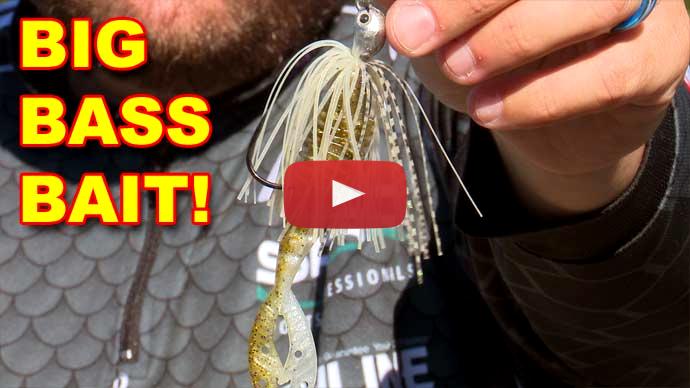
This is a 3/16. I typically have two rigged up, 3/16 and a 3/8, and just kind of go between till I figure out which set of the water column the bass are in. But this is the Big Bite Swimmer Head and a 3/16 with a Gamakatsu hook. And I like a light wire hook. When the bass are, you know, really lethargic like that in the cold water. They're not gonna be super aggressive. They're not gonna be hitting baits super hard. I like a light wire hook where you can just lean into them, it doesn't take much to hook them.
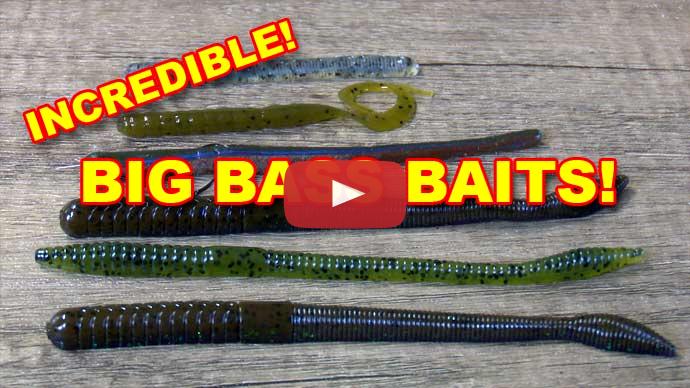
And this is just a Scentsation Slim Minnow, the 4 inch from Big Bite. And this is just a peal. Now, color is gonna vary depending on where you're at, what kind of bait fish you've got, if you've got herring, shad, if they're thread fins, gizzards, whatever they may be, but some sort of shad pattern is what you wanna stick with. You wanna mimic the size, and the profile, and the color, of those bait fish as well as you can. Typically when the water is cold, you don't wanna really big bait. You know, we've seen a lot of big fluke style or soft plastic jerk baits come around in the last little bit that have been up to 6, 7 inches. I like somewhere in that 3.5, no bigger than a 4.5. But a 4 is kind of a sweet spot for me, and that's just why I pick it.
And with line choice, I typically go with 12-pound shooter as the leader line. I'm always a braid to leader guy. I don't like wasting money spilling up a whole reel of just fluorocarbon. Number one, it's got a lot of memory, and it's just not nearly as cost efficient. If you put straight fluoro on your reels, you're gonna have to change it more often because of the line twist, because of the memory. You can put one spool of braid on and it can literally last you two or three seasons. You buy one spool of fluorocarbon to use as a leader, it can last you a whole year.
One real big key with this jig head minnow set up, though, is the loop knot. And, you know, I've always been kind of skeptical of it, and it's to me, just honestly, not as strong as anything that's connected directly to your hook eye. And that's one reason why I go up to the 12-pound test. When you go to the 12, it kind of offsets that. You're still using light tackle. You're using spinning tackle, so you're not gonna be putting a whole lot of pressure on those fish, especially with this light wire hook. But the loop knot increases your action.
So when you're twitching your bait, you're gonna have a rolling action that gets created with this loop knot. And the slack in the loop is what's going to allow that if you've got your knot tied directly to the hook, you're not going to be able to get near the action. It's gonna have to have something different on the bait to create the action.
Now as far as the rod goes, I also believe this is a really big deal. I was a guy with spinning rods, even that I liked a seven plus foot rod. I was throwing this technique on a seven and a half foot. Started paying attention to a lot of the trends that are going on, and I noticed a lot of guys using a lot shorter rods and a lot flimsier rods. And basically, this is almost what I would call a souped-up crappie setup. It's very limber. When you set the hook, it's going to bend all the way to this first guide right here. It's a Denali Lithium Pro, 6' 10", medium light. It's just labeled they're finesse rod.
And like I said, when I first picked it up. I wasn't real sure about it. I didn't think I would like it, but when I put my bait in the water and just testing it right beside the boat, you could tell instantly that the soft tip gives the bait enough slack, combined with the loop knot, to where you get a lot more action. As far as the braid goes, I just like a 10-pound. SX-1 is kind of my go to standard for any spinning reels. I like a 3000, this is the Denali Fission. The 3000s are gonna allow you to carry a little bit more line. They're gonna take up more line on a retrieve, and they're gonna cast further.
The more times your line has to come off of the spool, the less distance you're gonna get out of a cast. So when you're looking for those fish out there chasing bait fish, and you can even do this on the bank too, just around points and things like that. It's not only a live scope technique, but you wanna be able to make long cast, because that time of year when their fish are lethargic, they're going to chase the bait for a pretty good waste. So it's got to be really realistic, have really natural action. But you wanna make long casts where those fish have time to track the bait and make up their mind whether they wanna bite it or not.
After that big pre-spawn stage, you know, they're going to the bank, they're gonna start thinking about spawning. And the first, you know, the most popular bait for that is a soft plastic stick bait. But fishing a lot in Florida, you see a lot of guys throwing a soft plastic jerk bait, doing the same exact thing as you would a soft plastic stick bait. And I've really translated this out of Florida into a lot of different areas, and I think it just gives the fish a little bit different look. You know, a lot of fish anymore are super pressured all year round. And anything you can do to be just a little bit different than the guy you're going down the bank right behind, that's going to be a big deal.
So I've got this just on a Texas rig with a peg sinker. That's the thing about this, is you wanna peg it because you're going to use a light weight. You want it to fall real slow. You can do it weightless. I like an eighth, just speeds up the process a little bit, helps you get some more casting distance, some more casting accuracy, and increase that fall rate just a little bit. I won't go over an eighth, though, because, again, you do want this to fall slowly. It's gonna be a little bit more of a spiraling bait versus a shimmying bait, and it's just kind of a do nothing, dead stick, just like a soft plastic stick bait. It's just a lot different profile. I like this.
This is the Big Bite 5-inch jerk bait, and it's Tilapia Magic. You know, there's been a lot of tournaments won on the Fighting Frog in this Tilapia Magic color. It's just a green pumpkin base with purple and blue big flake and a little bit of gold flake in it, and it's just a bluegill imitator. And when these fish are thinking about spawning, or they are spawning, they're really defensive of their nests. And it's just a bait that looks like those bluegill that they're coming around, and it's super weedless.
So I like a 4/0 Gamakatsu hybrid worm hook, and the bend on it is what makes it a hybrid. It's just a cross between a round bend and an EWG. So its tournament grade wire doesn't have a super big barb on it. And I like that about the G-finesse series. It doesn't take a whole lot to hook one. If you've got a hook that has a super huge barb, you think, "Man, that's great. If I hook that fish, he's gonna be really hard to come off. That barb's really gonna hold him." Yes, that's true, but it's really hard to get that barb driven home. So this tournament grade wire is a lot slicker, little bit smaller barb. And when you're fishing around those spawning fish, they're really finicky. They're not always gonna get the bait great, but that's just my go to hook and a four aut for these jerk baits. And it's just a thing, you can fish, really, anywhere. There's no wrong place to fish this, just like a wacky worm, just like a soft plastic stick bait, whether it's skipping docks, whether it's fishing, you know, lay downs, brush piles. Grass flats is a really big thing.
A lot of people throw this offshore in Florida, just around those grass places, a lot of fish spawn in grass off the bank, a little bit deeper than you can see if your lake or river has grass in it, and not all bass spawn up where you can see them. So make sure you fish some of this stuff that's a little bit heavier, like this, you can fish a little bit faster than a soft plastic stick bait a little bit further off the bank. When you're doing that, you're fishing some unpressured fish, the ones that haven't seen 100 other baits that day, and you're giving them a little bit different profile on top of it.
After the spawn, after the bass spawn, is when you really start getting in to your bait fish spawns. And that's really the most classic way for a soft plastic jerk bait to be fished is, you know, just weightless on a single hook and just twitched, just like a jerk bait, just like you would a hard-bodied jerk bait. You know, there's been a lot of tournaments won on herring lakes on this and it's very overlooked, just in general, a lot of times it's just a bite getting thing. Like I said at the beginning, this is the most realistic profile you can get. You know, swim baits are great, but if you really pay attention to a shad, swim baits have a lot of kick to them, a lot of action.
When you look at a shad in the water, he's darting away from a bass, or he just has a very, very natural do-nothing swimming motion. You can't hardly even tell his tail is moving. So this is just gonna mimic the bait fish that is running from a bass, again, just totally weightless in the springtime, when you're fishing around those bait fish spawns, whether it's herring or shad. I like the same hook that I had on the Texas-rigged one. This is the Gamakatsu G-finesse. I go up to a 5/0 when I'm doing this. I want a little bit extra weight so I can make up the difference for not having a tungsten weight on it to get those long casts.
And for line, I like Sunline Shooters, 16 pound, just kind of my go to. It's where I have the confidence to where I like the small line as I can get away with to make as long a cast as possible, but I want as heavy a line as I can get away with at the same time to make sure I've got that knot strength. It's just that this is just a feeding bite. And you know, you can fish it slower, you can get it down deeper a little bit, or you can just work it up on the surface. And the rod I like, I've kind of went back and forth on this over the years, like with a hard body jerk bait, with a treble hook jerk bait, I like a short rod, because you're always twitching your bait down.
And if you've got too long of a rod, you're gonna be smacking the water. But you also have to make sure, with the hard body jerk bait that when you jerk it, you've got enough room, enough reflex to give it slack so the bait will work in the correct way. But with these soft plastic jerk baits, you don't have to have that. So I go with a little bit longer rod. I like a 7' 4" medium heavy. Again, it's a single hook. So you don't want anything super flimsy. You don't wanna broomstick either, because you want to be able to cast it accurately. You want a rod that's got some tip. This is just the same rod that I throw, you know, Carolina rigs, big worms, things like that, or even like a light, light flipping stick. But you wanna be able to have a rod that can take up that slack when they bite.
This is a bait that is not super easy to get the fish hooked, especially if you can't see it. And if you can see it, it's not that bad. If you're twitching it upwards and making it skip up and out of the water, you can watch those fish bite it. But if you're twitching it down and kind of letting it get in that two-foot depth, somewhere like that, or if the water where you're fishing is not super clear, and the fish bites it when you go to twitch it, you need to feel that resistance and be able to have enough length for a rod to be able to go ahead and set the hook all in one motion. If you've got a short rod, you're just not gonna be able to do that.
But, you know, the soft plastic jerk bait, like I said, is super versatile. You want a high speed reel for doing any of these just because of being able to take up the slack, whether it's the Texas rigged one or just the weightless one. This is the Denali Novus Elite, and a 7:1 gear ratio, kind of in between. Six to me is too slow. Eight to me, a lot of times you're moving your bait further than you actually realize with your reel, not letting your rod take care of the action.
So great places for this, the herring spawn or a shad spawn, rocky banks, anything that is gonna be shaded a little bit longer. You wanna look for those banks that are on the east side or more on the north side of the lake, to where you're not gonna have the sun beating down on it straight off the bat. Docks are another great place. You can put that on a spinning rod, even sometimes skip it underneath dock floats and things get that herring spawn or shad spawn bite going, but there's some good baits, some good ways to fish, some soft plastic jerk baits in the springtime, anywhere from that 40 to 70 degree water. Make sure you check that out and more tips from bassresource.com.