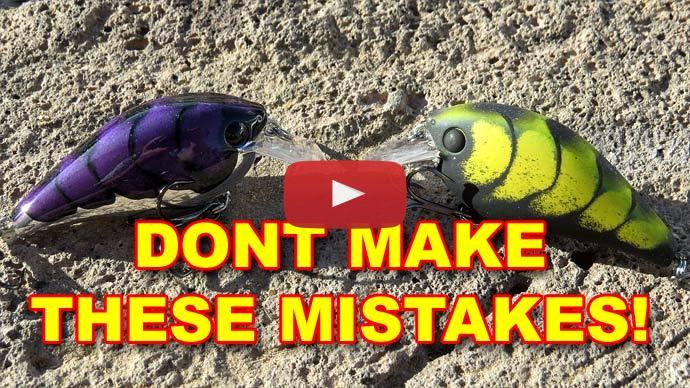
Hey, everybody, Mike McClelland here with BassResource today. And, I mean, we're getting ready to talk about something that is probably one of my favorite ways to catch a bass in the springtime, and that's springtime cranking. And, I mean, it's not a secret. I mean, I'm sitting here, and as you can see, laying here in front of me, I've got three full boxes of SPRO RkCrawlers.
I do have some other crankbaits that I'm gonna mix in in the spring, depending on what part of the country I'm fishing. But generally, if I'm fishing lakes across the country that have hard bottom, that have rock, sand, gravel, they have creek channels, ditches, you know, changes in, I guess you would say, topography, a SPRO RkCrawler is gonna be my number one go-to crankbait for my springtime cranking.
I mean, really, to me, I'm going to keep my springtime cranking pretty dadgum simple. And when I say that, I mean, you may look at this and think it looks pretty difficult. But, I mean, I can pretty well catch fish anywhere I go that are feeding on bream, that are feeding on crawfish, and really that are probably feeding on shad on this group of crankbaits I've got laying right here. I mean, I mix in a shad-colored rock crawler occasionally. When I start catching fish that are puking up shad, it's like, "Okay, maybe I need to be throwing a shad color."
But the thing about springtime cranking, and when I talk springtime cranking, I'm talking about when you get that turn, the days start getting longer. Mother Nature's starting to put a lot more warm days out than cold days. The water temperatures are warming on somewhat of a regular basis. I mean, that's when I'm gonna really rely on this group of baits right here.
Generally, my first go-to springtime crankbait is gonna be an RK 55 or an RK 50. And the reason these two baits come into play for me is simply for the fact of the depth zones that I can reach with these baits. And I'm not just talking lakes in the Ozarks and the Midwest. I mean, I'm talking about any lakes across, you know, the Midwest, the South, the Southeast. I mean, lakes in Texas. Lakes in California.
I mean, I've got buddies in California that constantly are sending me pictures of springtime catches on a RkCrawler, an RK 55, RK 50 that are getting it done, basically, border to border. I'm not gonna say coast to coast because... Well, I'm not gonna say border to border. Coast to coast, yes. Border to border, maybe not because there's really not the same style lakes up North as there is in the Midwest, the South, the West. So these are gonna be the two baits that I depend on. And the reason for it, like I said, is gonna be the depth range. I mean, the DD 50 is a bait that I can reach, you know, depths of about 8 to 12 or 14 feet on the right line and the right rod and reel combination.
Generally, the DD 50, I'm gonna throw on 8 and 10-pound Sunline Crank FC. It's gonna be a bait that, you know, I'm fishing at a variety of speeds but, generally, early in the spring, I'm gonna be fishing this bait relatively slow. I'm gonna be winding it with a 5 to 1 gear ratio reel, and generally, 8 to 10-pound line on that DD 50.
When I start talking about the RK 55, the original SPRO RkCrawler, that's generally when I'm going to up it a little bit. I mean, I'm generally gonna be throwing 10 or 12-pound Sunline FC Crank. And the reason for that is is the bait naturally will go a little bit dipper, I mean, this RK 55. I mean, I'm talking about a bait right here that I can truly get down to about 15 or 16 foot on the right line. So, to me, that is really important to keep that combination going.
And when I started talking colors, I mean, you can look in these boxes and see that I have got colors of all varieties, bream colors. I mean, I really believe that you've gotta stay focused on what the fish are primarily feeding on. In my opinion, on our Midwestern lakes, the lakes in the Ozarks, a lot of those fish in the spring are generally feeding on crawfish, just simply for the fact that the bream are usually a lot deeper than we're able to get that particular style of crankbait that time of the year. So those fish that are up there are generally feeding on crawfish. Sometimes they're feeding on shad if the water's warm enough that the bait starts pushing up a little bit. But that's really what I'm focusing on is primarily crawfish-colored baits.
When I talk about my rod and reel setup, I mean, the big thing to me is I wanna use a rod that is gonna feel about the same across the board. So I'm gonna use a Falcon 4-17 Cranker. And the thing that's great about Falcon is they build a rod in everybody's price range. I mean, they've got four different series of rods that are all built in that 4-17 medium action that you can throw a RkCrawler or any of these style crankbaits on.
I'm also gonna throw generally early in the spring before the water temperature starts getting up there closer to 50, I'm always gonna be throwing a 5 to 1 gear ratio Bass Pro Shop Pro Qualifier Reel because I feel like we as anglers tend to fish too fast in the spring. We're excited to get out there. The water temperatures are warming. We're ready to get after it. And I think when we try to team this bait with a higher speed reel, a 6 to 1, 7 to 1, 8 to 1, we don't fish slow enough to be truly effective. So that's the reason I force myself to throw that 5 to 1 gear ratio so I can make myself slow down.
It's generally always, like I said, a medium action rod because you want that rod to give to those fish when they eat that bait. I mean, when you look at that rod, it's got a good, soft tip. So it's gonna give to those fish when they eat that bait. And anytime you're throwing baits with treble hooks, you want a rod that the fish can inhale that bait and you're not pulling that bait away from it. So that's the reason rod and reels are so important.
As the water temperatures warm up and you get into that later portion of spring, you know, where it's getting up into the 50s, that's when I am gonna increase the speed because the fish get a little bit more aggressive. They get a little bit harder to control when you hook 'em. So I'm gonna go to a 6 to 1 Signature Series Bass Pro Shop Reel. My lines really aren't gonna change.
The only reason I generally ever go up in line size is if I'm trying to keep this bait shallower. And when I say that, you know, people are like, "Well, why would line size have anything to do with that?" The bigger the diameter your line is, the more drag it's gonna have when you're cranking it down through the water column. So heavier line is not gonna allow this bait to go as deep. So if I wanna keep that bait up say, you know, 10 foot or less, I might go to 14 or 16-pound Sunline Crank. And that's a way you can kind of adjust the depth range of your bait.
Or you can do it with the size of bait. Like I said, the DD 50 isn't gonna go quite as deep as the original RK 55. So it's one of those situations you could do it one of two ways. And a lot of that depends on what the size of the forage is the fish are feeding on. In my opinion, that RK 55, day in and day out, is a great size to throw. But when I get to catching those prespawn bass that are spitting up those little bitty crawfish, that's when I think about that little 50 because that's a key time that those fish are telling you they want smaller profile baits. And that's when that little 50 can really get it done.
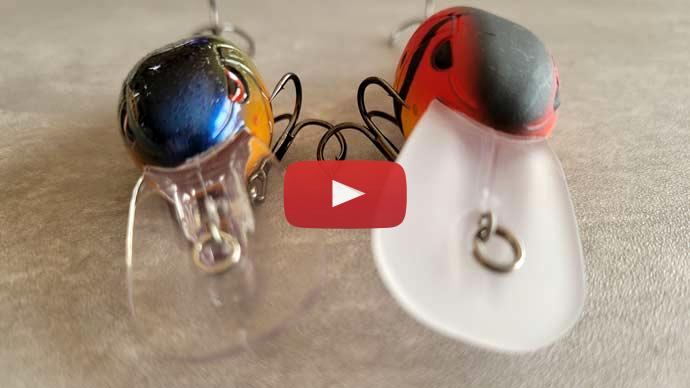
As the water temperature warms a little bit more, and the fish even get shallower, that's when a bait like this little, just the original RK 50 is gonna come into play for me. This is that bait, it's a smaller profile bait, but it'll only dive about 4 to 8 foot deep. The build angle on it is just slightly different. It's got a little different wide-wobbling action. And that is a bait if I wanna fish in that 4 to 8-foot zone that I'm probably gonna rely on a little bit more.
Now, when we start talking about lakes... Well, let's back up just a hair. I've kinda talked about the bait and the lakes that I'm looking at, you know, the fact that I'm wanting lakes that have channel bends and transition areas. And that's probably one of the biggest things to fish in a crankbait that I think a lot of people overlook. I see so many people go in a cove, and they just put the trolling motor down on one point and they fish all the way around the cove. Even if they catch a fish or two, they don't really focus on why they caught that fish.
And to me, there's two or three things that really, really contribute to that. And generally, it is transition areas. And when I talk about transition areas, it's not always, you know, a depth change. It's not always, you know, something real dramatic. It can be something as simple as a rock change. You know, you go from a ledge bank to a broken-up type rocky bank. You go from broken-up rock to gravel. Those are the kind of transitions that I really start paying attention to.
And you'll figure out you can pattern these fish that you're catching on baits like this where you don't have to go in and fish the whole creek. You go in and strictly focus on those key transitions. Sometimes it is the creek bend transitions where that creek channel swings up close to a point and then swings across the creek. Those transition areas where that creek channel switches sides can be really, really key places to catching 'em that time of the year.
The other thing that you really wanna focus on is the type of lake that you're fishing. When I get into that situation in the spring and the water temperature's really warming up but you're still ahead of the spawn, I mean, the fish aren't ready to spawn yet, another little bait that I like to throw in the spring is a little SPRO Speed Demon. It's a bait that will only run, you know, maybe 3 to 5 foot deep. It's a bait that has a rattle built into it. It's similar in action because it's kind of a wide-wobbling bait.
So it's one of those baits that if you wanna fish shallower than what you're able to fish with a RkCrawler and you're wanting a bait that, you know, has a little bit more noise, the Speed Demon is a bait that I'm definitely going to lean to. It's the same deal though, I'm still fishing those transition areas. Laydowns, boat docks, things like that can really come into play with a bait like that.
The last thing that I will have to say is a RkCrawler may not fit all springtime applications. Sometimes a flat-sided bait, and especially in lakes that fish really, really feed heavily on shad. And I don't know what it is about the lakes in the Southeast that have a lot of clay, but it seems like a flat-side style bait sometimes can be a real key. And that's the reason I always carry a good selection of the Little John. Not just the original Little John, but the Little John MD.
I mean, I've got two baits here that I can fish in depths of the Little John, you know, 2 to 5 foot deep. The Little John MD, 5 to 7 foot deep. And these are baits that I'm going to throw on lakes where the fish maybe are a little more tendencies are to feed on flat-sided baits. It's got less action. It's a little bit more subtle in the water. And that's really kind of my springtime cranking tactics. I don't feel like I gotta have 15 different styles of crankbaits. I really feel like I can get pretty much everything I wanna do cranking in the spring done with this selection right here.