Carolina rig in the summertime, definitely probably the Primo time to throw a Carolina rig. Absolutely love it. It is great for covering deep structure. Mid range structure, hard bottoms and finding. Those fish and finding that hard structure Carolina rig great great great way to do that I want to walk you through my setup kind of what I throw why I throw what I throw and then we'll get into some of the areas to throw it and and actually how to retrieve that Carolina rig because it is just a ball and chain that you're throwing out and dragging in but. There's more to it than that for sure.
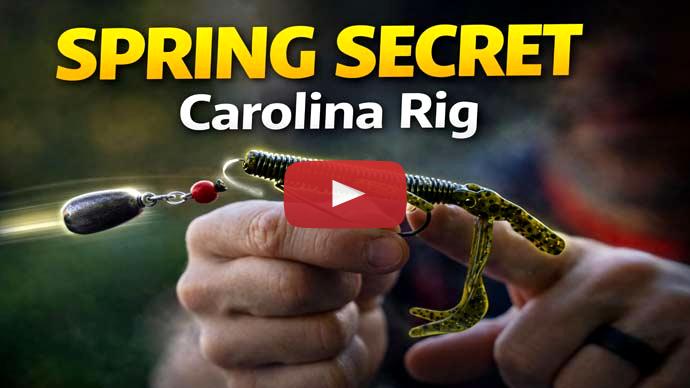
For those of you that don't know, Carolina rig is is it there's a weight. And a swivel. And then a leader to a hook with a bait on it, so your weight and hook are separated. This is going to be dragging along the bottom and all of a sudden, ol Mr. Snack is going to come right behind it.
But the weight I'm going to probably start with in the summertime, half oz weight. I'll go up to a three quarter quite a bit. I'll even go up to a 1 oz if I'm fishing a little bit deeper and I've got that hard bottom without a lot of cover on it. Tennessee River ledges, things like that. Don't be afraid to throw at least an ounce or more on that.
So my main line is going to be a 20 LB Sunline Shooter. That Shooter is very abrasion resistant, doesn't have a lot of stretch in it. That's what I want with my Carolina rig set up, 20lb. On my main line, almost exclusively 14 LB leader is, is what I'm going to be throwing with that same same line, that same Shooter, but you want to have a good fluorocarbon with a little bit not much stretch, very little stretch and and very high abrasion resistance. That's kind of the combination of what you're looking for.
But on my on my setup, whether it's 1/2 ounce or more weight, I'm going to have one of these plastic or glass beads on there and then I'm going to have a knot protector. So you. Because you're going to have these crashing down and banging through all that bottom and I want to be able to protect my knot so my knot doesn't break off. So I'm going to have that little, that little clacker, that little, the little knot protector right there.
They don't have a SPRO Power Swivel. That's, that's typically what I have is that SPRO Power Swivel. You don't need a tiny one. Just go ahead and get a decent sized one. And then you're going to have that leader down to a Gamakatsu offset Shank, round bend, worm hook. That is the hook I've caught, you know, hundreds, probably thousands of fish on mostly on a Carolina rig. That design is absolutely perfect for a Carolina rig and and the way it works, you can use an extra wide gap caught plenty of fish using the extra wide gap hook as well. But that's what I'm going to be using.
And then my number one bait on a Carolina rig is a Missile Baits Baby D Stroyer. I have caught smallmouth, largemouth, spotted bass, and lots and lots and lots of them. I've caught large. Up to 8 lbs on a Carolina rig with this bait. I've caught smallmouth over 5 lbs, a pretty good number of them over 5 lbs on this, and I've caught some 4-plus-pound spotted bass. So big fish bait, especially in that summertime is something about those, those two little twin tails. You just barely move this bait underwater and you're going to see those little tails kicking it. It just it's too, too much for them. They can't stand it.
Green pumpkin is a really good place to start. Green Pumpkin Flash is my number one color, hands down in the summertime. Something about that little, that little silver flake. It's got kind of a gold tone to it when it's in the green pumpkin. But Green Pumpkin Flash, definitely my #1 super bugs, also really good color. But you can you can kind of experiment a little bit with the colors. Green Pumpkin Flash is just a good default to start with.
Tell me to be taking this setup looking for those hard bottoms. I'm going to start with points. And ledges, any place that I think that those summertime bass are going to be sitting, that's where I'm going to be throwing my Carolina rig. My setup is going to be a 7 foot, 3 inch medium heavy. Fast taper, not extra fast, but a fast, almost a moderate fast, but it's definitely a fast taper. You don't want to overpower it. You want to be having more of a loading up action with that rod because you, you're going to have that bait and, and everything so far away.
When you reel down and set the hook, you're, you're really not going to be setting the hook. You just want to be able to put as much pressure on those fish as possible. So when they, when they, you know, shake their head, you can really pop that hook into them so you want to be able to have maximum pressure on them when they start to come up or when they start shaking their head and then you want a high speed reel I've just I've really kind of settled in with this GSC model from Seviin 8.1 to one.
It makes really really long cast and then that eight to one gear ratio you can reel up slack really quickly that's one of the things I love about that that reel and about any kind of high speed reel low speed reels you're just not as efficient you're not going to. Be able to reel up all of your slack as quickly and get it back out to where the next spot is.
So when I when I pull up to a deeper area with that Carolina rig I'm going to. No, essentially where I want to throw, whether I'm using forward facing sonar or not. There are times when those fish are so tight to the bottom that you're not going to see them on forward. And the smallmouth are really bad about this. They'll be so tight to the bottom that you, you, you will not see them on forward facing sonar. So whether you have it or not doesn't matter.
When I get to that ledge, I might scan with my forward and, and be able to see kind of where that ledge is, where that drop off is, or if I'm just fishing. I want to find it. The best way to find it is to throw that Carolina rig and drag it in. Feel the bottom, move it a little to the right or left, drag it again. And then you're just going to kind of fan cast in that area until you find where those little sweet spots are or where the hard bottom is, or where the structure is, or where the stumps are or where the brush piles are.
You could feel all of that because you got that heavier weight. And you've got that fluorocarbon and that fluorocarbon is. So much denser than mono.
I remember years and years ago when I first started fishing fluorocarbon on a Carolina rig, it was like, it was like I had a whole completely different setup. It just by changing the line and how dense that line is, it transmits those, all the bottom, everything that you're feeling down there, you can transmit it so much better because that line is just denser.
That's just the properties of fluorocarbon and you're going to take that, that Carolina rig, you kind of. And cast around in those areas and then you can feel where the structure is. And if you get bit, is it worth? Typically we're talking about off the bank, you know, not close to the bank. So it's, it's hard to have references even with GPS, even with all this kind of stuff.
You get bit in one area, you remember, oh, that tall tree. You know that that fish came from where that tall tree is. If you can keep your boat stationary or relatively stationary, then you're going to be making that same cast trying to hit that same piece of structure to see if there's more fish down there. So that's one of the tips or the tricks, if you will, with that Carolina rig.
Carolina rig is is just caught me so many fish whenever I go up north fishing for smallmouth. It's one of those things I keep handy and whenever people think about fishing for smallmouth, they default to a a tube or a drop shot or something like that. Now the jig head minnow has really gotten popular, I'm telling you folks. That Carolina rig still absolutely smashed. Them especially if you have some current, anytime you have a little bit of current or if the wind blows and you having a hard time pinpointing those fish with those little finesse techniques, take that Carolina rig.
And fish in those same areas that you'd been fishing or you think that you need to be fishing with those finesse techniques. Take that Carolina rig this the smallmouth absolutely love, love that Carolina rig. A little bit of wind, a little overcast, something like that makes the Carolina rig better up in those kind of conditions.
But when you're down at, you know, fishing for largemouth and even spotted bass, you can you can absolutely catch them very, very good with. With the sunny skies, without having the heavy wind, all that kind of stuff, especially if there's a little bit of a little bit of of of a stain in the water.
But in the summertime, you typically want a longer leader. A three foot is kind of my standard. In the summertime, you can go a little bit longer, but if you get around current. You don't want to go too long. I'd say 2 to 3 feet in current is a better way to do it. For for whatever reason, this fish seem to come off that longer leader. You're going to hang it up way more in current that that leader is going to cause your bait to wrap around things in the bottom if you've got some some weird currents down there. So just just remember I told you that.
And then the other little trick is in some. Some areas you might have. One big. You know, heavier weight, three quarter oz or one ounce, let's say if you get around real heavy cover and you you're having problems breaking off, you don't need to do that. You don't need to do that because you can take 2 weights, 2 smaller weights, put them on there if you're in real heavy cover areas and you will, because the weight is dissipated between the two weights, you will not hang up almost at all.
You'll barely, barely, barely hang up at all. And you'll be able to fish through some really heavy gnarly. Stuff that everybody else will be breaking off on if you divide up those weights and instead of a single one ounce weight, you might throw 2 half oz weights. Those weights will be coming through cover way, way better.
So just remember that when you're out there dragging your Carolina rig and typically, you know, just walking you through a single cast, making a big long cast, letting that bait settle to the bottom reel up all of my slack and then I'm going to be I'm going to drag somewhat closer to the to the. Surface of the water with my right tip until I feel some cover.
And once I feel a little bit of cover, I'm going to raise my rod tip and, and, and then drag that weight over that piece of rock or, you know, stump or brush pot, whatever it is. Then I'm going to then I'm going to put my rod tip back down so I can feel every Little Rock, every little Pebble that that comes through.
Just remember you have to drag this way until you feel something. Then you put your rod up and then you can kind of shake and pull to get that weight to come over. A lot of cover, get the feel of that Carolina rig. You'll catch a ton of fish. You'll find where the cover is. You'll catch fish that other people are not catching because you can take that Carolina rig and I've caught fish out of 40 and 50 feet of water with the Carolina rig.
You can fish it super deep, especially if you go up in your weight a little bit. You don't have to downsize your line. You can still take, you know, 14 LB line and however bigger fish you want to, you want a boat flip with 14 LB line, you can absolutely do it.
So Carolina. Big in the summertime equals a lot of fish. Small fish, big fish, all fish, all species of fish can be very good. Helps you find those hard bottoms that you need to catch bass in that time of year. Carolina rig. Put it in your summer arsenal, you know what's going to happen.