All right, plastic worms, ribbon, tail, straight tail, whatever, there's a whole bunch out there and they catch fish, but how do you use them?
Well, let's dive into it real quick here.
First of all, there's a lot of different ways to rig them right? Drop shot, Neko rig, weightless, Texas rig, Carolina, I mean there's a whole bunch, but let's get down to the two that really catch them a lot. The most popular ones, starting with the Texas rig.
Texas rig is very simple bait. It's been around since the 70s guys and fish still. Still bite it and you can fish it in all kinds of cover. Why? Because it's weedless.
So how do you rig it?
Well, first of all, what you do is you take a bobber stopper and put that on the line 1st and I'll tell you what that does in a second, but you want to have that on the line first. Then you put on your bullet sinker.
A three eighth ounce tungsten bullet sinker works for most. Worms 1/4 ounce can work as well because you know, worms don't have a lot of appendages and they’re not very thick so they don't have a lot of resistance as they fall in the water. You really don't want to go much heavier than that unless. Yeah, you're fishing really deep or you've got a lot of wind and it's difficult to maintain contact to feel that bait while it's on the bottom.
Then you maybe go up a little bit heavier, maybe up to 1/2 ounce, but typically 1/4 ounce to 3/8 is perfect for that. Then tie on your hook.
Now the hook I like to use 3/0 extra wide gap hooks because the hook is easier to keep from getting snagged. And I'll show you why in a minute here.
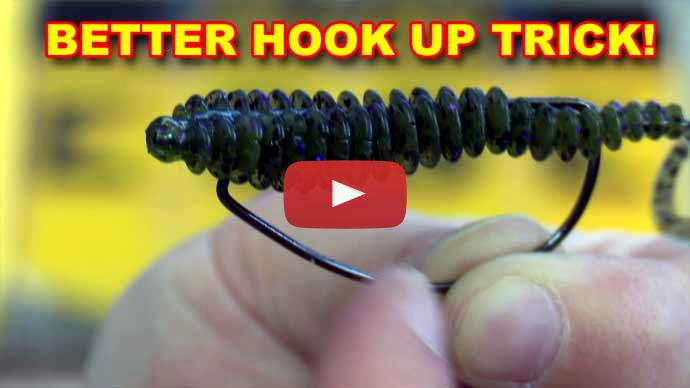
So what you do is you rig the bait, you just take the the hook tip right all the way up to where it starts to bend. And bury that right straight, center, right down the middle of the worm.
Then you turn it and curve it out down the bottom of the worm. Pull the hook all the way through and just before you get to the line tie, flip that hook 180° all the way over.
Now what you want to do is line up that hook to the bait and see where, you know, just make it so that the hook would be laying flat on the top if it were in the hook in the worm and you want to see at the bottom where does that hook enter the worm. That's the point you want to pay attention to.
Now you know where that is. Take the worm, bend it 90° and put that hook straight through all the way right where it's supposed to go through where you mark that straight all the way through. Then straighten the worm out.
Now the hook is flat to the surface of the worm. You're almost there. Top that off. Take the hook tip and bury it. Just skin hook in the top of the worm just like so.
Now it's not going to get hung up on anything. And that's what makes this worm so so good 'cause you can throw it just about anything. We're not done yet.
One of the things you want to do is take that bobber stopper and bring it all the way down to the to the weight and peg it. We'll talk about that in a minute, but that's going to hold that weight in place.
Last thing to do is if your hook doesn't have a keeper, a little keeper barb right there by the eye of the hook. What I do is I take a piece of monofilament. It's like a 30 LB piece of monofilament.
Really wiry, cheap, cheap stuff. That's what you want terrible stuff for fishing. But the thicker the wire it is, you know, it's just really. Wiry, take a piece of that and stick it through the worm and through the eye of the hook and then clip it off so it's flush.
Now it's going to hold that worm in place. It's not going to slip or anything. This is great because when you set the hook, a lot of problems people have when they set the hook is the worm slides down that hook and balls up around it, and the hook doesn't penetrate the fish's mouth.
So this prevents that from sliding down the hook. Plus it makes the worm last a little bit longer because it doesn't get tore up as much.
Now. Why do we have that bobber stopper pegged to that weight? Well. For me, the reason I do this is I want that weight. I'm using it to put that worm where I want it to be and that could be in weeds, it could be thick weeds, little pockets and holes and weeds it can be in.
You know, in lily pads it can be, you know you want a specific pinpoint spot right next to a stump or a lay down. And if you have that weight unpegged, what happens is when you cast it out there and let it sink, the weight slides down the line and it can penetrate through say, a a sunken Bush pile, the weight it'll slide through all that.
But. That worm's going to get stuck at the top and it's not going to penetrate. It's not going to be where the fish are or you throw it in the thick weeds. The weight will go down through the weeds, but the worm is going to get stuck at the top.
So you're not using the weight to get the worm where you want it to be. So that's why I use that bobber stopper to punch it right up there next to the snug to the worm. And that way I get that worm where I want it to be.
Now, where to fish it? Well, because it's weedless, you're pretty much free to throw it wherever you want to. And bass, well, they like to get deep into cover. They like to hide up under docks. They like to be right next to stumps, rocks, lay downs, stuff that you would normally get snagged on.
Well. The beauty of this rig is that that doesn't happen. Plus, this is a nice slender profile that Bass just can't ignore. Man, they love eating it.
So throw it out there and let it fall all the way to the bottom and you can tell when it hits the bottom. Watch your line carefully. The line will peel, peel will be falling, falling, and suddenly it'll just go slack on you. Now you know it's hit the bottom.
Once it hits the bottom. Reel up on the slack now. A lot has happened right at that point. A lot of times you get hit, the bass will actually bite the worm as it's falling.
And if it's falling on slackline, well, how do you tell you got bit? Well, there's a couple different ways.
One is it's all about, it's all about watching the line as the line is falling. If that line suddenly jumps, it pops, it twitches, makes a move well. You didn't do that. A fish did. So reel up that slack and set the hook.
Another way to know is once that lure hits the bottom and you have that slack and you start to reel up on it, sometimes that line is peeling off. It's swimming off to one side. Well, that's not where you cast. So a fish has it on the other end. He's swimming off with it. He's got it, man. Set the hook. Don't wait.
That's the other thing some people talk about waiting. Wait 123 or some kind of count to to set the hook. Don't. As soon as you detect that strike, set the hook.
You know another way you can you can detect that is. When you reel up, you've got that slack and you feel this thump, thump, this little tug on the end of your line. That's a fish. Pop them. Set the hook right away. Don't wait.
A lot of times you'll you'll be surprised. He's got the fish deep. He's got the hook deep in the fish's mouth. He's got that worm all the way in there. They just suck it up and they pull the whole thing in. You don't have to wait.
So does a couple things to pay attention. It's always be a line watcher because a lot of times that happens right on that fall or right when you reel up, you see, you realize something's different and that's a fish.
But let's just say it fell all the way to the bottom. You reeled up and there's no fish there. What do you do now?
Well, take your rod tip and lift it up about. 2-3 feet, not that much, maybe 3 feet at the most. 2 feet. Lift up and then let it drop back down on that semi slack line. Reel up that slack as it's falling, pay attention to that line again because here we go. Same. Rinse, lather, repeat.
That fish could possibly bite it as it's falling again. Let that worm settle down on the bottom. Let it sit for a couple seconds. Lift up one more time and let it fall back down.
If you don't get bit for me in the first two or three lifts like that, I reel back up and throw. Back out.
Some people like to work the worm all the way back to them. And you know, it's not to say you're not going to get bit because it does happen. You can work the worm almost all the way back to you and suddenly you get bit.
But from a percentage standpoint, the majority of your bites are going to happen on that first fall or that set first or second hop. And then the percentages go way down. And I work the percentages.
So couple of lifts and drops and then reel back in and fire it back out there. And you know, a little bit different spot.
So that's the Texas one. Very basic I, I use fluorocarbon line most of the time on wherever I fish. Fluorocarbon is a real universal line. I use Seaguar InvizX fluorocarbon, 15 LB line.
You can throw that virtually anywhere. It's a, you know, Swiss Army knife of lines. You don't have to think about any kind of specialty or anything like that.
The only difference is, is when I'm throwing in really thick, heavy cover, then I'll, I'll use braid. Braid is a lot better. In thick vegetation as far as it cuts the vegetation better. Better than fluorocarbon, but other than that I'm using fluorocarbon all the time. No leaders, don’t complicate things guys, just straight up fluorocarbon. You'll be good.
Now there's one other rig I want to talk about, and that's a Carolina rig.
Carolina rig has been around for ages and again, there's good reason it works man, it really does work. I many times I take people off fishing and they have never been fishing before or rarely fish and I'll I'll give them a worm with a Carolina rig. And have them drag it behind the boat and they'll catch more fish than me.
You know, it's, it's, you know, I was fishing a tournament. It was down in Texas and it was on Fort Hood. Take a soldier fishing. You got paired with a soldier. And you know, my, my luck would be that this guy had never picked up a rod before in his life, ever.
And so I rigged up a Carolina rig for him and had him drag it behind the boat. First two keepers in the well were from him. And that told me the fish were deeper than I thought they were.
I backed up and started fishing at Carolina Rig right alongside with them. And we limited out. Matter of fact, we culled, we caught a bunch of fish. We did really well in that tournament. Took 17th out of over 300 boats on a Carolina rig. OK guys, it works.
So here's the deal. First of all, let's talk about rigging. This is where I do use braid. Up to the up to the swivel. So you you you start off with braid. 30 LB to 50 LB braid works just fine.
You don't really don't need 50, but 30 is fine.
You're going to take a Carolina weight or a heavy sinker. You want like a one ounce. A three quarter oz to 1 oz sinker works best. You can go heavier if you're fishing deeper, but I find a three quarter oz to 1 oz works just fine.
Then you want to put a bead, it could be a plastic bead or a glass bead. I like glass simply because what you do next is you tie onto your swivel and that heavyweight can bang against that knot.
As you're using it, so you put that bead in there between the the knot and the weight and it acts as a cushion. Plus if it's glass, it makes a clicking noise and that clicking noise can draw fish in. So there's a little bit added attraction.
On the other side of your swivel, you want to tie a fluorocarbon line like 15 LB fluorocarbon line, a little bit lighter line. And it also has, you know, fluorocarbon is less visible in the water. I think that works best.
If you do get hung up, then your braid is stronger than your fluorocarbon line. If you need to pull and break off, you could also lose is that leader.
And speaking of the leader, you want that to be 18 to 24 inches long. That's great starting point, pretty standard.
If it's in the middle of summer and it's the fish are really active, you can shorten it up a little bit, maybe go 12 inches. And if they're not as active, you can go longer. I've been known to go as long as 5 feet long. OK, that's extreme, that's extreme.
But 2 foot to three foot is not unheard of. So you can you can get a little bit longer out of that. And then you tie your hook again. You can use a 3/0 hook. And put on your worm, you know, 7 inch worm, you know, Berkeley power worm works really good for this.
You can also put a lizard on there, a Rage Hog, you know, some kind of a Brush Hog, a little bit more of a creature bait. I think works even better with a Carolina rig than a straight worm.
But a worm can work really well, especially if you got a scattered vegetation. You can fish this over points and humps and deeper water. This is what it's designed for is deeper water.
Texas rig. You're throwing it to visible structure and cover and weed edges, whereas a Carolina rig you're fishing in deeper water, 10 to 15 foot deep. That tournament I just told you about, we're fishing a 25 foot deep. There was a deeper weed line down there and we just drug around that weed line. We're catching fish all day long so.
Again, you want to peg that plastic bait with your monofilament line, just like I showed you before, OK, works really well, holds that bait in place and you can Texas rig the same type of way.
Again, you're taking your hook and rigging it the exact same way. So the hook point is flat on the surface of the worm and you embed that hook point back into the worm. Now it's weedless. You're not going to get hung up.
Now the thing about with a Catalina rig, it's a little bit difficult to throw. Because you got this big leader on the end of it and this weight that's a pretty heavyweight up towards the, you know, away from it. So it's a lobcast.
And the key with throwing a lobcast is when you bring your rod and reel back, pause, stop for a minute. Because if you bring it back, your lines doing this and you're, it's kind of swaying everywhere.
And if you throw, it's going to be this little spin and do all kinds of weird things in the air and get tangled up. So bring it back, pause, look, look back if you have to and you'll see.
Wait till that line straightens out a little bit, then you just kind of loft it. You don't throw it hard like you would a normal cast. It's just a loft and like release the spool a little bit earlier than you normally would. That helps and it just lobs it out there.
You're not going for distance on this thing. Remember it's deep. So you lob that out there and then you peel off some line and let it sink and get it down to the bottom. Once it hits the bottom, you'll know because the line goes slack.
And it's the same sort of thing with the Texas rig. You know if the line jumps and moves and takes off on you, well, that's a fish. So make sure you set the hook. We'll talk about hook setting in a minute. It's a little bit different, but once it hits the bottom.
Reel up the slack, but don't move it yet. Because what happens is the weight hits the bottom and now you've got this 2 foot behind it and the worm is now floating weightless, so it falls real slow. until hits the bottom. This is really critical.
What happens is when you throw it out there, the worm is following the weight the same rate that the weights falling. So it's falling along and suddenly the weight hits and the worm stops and then it slows.
That change of action, change of speed oftentimes triggers a bite, but if it doesn't, that slow, enticing fall will trigger a bite.
So just wait. Wait on it and give it, you know, a count of 10/15/20 seconds. And now the worms on the bottom.
Then what you want to do is give it a drag, kind of lift up, lift up about two feet and let it drop again.
Now the weights come up, so has the worm and the weight drops and again, now the worm is slowly falling again. So pause, give it another long count. Let it let that worm do its thing.
Don't just lift, drop, lift, drop, lift, drop. You're not. That's the whole key with Carolina rig is that nice enticing weightless fall. So let it do its thing.
Give it some time to work it and a lot of times you get bit that way. The bite on is pretty prominent. A lot of times you just tug, tug. You got a fish, you know it's there.
Now to set the hook. A lot of times you've got this long line out, you're in deeper water and then you've got this weight and you've got the bait. So you've got, you know, like almost like a bow in the line, if you will visualize it that way.
When you set the hook, you lift the weight up and then you finally connect with the with the worm and the hook.
So to set the hook, don't lift up on it because really all you're going to do is lift the weight instead reel down. Get that rod tip pointing on towards the water and then sideways, sideways and reel and do it hard.
Just well, big sweeping move. You're going to move a lot more line and get a much better hook set because you get, you can now pivot your whole body and swing outwards and get a lot more line and you'll get a better hook set that way.
So it's a sweeping side hook. That's how you set the hook and then reel into them, lean into them and now you got them, OK.
And that's how you fish Carolina rig.
Those two rigs are the most prominent ways to fish a plastic worm. There's other ones like I mentioned earlier in the video, and I've got videos on those. You can go check those out and you're going to catch yourself a ton of fish using these rigs.
Hope that helps.
For more tips and tricks like this, visit bassresource.com.