

You’ll learn why fishing a crankbait slightly deeper than your target zone is critical, how speed and deflection trigger strikes, and where crankbaits shine from boats and from the bank. These simple summer-specific tips will help you catch more bass all season long.
Summertime crankbaiting. It's time, guys. It's gonna be a lot of fun this season, so here's some quick tips so you can catch more fish on crankbaits.
The key thing with these baits is you need to fish them a little bit deeper than what you're targeting. Like that's the main thing. A lot of people think it's color, but the primary 1 is that because say for example, you're fishing 8 foot of water, you want a crankbait that runs nine to 10 foot deep.
And the reason for that is you want it to ricochet off the bottom. You want to hit things, you want to aim for objects. Be it a stump or a rock, something like that, or any kind of object on the bottom, it goes down and it hits that, it does a quick hesitation stop and it bounces off of it in a different direction.
That erratic movement, that sudden change in direction often triggers a bite. That's the key to getting more bites. So fishing the baits a little bit deeper is the is the key thing.
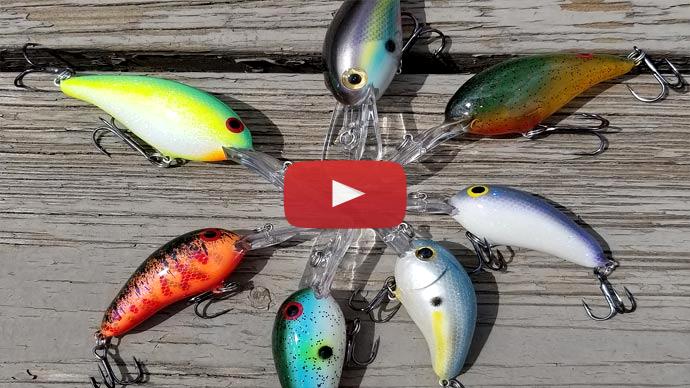
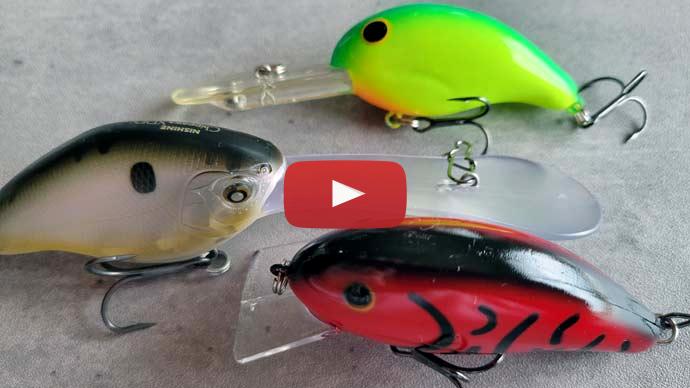
Wider wobble. That's what you want. So a bill that's it's a rounded, wider bill. It makes the bait wobble like this, the tighter. Wiggle crankbaits, those are better in the cooler months, so stay away from those. They've got the narrow, thin bill. Yeah, don't do that. The wider bill works a lot better.
As far as where to fish them, well. Anywhere that's got a point. You know, a ledge, even Bluffs can work really well during the summertime.
I like fishing a shallow bank that's near deep water. So maybe a Creek channel comes in, or maybe you've got a steep bank and then it flattens out a little bit. Then there's a steep bank next to it. Or maybe there's a point that comes right up next to a shallow area.
Like those areas, the bass can move up shallow feed and come back down relatively quickly without moving a far distance. So those are going to be hot spots to look for. And if they've got chunk rock on it or scattered stumps, patchy weeds, things like that, even better. That works really good.
You can take your crankbait, run it down there and bounce it off those objects, or even tick the top of the weeds and then RIP it out of the weeds. That sudden change of direction can work again to trigger a bite.
Sometimes what you do is you hesitate. If you can't bounce it off things, you can force that action, crank it down and then just do a pause, stop for a couple seconds and then reel again. Just that sudden stop.
A lot of times the bass are following it and you stop it. That's in their face and they have to react, they have to bite it. So that's a good way of catching them.
I fish the crankbaits relatively fast. A lot of guys like to fish them a bit slower. I fish them fast because I want that bass to easy. He has to react to it.
I'm forcing him to bite it so he doesn't have time to look at it and decide. It's like it's going by him and he either he acts now or it's gone forever. And a lot of times you get him to react that way. So moving it a bit faster works really well during the warmer months because they're super active and the water temperature temperatures are up.
If you're in a a pond, a shallow pond, or your bank fishing. A square bill crankbait that runs a foot and a half to 2 1/2 foot deep really helps you figure out like what's on the bottom, what kind of structure is there.
You can find the deeper pockets that you might want to go back and throw a Senko into or something, a plastic or a jig that you can work those deeper pockets.
But you can just walk along the bank and throw that square bill. And you can catch a lot of fish that way too. They'll be up shallow along those. Weed edges or along a dock, something like that and kind of cover and you can bounce it off of that with a square bill without fear of getting hung up, and you can catch a lot of fish that way, so don't be afraid to throw crankbaits even if you're from fishing from the shoreline.
One other thing to keep in mind is watch your weather. I know you don't get the big fronts that come through that you've seen in spring and the fall, even the winter time, but you still do get some fronts that come through.
And crankbaiting tends to be better on a falling barometer as a storm is approaching or as a front is coming in.
As that barometer drops, the fish get more active or you know, just before the storm hits can be really good.
Just make sure you get off the water because you don't want to be in a bad situ. I'm talking Thunder and lightning here. You don't want to be an outer get caught up in a, you know, a suddenly wind just boom, it's on.
You can be a bad situation from a boating standpoint, but even if you're on the shoreline, you don't want to be out there when it's lightning out, guys, it's it's very, very dangerous. You go catch fish another day.
But as the storm is approaching, maybe a day before or that day off and that barometric pressure is dropping. That can be a really good time to throw crankbaits
if it's a rising barometer. You can still try crankbaits, but just the bite typically isn't as good so.
Keep that in mind and I hope you catch a lot of fish this summer.
For more tips and tricks like this, visit bassresource.com.