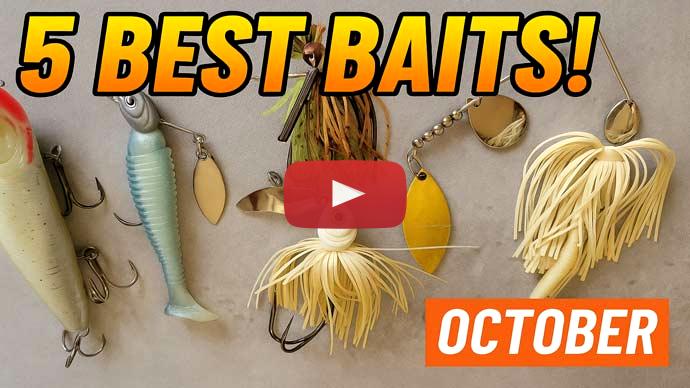
It's October and the bass are chomping, man. They are feeding, and typically this time of year you're matching the bait fish that they're feeding on, which is usually a smaller-size bait fish that hatched earlier this year. Well, that's going to catch you plenty of bass. But if you're targeting true trophy bass—which this is the time of year when you can catch a true trophy, a true giant—then you got to go big. Go big or go home. Big baits rule, and topwater… man, this is the time. This is the time you can catch a big bass on topwater lures, primarily those walking baits. A Spook or a bait like it that walks back and forth is irresistible to those large bass.
Now, before you start throwing them, there have to be three conditions that exist. One, the water temperature has to be above 50°. Number two, you need a little bit of stain to the water—or clear to stained—you don't want muddy water. This is a visual bait, so the bass have to be able to see it somewhat. And third, the bass have to be feeding on some kind of bait fish. It could be shad, perch, whatever, but they have to be feeding on bait fish because this imitates a wounded bait fish on the surface.
The Zara Spook is the bait that everybody uses. I've been using it for decades and for good reason—it really works. It catches a lot of bass, so definitely use the full-size version. Now, in addition to the Zara Spook, there are other baits worth trying because they have unique characteristics. The Megabass Giant Dog-X, for example, has realistic colors and patterns and an internal weight system that helps with the walk-the-dog action. The Lucky Craft Sammy has a flatter face that spits water, sits tail-down for easier walking, and comes in a great range of colors. There are also walking baits with a flat, concave face that add extra spitting and gurgling action, which can be effective in clear water or when you need more commotion in dingy water. The Reaction Innovations Vixen is probably the noisiest of them all, making it especially popular in southern waters where visibility is lower and more noise is needed to attract fish.
As for colors, natural patterns like frog, perch, and shad work well. White “ghost” is excellent in clear water, and translucent colors excel on bright, sunny days. Smallmouth often respond well to bright, gaudy colors—chartreuse, yellow, red, chrome—especially in the fall.
For equipment, use a rod no longer than 7 feet; I prefer a 6’10” for better control when pointing down at the water to work the lure. It should be a medium-heavy, fast-action rod, paired with 15 lb monofilament. Mono is important because braid in lighter tests can tangle on casts with big lures, and mono floats—critical for topwater presentation. Use a reel with at least a 7:1 gear ratio so you can maintain cadence and take up slack efficiently.
The technique takes practice. Walking the dog requires coordinated rod pops and reel turns, always allowing slack between pops so the bait can swing side to side. A loop knot, snap, or split ring helps give the lure freedom to move. A feathered rear treble hook adds drag and acts as a pivot point. Start slow to get the feel for the action, then vary your cadence, add pauses, and experiment with speed. Advanced anglers can even “steer” the lure around cover by varying pop strength and duration.
In terms of location, smallmouth in fall often pack up on shallow flats with scattered rock or vegetation, or they position on points and steep breaks. Largemouth are often in coves or tributary arms, about halfway to two-thirds back, near creek channels, weed lines, or isolated cover. They may also be buried in weeds on drops with mixed cover like boulders or laydowns. Walking baits over these areas can trigger trophy-class bites.
For more tips and tricks like this, visit bassresource.com.