

You’ll learn how to sort gear into logical categories, clean and reset storage areas, declutter unused tackle, and organize baits so you actually remember what you own. Whether you fish from a boat or the bank, this system saves time, reduces frustration, and keeps you focused on catching fish.
All right, if you're anything like me, you have a ton of tackle and gear related to your fishing, and it can get unruly, especially as you get through the season. Things just get disorganized no matter how well you organize it.
Typically, I organize my gear twice a year, once at the beginning of the season, then I do it again midway through just to get everything reset back to where it's supposed to be. You start to get frustrated trying to find stuff. Where did I put it? I don't know, so let me walk you through. Here's here's how I get it all organized. Whether it's the beginning of the year or it's mid season, it's the same. Process first of all.
Take everything out.
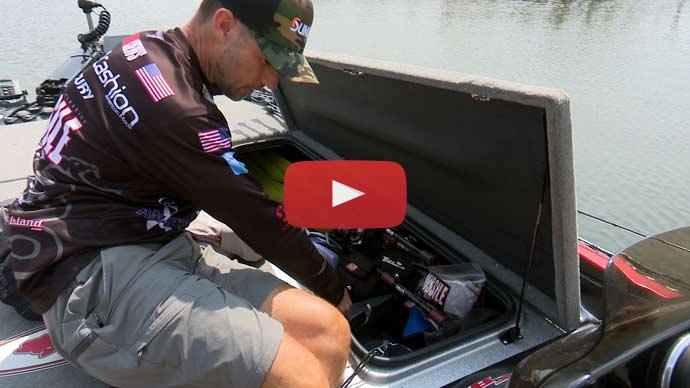
If you got a boat, take everything out of the storage compartments and lay it all out. If you're a bank angler, you may have a storage closet, maybe a bedroom of gear. You know, it could be a lot of stuff. Just take it all out.
Not out of the boxes, don't take it out of the Plano boxes, but take all the boxes and the rods and the reels and take all the with the boat. You've got your flares and your tool kit, all that stuff. Take it all out. Lay it all out.
All right, that's a lot of stuff, right? I think the first thing you might be alarmed is like, wow, I got a lot of stuff. OK, we're not organizing yet, but what we want to do is start to group in categories.
So think about it. If you've got a boat, there's stuff that's just related just to the boat. So your flares, your fire extinguisher, your emergency kit, your tool kit, you know, anchor, dock ropes, things like that, right, on and on and on.
Take all that. Group it in one pile. We're not organizing it, but that's one category.
Now take your next category and that's going to be your rods and reels. You can put all those together. Now if you got a lot of rods and reels, you may be breaking up a little bit and like bait casting and spinning, but those are all now grouped together in one other area.
Now take your tackle and this is really depends on how much tackle you have, but for the most part right now it's just a pile. Just put all your Plano boxes all together or your your bags if you got storage bags with all your plastic baits, whatever you have, all that stuff, your terminal tackle, Put that all together in a pile.
Cool, now we've got three main piles.
Now before you go any further, guess what? All your storage compartments on your boat are empty, or your storage closet is empty, or wherever you keep all your stuff, it's now empty.
This is the prime time to clean it, right? Get the vacuum cleaner out, get some cleaning supplies, and go to town. This is there's be no better time than the present to clean all that up.
I don't know about you, but I find you know old plastic baits that have torn up. I'll find pieces of line. Or things that have fallen down in the through the cracks, maybe a hook or two, whatever, you'll find things.
It's clean it all out. This is the perfect time to do it. OK, so get all that done.
Now that that's done, let's go back to these categories. We're going to start to organize them.
First of all, let's take the boating stuff. Start to look at it. You're gonna have the stuff you wanna keep. There's stuff that you've run out of or stuff that you need that you haven't got yet. And then you're going to have things that you need to toss just not using anymore.
You've brought it with you and you thought you're going to use it, but you just don't need it anymore. The exception, of course, would be a fire extinguisher emergency kit. But and you're going to write a list.
The list is going to be. You need to have want to have and. Toss. Right. Or set aside and break those things into that category. Now you've got that kind of organized and you've got you're starting your shopping list.
Do the same thing with your baits. And this is this is this is where it all gets nuanced because everybody's different. Everybody has a different amount of baits. They have a different way of how they think, so how they categorize things.
So I'll just tell you how I do it. I'm not saying mine's the right way. I'm just saying it works for me. But it might give you some ideas of how you might do it.
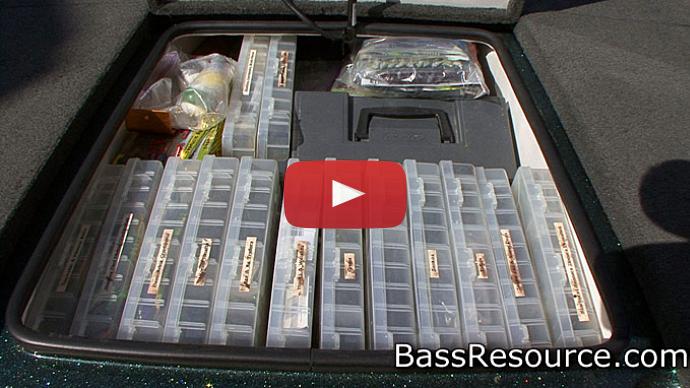
So first of all, I break up my baits by soft plastics and hard baits. And the hard baits are easiest. I have 4 Plano boxes for that.
First is top water and I exclude buzz baits out of this for a minute and I'll explain that in a second, but top water would be. And spinnerbaits, top water is anything your poppers, your Walker baits and all that prop baits, that all goes into one Plano box.
Then I have my crank baits and I break those into shallow diving, medium diving, and deep diving crankbaits. And I have a Plano box for each.
Then when it comes to my jigs, that's its own box. It's just jigs and nothing but jigs. Some of you have a ton of jigs and you might want to break that down even more. Maybe you have a box for finesse jigs. Maybe you got football jigs and another one and we, you know. Swim jigs on another however you want to do it, but mine, I have them all in one box except for the finesse jigs. Those are in a different box.
Then comes the buzz baits and spinner baits. I fish those so much I actually have a separate Plano box for that and I keep them in that.
Now if you don't have that many then maybe you can fit them into a a smaller box or a compartment or pouches. Some people use bags however you want to do it, but that's how I break it down my hard baits.
Now my soft baits. This again goes into what you have. I do a lot of finesse fishing. So instead of having a box with just finesse, I have a box that's for split shot and dropshotting and that's a lot of your small 3 inch baits, your straight tail worms, your reapers, just that that's in there.
Then I have another box of just tubes. I fish tubes a ton, so I have a different box for tube. I have a different box of all grubs. I have a different box for all hula grubs.
OK, see what I'm saying but. I know a lot of you guys like to fish Senkos, so you might have a box just for Senkos. Another box with just straight tail or ribbon tail worms. Another box that has some creature baits in it such as Rage bugs or Rage craws, brush hogs.
Maybe some take some Flukes and mix that in there with your sankos. It just depends. But the idea here is you're gripping them like baits together in each box to make it makes sense to you.
I like to put, say, for example, flukes in with my Senkos because sometimes I'm so much focused and like, oh, I'm going to throw a Senko and open up and realize, oh, that's a reminder. Actually, a fluke might work better in this situation.
I might not have thought of that if it wasn't there staring in front of me now as you do these. Look at the baits and. Look at what you again, here's the categorization.
What are you going to keep? What is it that you need to restock or need more of? And what is it that you're missing? And maybe meant to get, but you don't have or you thought you have it, you don't have.
And then what do you have that you can toss? Like a lot of us carry a lot of gear and baits that we never see the light of day.
And this is the moment, you know, this happens a lot. Whenever I do this, I'm like, Oh yeah, I put that in here. I forgot I had that. How come I haven't thrown that? Well, out of sight, out of mind. I I just haven't thrown it yet. Right.
And so maybe that's a candidate for removing, but put that down your list. Now you know what you need the same thing with your terminal tackle. Go through all that, all your hooks, your weights, all your stuff that you got in there, jig heads, make sure you got what you need, you don't have unnecessary stuff in there, and that you restock whatever that you've depleted and you have all that down now.
Now you've got that all organized and ready to go. And you can put that all back in now some guys, you know, I'm using a boat, so I put that all back in the storage compartment. So it's all organized.
If you some guys in boats don't use all Plano hard boxes, they use bags, storage bags, they to put all the maybe all their soft plastic goes in the storage bag, which is fine. That works just great.
Some people like to group things by type of fishing, all the finesse gear in one bag, all the punching and heavy matt and heavy vegetation gear, you know, that's terminal tackle and all the. The baits that you would use for that, that all goes in another bag.
I mean, there's a variety of ways to do it. I like to put all my terminal tackle in one box because then I it's all there. If I ever need to rig something that's my rigging, I just grab that box and if I need to rig a drop shot or if I need to rig something for punching, whatever, it's all in there. It's just my rigging box.
So however your brain thinks, organize it in a way that's logical to you.
Now you got the reels and the rods. Here's the thing. At least at the beginning of the year, you wanna put all new line on your rods and and clean them all out and clean.
Clean the guides, clean the reels, get it all ready to go for the season.
Midway through the season you may find there's some rods that you haven't thrown very much and so the lines they're pretty good may not need to be re strung.
On the other end of the spectrum, you may have a rod that you throw almost every time It's probably you need to restring put new new line on it. Make it it's a judgement call on your behalf.
But you know if the line if. A new line. Now is the time to do it. If it needs to be cleaned up, now's the time to do it.
And then finally, before you put everything back, all the rods back, get some rod sleeves. And the rod sleeves don't really protect your rods per SE, but they keep them from getting all tangled up.
Whether you're storing it in the closet or you're storing it in your boat, these things make a whole lot of sense. It just saves a lot of headache and a lot of tangles later.
They come in a variety of different colors, so I use the colors as a code system. I have all my spinning rods one color, my bait casting a different color.
My wife fishes move with me a lot and so she's got her own set of rods. So I have different colors for her rods and we may even get a little bit more like if you. Crankbait rod that may be a different color, you're flipping or pitching rod may be a different color.
You can get a little crazy on the colors, but then you got to remember what the color codes made. So don't get too crazy with the colors, but use the colors of those rod sleeves to again, help you organize.
Once you've done all that, now you're ready to go. You remember what you have, you know where it's at now, and you're ready to go out there and have yourself a ball.
Hope that helps, but more tips and tricks like this, visit bassresource.com.