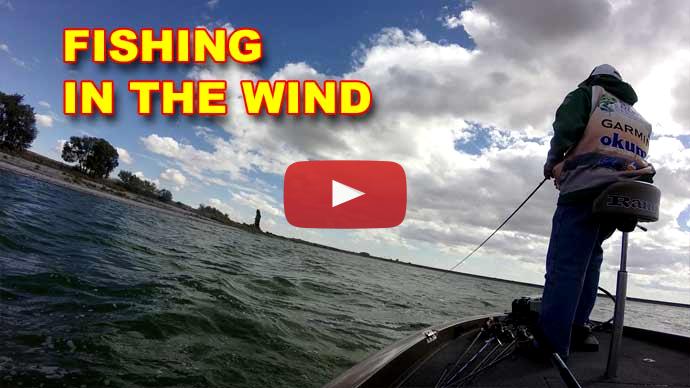
Fishing when the wind blows can be a blast. It can be really good fishing if you know how to leverage the wind to your advantage and if you know how the wind affects the fish. So let's start off with how it affects the fish.
The wind, it breaks up the surface of the water and breaks up the light penetration entering in the water. And it also stirs up sediment, stirs up the organic matter in the water, and that, in itself, can increase the fish activity. Also, by nature of breaking up the light, especially in clear water, bass tend to feel a little more secure. They roam more, and they become a little more aggressive. Their strike zone widens. So those are all positive things.
One of the things that anglers...they overemphasize or overestimate wind-driven current. There really isn't much current that's generated by wind, not as much as what some people think. For example, a steady 30-mile-an-hour wind that lasts for several days. First of all, you got to have several days of steady wind to even create any kind of current. But a 30-mile steady wind for several days creates about a half-mile-an-hour current at the surface, and that greatly diminishes the deeper you get in the water, and not by much. You only have to go five, six feet deep, and there's no current at all. It doesn't go very deep. A 15-mile-an-hour wind for several days and going in the same direction. Well, that might create about a tenth-of-a-mile-per-hour wind. Okay.
So I'm not going to say it doesn't generate a current, but it is barely there. It doesn't make a lot of impact. But what it does do is it...the wind, think of it this way. If you put a stick, a floating stick, or you put some leaves or something that floats on the surface, and it's windy, you can see it go across the surface of the water, and it looks like, hey, there's current. But it's actually the wind pushing that thing, whatever that may be. Now, apply it to what's in the water, right? Organic matter, zooplankton, living organisms, insects, algae, things like that, they can get pushed by the wind until they get to a bank and start to pile up. These are the things that baitfish feed on. And, you know, bass feed on insects too, by the way. But this attracts the baitfish, and if the baitfish are there, then it attracts the bass. So it's natural for us bass anglers to think the wind got some kind of current and pushed the baitfish on the shore. But that's not what happened. The food source got pushed by the wind, not by current, and then the baitfish are there. So kind of keep that in mind.
The other thing it does is if you have steady wind for several days, the surface layer of the water, that's the warmest layer, right, particularly in the warmer months, it can push warmer water to one side of the lake. And on the other side, it can actually be a little bit cooler because it basically pushed that surface water over. You have to think about the time of year. That could be good. Warmer water could be great, say, for example, early spring, or cooler water could be better, like in the better summer, a little bit better oxygen levels. So the leeward side might be better. So kind of think about those things and how they might affect the fish. The wind can do all those things.
Now, keep in mind, wind is just one factor into the bass fishing equation, and it is not a primary factor. Think of it this way, seasonal patterns rule everything. So winter and summer, bass typically are deeper. In spring and in fall, they're typically shallower. Wind isn't going to change that. The seasonal pattern is what's going to position the fish. Also, the trends, get it up to the day you're fishing. Say, for example, you have stable weather, and then a front comes. Now, if a front has come before your fishing and it's already passed and now you're on the backside of that front, there might be some wind associated with that, but you're still fishing bluebird post-front conditions, which is going to be tough. And the wind really isn't going to make a big difference. It's still going to be tough fishing. Conversely, if the front is approaching and you got winds in front that are being pushed by this front, typically, fishing is better before a front anyway, and the wind is going to energize that. It's going to magnify that and make it even better.
A good way to think about it is think of wind in terms of, like, gasoline. If you take gasoline and you throw it on a fire, then it accelerates the fire. It magnifies the fire. It makes it bigger. But if you throw gasoline on the sidewalk and there's no flames present, it doesn't do anything. So it's not the gas, per se, but the gas can amplify fire. So the wind can amplify already good conditions, and at the same time, it doesn't do much to improve bad conditions. So you got to think of it in that context when you're looking at wind and assessing it and how it might affect your fishery.
Now, how that might play out, for example, there's a lake that I fish in that's got a bunch of riprap, long stretch of riprap. And there are times of the year where that riprap is just nothing. You can fish it with all kinds of lures and techniques and not get a bite except for maybe some small fish. You get the wind coming in, preceding a front, and the wind blows right up on that riprap. And look out, man, it's every other cast you're catching fish. It is dynamite. It's crazy. The fish go nuts in there. So it can turn a dead spot into a really good spot. You think about it, it stirs up all that activity I told you about, but like, in riprap, you have all this organic matter that comes up against the riprap, and the crawdads will come out and eat it. And now, the crawdads are another source of forage for the bass.
Some people think, "Oh, the waves dislodge the crawdads and they fall into the water." No, no, no, no. Have you ever held a crawdad? Yeah, they got a grip, man. They got claws. And they hang on, and they've got the pinchers too. They're not going to fall off anything if they don't want to. They're not going to be dislodged. But you bring food their way, yeah, they're going to come out and eat it. And now, they're exposed, and the bass are there feeding on them. So think about that in areas where crawdads can hide, if the wind's blowing up on it, that might bring them out, and that's another food source.
Now, think about how you're going to fish the wind. Again, some guys, you know, they say, you know, cast into the wind and bring it back with the wind because of the current. Well, they're right about one thing. Casting into the wind and bringing the lure back with it is a good technique. But it's not because there's current there. Think about it this way. Again, the wind is blowing these microorganisms and zooplankton and all of this matter in one direction. Well, the bass just face it, and as it's coming their way, they can feed on it and they can feed on the baitfish that are coming up on it. So this is a constant conveyor belt coming their way from the direction the wind is blowing. So they're going to face it because that's the direction the food is coming from. They don't face it because there's a heavy current, like you would see in a river, a creek, or something like that. So it makes sense to present your lure in the direction the wind is coming from. Okay. You follow me? So it's almost a distinction, a difference, but I don't want you guys to get confused that there's some current involved here.
Lures to use. Lures, because of this condition, because it's a lot of wind, it's hard to cast into the wind, I use heavier lures and lures that don't catch the wind so much. So a spinnerbait is my number one choice. Half-ounce, three-quarter-ounce spinnerbait works really well, and I try to do sidearm casts and underarm casts. I don't want it bowing through the air. The more it's like that, you'll think about a kickoff at football in a windy weather or trying to kick it through the field goal. You can see, it just blows the football everywhere. It's the same thing. It's going to do that to your lure if you have this high trajectory. So try to keep it low to the water as best as you can, and you'll have better casts that way. And bring it back at a swift pace. Again, that wind is breaking up the surface and breaking up the light penetration. Bring it back quickly. The bass don't have a chance really to examine it, and they have to react to it, and they typically will.
Crankbaits are another option. Crankbaits work really well in the wind. I really do love fishing crankbaits in the wind. They're a little bit more unwieldy to throw in the wind. Some of them are bigger and lighter crankbaits, and they're harder to cast. But like a Rat-L-Trap, a lipless crankbait that's a half-ounce works very well in the wind. That's a great bait to throw, and you can vary the depth out at the same time and the speeds. Typically, a fast speed works well, but you can slow it down, and you can catch them that way too. Just experiment with the speeds. But those are the two main baits I would use while fishing in the wind.
And you might want to crank down a little bit on your brakes just to help you avoid backlashes. But that's critical. It's also critical that you have all your hooks very, very sharp. When you're fishing in the wind, it's a little bit more difficult to detect strikes, and a lot of times, the bass will slap at your lure. And if you have super sharp hooks, you have a better chance of catching them that way. If you're fishing from a boat, make sure it's in good condition. Your trolling motor has got to be in good shape. Your battery has got to be fully charged. Make sure you're gassing the boat and your engine cranks up good. I've seen so many guys that have ended up losing power and control, and their boat gets pushed up on the shoreline. And now, waves are crashing over it, and it's a hot mess. It's terrible. And every single one of them, to a tee, you know, "I never thought this would happen to me. This is something that happens to everybody else. I thought everything was good." Check it. Just make sure before you head out in the wind, especially strong wind, that everything is in good working order.
And regardless of whether you're fishing from a boat, a kayak, or from the shoreline, make sure all your stuff is stowed. Don't leave anything out because the wind, a good gust of wind comes along, and there it is, in the water it goes, and it's gone. A bag of plastic baits, you leave it on the deck or you leave it by your feet, boom, gust of wind, it's gone. Nets have a way of disappearing. Getting caught up by a gust of wind, nets suddenly are gone. Things like that. Just make sure everything is tied down tight, and the wind won't carry it away, and you can focus then more on fishing rather than what you just lost.
Now, how about finding a good spot to fish, or what about areas that might be too difficult to fish when it's windy or perhaps even dangerous? How do you figure that out? Because in your given area in one day, the wind blow in the same direction, if you may have several lakes in your area, you may have one lake that's better than the other when it's windy. You may have, even on a given lake, a shoreline that's better than the other shoreline. Either it's easier or better to fish or more safer. How do you figure that out? Well, there's a lot of variables in this. So what I did is I created a video that helps you determine exactly the right wind conditions for your area, for your specific circumstances, so you can find the right place to fish when it's windy out and be safe and catch a lot of fish. Try it out. It's linked up right here. Give it a go.
I hope that helps. For more tips and tricks like this, visit bassresource.com.