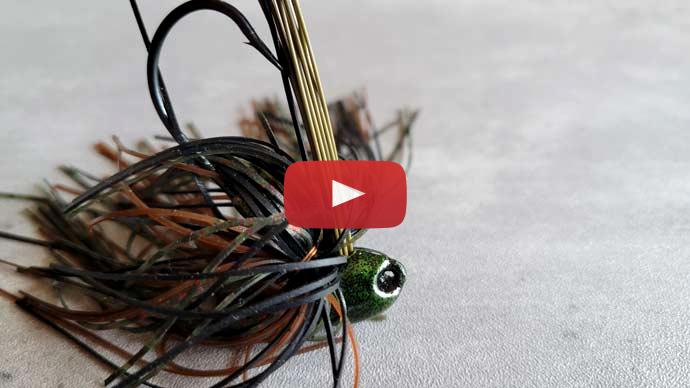
Winter fishing and football head jigs are go together like peanut butter and jelly, man. It is football season, it is a great time to fish, and for good reason, football jigs are outstanding during this time of year. But not all football jigs are the same and when you combine that with different types of skirts and different trailers, you have almost an endless combination. And some work better than others, depending on the situation they're at. So it first starts with trying to figure out which is the right combination. So let's talk about the jig head itself.
Football head jigs, by their nature, the eye is back away from the front of the weight, and it's also shaped kind of bluntly. And this enables it to fall straight down unlike other jig heads. This is really important because this time of year, you're fishing steeper bluffs, rock walls, bridge pilings, those type of things. And getting that jig to get right down the base of it right along the edge is really important. It's not going to drift and glide away like other jig heads do. So football jigs are perfect for this situation.
Also when you're dragging it on the bottom, which is what you do this time year, when you're dragging it, a football jig as it goes over little rocks and pebbles, it will rock up, rock upwards and crawl over the tops of those things. And you usually got a craw trailer on the end of it, and it looks natural. It looks like a little crawdad crawling its way through all this debris, and it is a perfect crawdad imitator. Those are the key characteristics of a football jig.
Now beyond that, let's look at the line tie. It may just seem that you just tie onto it and cast it. Well, no, there's really two different things that you need to pay attention to. One, is the line tie that is towards the back of the way of the jig, and it sticks up at a 90 degree angle. This is the kind that you want to throw in rocky areas and uneven areas because it will roll over those objects, and will bring that tail up and make it look alive. That works perfect for those areas. However, when you're in like a sandy or gravel type bottom, you're gonna want to drag it through that. And that's when the jig heads that have the 60 degree line tie come in play, and those are more towards the front of the weight of the jig head. And those drag through, it looks more like a sculpin or looks like a crawdad just making its way through that flatter area without a whole lot of action. And sometimes that's what the bass prefer. So just the line ties and where they're located changes the action and the characteristics of the bait. And the bass sometimes prefer one action over the other.
Now the skirt plays a big role on how many bites you get, depending on what the bass want. Let's start with the silicone and rubber skirts. This is the most predominant out there. They do have a lot of lifelike activity. I like the rubber ones better during the cold, cold water temps because they have a little more movement to them. You just let the jigs set in the bottom that just slowly opens up and just breathes and looks alive. And you can match the color to anything. Typically you want your browns and your greens this time of year. If it's really deep, 30 foot or deeper, I tend to go with white colors because they stand out the most. Typically all the colors are washed out at that point. It's the shades of gray when you're that deep, and so you want your jig to stand out. So I'll use white. But typically your shad colors, you know those work as well, but I like to use the Browns and the greens the most.
Hair jigs can be really good this time of year. They're very, very popular. Again, they just sit in place and breathe. You can use Marabou or any kind of hair jigs out there. There's a variety of different types that they make them out of. They're all good. It's more of a matter of personal preference. Again, your greens, your blacks, your browns, those are gonna be your basic colors that you're gonna want to have with you. And some of them have feathers in them too. And those feathers can give you a little bit of breathing and movement as well. Make that bait look alive and that's sometimes all you need, just long pauses in between when you're dragging on the bottom is key. And these different types of skirts will breathe and move and undulate while it's not moving, while it's just sitting still, it makes it look alive.
So it's really key to have the right one. Sometimes the bass prefer one or the other so you might want to have a variety with you and change it up. If you're not getting bit and you know the bass are in the area, change it up and find the right one that they want.
Length pays a factor as well. Sometimes they want a bulky jig. So the ones that have the strands that go past the hook, sometimes well past the hook like in mop jigs, give it a lot of bulk and size to it, and sometimes that's what the bass want. Other times a more finesse approach is what you want. And those are kind of...I call them the mullets jigs. It's all business and short up front, and long in the back. Especially if you have smallmouth. They tend to like those finesse jigs the most. And that little compact small size, little bite size bait is oftentimes what bass want during these colder months. So have a variety with you and be sure to just try out the different ones that that day and figure out what they want the most.
Trailer choice makes a difference too. Now there's a couple different types of trailers. One of them is the twin tail. Grub type deal. Those typically are used in the warmer months. They have a lot of action and movement in. And that's too much for the wintertime. However, if you get a warming trend, you have a warm rain or warm sun, or if you happen to be on a discharge where you got a PowerPoint...a PowerPoint? Where you've got a power plant with water discharge that comes out really warm, and warms that water up in the 50s and 60s, you can use a jig that's got more action to it. That's where I'd use that Twin Tail Trailer. Otherwise, I would use something like a craw trailer. This is a realistic looking trailer. It's a plastic that has realistic pinchers on, it has antenna. They've got beady eyes, they got scale on. I mean they look real, looks like a real crawdad. They don't have a lot of action to them and that's perfect for really cold water. And sometimes that's exactly what the bass want. Especially in the clear water when the bass have more time to examine your offering, something that looks more realistic is gonna get more bites. So that craw trailer is what I would use.
Otherwise, I use what's called a chunk trailer. And these have large appendages on them, kind of a crawl like type, a pincher type appendage. There's two types you can get. One have a flange on the edge and the others don't. The ones with the flange on the edge make that flap back and forth, lots and lots of action. Great for the warmer months of the year. Leave them at home during wintertime. That's too much action. I want something that's got a little bit of action to it and that's what these flat ones do. They still move and undulate, but it's not wild crazy movements. Things like the the Paca Chunk or the Zoom Chunk. Those type of trailers are perfect for this time of year.
And now there's one other type that I haven't talked about and that is the spider grub, or the hula grub. And this you just thread it on to an open jig head, a football jig. Typically, I use a half ounce and I'll thread that onto it. And this is a nice compact size jig, works really well in those colder waters, especially if you got smallmouth. They tend to really like this small offering. And don't leave those at home. Be sure to try those out too every once in a while, you'd be surprised at how well those work.
As far as rod and reel goes, it's pretty simple. A 7'1" medium heavy fast action baitcasting rod is what you want. I would use fluorocarbon line this time of year. Why? Fluorocarbon line works best in rocky conditions. It's more abrasion resistant than braid. Typically this time of year the water is clearer, and fluorocarbon has that refraction type action to it. Refraction. And it's almost invisible. It really limits the visibility of that line. Whereas braid is opaque no matter what pound test you use. Also braid's better for weedy areas and you're not gonna find a lot of weeds this time of year. So you don't really necessarily need braid. Fluorocarbon has a lot of that sensitivity to it too. And very minimal stretch, not as much as what people think. You're hooking a fish and you're fighting it, sometimes that little bit of stretch is what you need to help keep them pinned. So I just use straight fluorocarbon this time of year.
The reel, I like to use a little bit faster gear, something around the 7:1 gear ratio. Maybe a little bit faster. Typically because I'm fishing deeper and I'm working an area, and when I'm done with that cast, I want to reel up really quick and cast back out there. And get more casts out there, more presentations through the course of the day that way with a faster ratio gear than a slower one.
Now areas that you want to target. As I alluded to earlier, those sharper banks, those steeper areas, that drop-offs, that's what you want to target, So a long tapering point, you don't want that. A sharper point. If you've got a creek channel or river channel nearby even better, or some kind of a ledge or a drop nearby, that's even better. Or a bridge pilings, vertical structure again. So the bass can move up and down the water column very easily without having to travel long distances. That's the key. Also, you want some kind of cover there, typically a hard bottom with rock cover, like scattered boulders, or chunk rock. Those tend to hold bass better. They hold heat throughout the rest of the day, keeps the area a little bit warmer. There's a little more activity there so that's gonna harbor the bass. So those are key areas that you want to target.
And then finally depth. This isn't the time of year when you want to be fishing at three feet of water all the time. There will be some bass shallow, especially if you've had a warming trend. There's a little wind of opportunity when some bass will be up shallow than not. But typically during the winter time, they're gonna be deeper than normal. Pretty much this is gonna be the deepest that they are throughout the entire year. And deep is relative. If your lake doesn't get much more than 20 foot deep, than 10 feet deep is deep. But if you got a lake that goes to 100 foot deep, then 10 foot is pretty shallow So, you know, it's relative to the depth of your lake. A lot of lakes I fish are deeper than 100-foot deep. They go 150 foot or even deeper but the bass will hang out in that 45 to 55 foot zone. So just because you've got a deep deep, spot in your lake, doesn't mean the bass are gonna be at the deepest spot. They're going to be deeper than they normally would be during the winter time. I hope that makes sense. But just fishing deeper than you normally would during the rest of the time of the year, and you'll You'll find the bass that way.
Hope that helps. For more tips and tricks like this visit bassresource.com