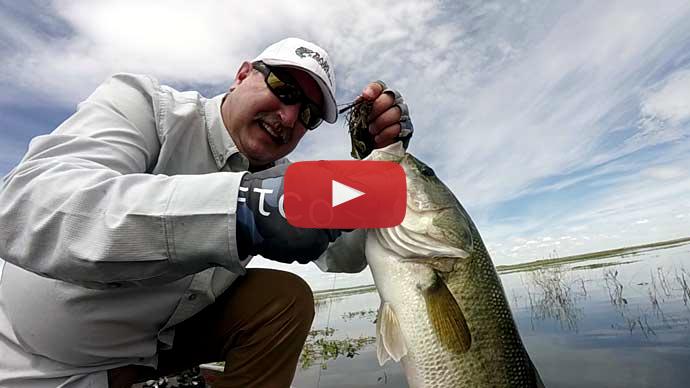
All right. Here we are at the peak of summer, and boy, is it ever hot out. Not only is it hot temperature-wise, but the fishing's real hot too. I know there's a temptation to stay indoors with the air conditioning on, but get out there and fish, guys. Get out there and fish. There's a lot of action to be had here. Now, before you go out, you got to do a little bit of preparation here, and doing the proper thing for this time of year is going to go a long ways. Think about it. For wintertime fishing, you wouldn't go out there wearing shorts and a t-shirt, so it's the same thing with fishing in hot weather. Be prepared. Wear long sleeve. There's so many long-sleeve performance shirts out there now, button-up or hoodie style, that give you some protection and keep you really cool. There's great fabrics out there that keep your skin nice and cool and protect you from the sun. Same thing with the pants. Light, airy, the air just flows through them, and again, keeps you protected from the sun. Sun gloves keep your hands from burning. You can even put masks on your face if you want. I'm not a huge fan of those. I like to wear sunscreen instead, 70 SPF for sure. And again, with your shoes, don't wear... I know you guys like Crocs, but some of you guys think it's a badge of honor to have this burned-waffle pattern on your feet. That's not good for you in the long run, man. That's not good for you at all. I like to wear HEYDUDE shoes. They completely cover you, but they're breathable. The air flows right through them. You don't even know you're wearing them. They're very comfortable and it keeps my feet nice, cool and dry. With all that, I am protected from the sun. You feel cooler and you can fish longer and you're energized. At the end of the day, you don't feel wore out and hot. Your skin doesn't feel clammy.
Also bring plenty of water, lots of cold water, just straight-up water, and drink plenty of it. Drink more than you think you need. I also bring coconut water on the boat. It's got plenty of those rehydrating properties that the sports drinks have, without all the sugar and salt because that's all bad for you too. So, just, you know, water and coconut water is all I bring and I'm good to go for the rest of the day. So, being prepared, now you're going to have a comfortable, good day on the water.
How do we go about doing this? Well, fishing during the heat, fishing during the peak of the summer, there's kind of a methodical approach. When the light is low, particularly this is starting in the morning, when the light is low, topwater reigns supreme. The bass are up shallow, they're aggressively feeding. So, buzzbaits, Zara Spooks, prop baits, poppers and frogs work particularly well when the light is real low. As that sun comes up, those bass start to bury up in those weeds and now, you've got to change your tactics a little bit. For example, if you've got some matted vegetation, grab that hollow body frog, throw it out there across that matted vegetation. Aim for those areas where there's open pockets. Cast past it, bring it to you and when you get to that open pocket, pause it. A lot of times, the bass will track it because they hear it coming across and when it gets in that open pocket, boom, they thrash it. You can also go in after the bass by punching the matted vegetation. Take a rage bug and, you know, it's a beaver-style bait, put it behind 0.5 ounce to 1.5 ounce bullet sinker and you throw it up in the air and let that sinker punch right through that vegetative cover and that bait will slither right behind it and it'll get eaten by those bass that are waiting below. So, that's a great way to go after them.
Now, the vegetation is key because vegetation is a little bit cooler, a lot of oxygen in them and it harbors a lot of bait fish. So, some of those bass aren't going to go deep. They're going to stick around in the weeds, outside weed lines in particular. This is where I, again, like to use plastics. Plastics are really good. Just a Texas-rigged plastic, swim it over the top, drop it into those holes, flip and pitch around docks and other visible cover. A lot of times, the bass will be there and you can catch a bunch with a variety of different plastics, a Senko being one of them. You've got to have one of those handy this time of year. But pick your plastic of choice. It's really a bonanza right now. The fish have one thing in mind and that's to eat. So, there's no wrong answers here.
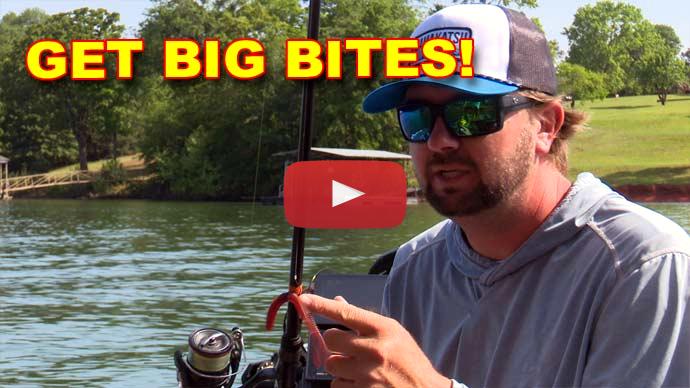
However, I like to go larger. I like to go a little bit bigger on my plastics this time of year. They're looking for a big meal. They're very hungry. So the larger the bait, tends to get more bites, particularly if I'm fishing deeper. As that sun gets high up in the sky, sometimes, you know, a good chunk of the bass move deeper. This is where I'm using full-sized brush hogs. I'm using the larger-size beaver-style baits, 8-inch to 12-inch worms. They work better in deeper water. They put off a lot of vibration and commotion. They offer an easy meal and it's substantial. The bass, that's what they want. I put them behind a Carolina rig for the most part, sometimes a football-head jig, then just crawl it along the bottom, along the deeper areas, along rocks. If you can find deep weed lines, a point with some scattered stumps on it that goes into deeper water, maybe there's a creek channel that bends, swings up close to shore. Those steeper banks. If you're a bass angler that is restricted to fishing from the shoreline, look for steeper banks and points. Those are the areas you want to target. Those long, flat tapering areas, I'd skip them right now. Most of the bass are going to be in areas where they can easily move up and down vertically without having to travel far distances. So, the steeper banks are areas that you want to key on. Even if you don't know what's underwater, if you're fishing from the shore, for example, look at the docks. The shorter the docks are, that indicates a steeper bank. If it's a really long dock, then it's a long tapering bank. So, just look at how long the docks are and just scan and you can see where they come in shorter. Those are the areas you want to target.
Just a couple ideas. You know, you look at the shoreline and follow it on down under the water, visibly. If you've got a steep shoreline, it's probably going to be steep out of the water too. So, those are the things you want to look for. And another area you want to target, particularly with rivers, obviously, is current. You know, anything that breaks the current, those little eddies and those breakwaters, wing dams, things like that, that break the current, the bass are going to be up right behind that. Just food is washing to them all day long. They can dart out in that current, take a bite and get back in that eddy. So those are great areas to fish. Typically, the water's a bit cooler in rivers and streams, so that can be dynamite fishing. But if you're on a lake or a reservoir and it's got some water coming into it, not necessarily the main river that comes in, but, you know, creeks, water runoff in particular, and culverts can be really good, particularly just after it rained. When you've got water coming through there, insects and things like that, that have been in the culverts are getting washed into the water, zooplankton and vertebrates. That brings in all the baitfish to eat on that. If there's baitfish, well, you can bet there's bass right there feeding on them.
I've got a lake that I fish where I've GPS'd all the inlets and little culverts all the way around the lake. There's seven of them. And I just make a milk run when it does this in the summer. Good rain, cool. I'm going out there and I'm just going after all the areas where the water comes in. It's cooler water coming in too, more oxygen. It just congregates all the life around it. And you can just go from spot to spot to spot picking up fish and have a ball all day long. So, key on those areas as well.
I mentioned before, you want those big baits. They work very, very well. But sometimes the bite is off. You may get in the dog days of summer. You've got a lot of boating activity and that tends to shut the bite down a bit. That's when you go down to Finesse-size stuff, like a split shot rig. That's just the baby sister of a Carolina rig. But now, you're using 6-pound test with 8-pound weight and you're using 3-inch baits like a tube or a grub. And you just drag that around. You don't have to, you know, move super-slow. You lift up on it, let it drop, let it sit for a second. Because what you did is you lifted the bait up off the bottom, you dropped the weight back down. Now, that bait's kind of making its way back down. So, give it a rest and let that bait settle back down. A lot of times, that falling bait, that's when it gets hit. You don't get a bite, lift back up, reel up on that slack, drop it back down and just let the bait do this all the way back to you. And you can catch a lot of bass that way and do it fairly quickly. Just because it's Finesse, doesn't mean you got to go super-slow, especially in July. You don't have to work it painstakingly slow to get a bite. So, those are the different things I would try.
Now of course, you can always fish at night. Because, you know, if it just gets way too hot, it's unbearable heat during the middle of the day, you could just go out in the morning hours or in the evening, you fish a few hours, you can get a great, fantastic bite going. But if you want to continue fishing, you can do it at night. This is a very popular time of year to do that. It's comfortable. It's nice. You don't need sunscreen, but you certainly need bug spray. So, make sure you got that with you. Make sure your boat's got navigational lights and they're on all the time. You might be able to see people, they can't see you. So, make sure you got your navigation lights on all the time. Make sure you've got like a headlamp, some reflective clothing. It's particularly helpful if you accidentally fall in the water, reflective clothing could save your life. And, you know, just be ready for that stuff. Keep your deck and everything all clean and clear of clutter. Even if you're fishing from the shoreline, you don't want to be stepping on a crankbait, for example. That'd be a very painful experience. So, just make sure things are all tucked away and put away so you don't trip over stuff.
Topwater reigns supreme at night. The Jitterbug is one of my favorite baits. It's been around for decades. It produces extremely well. It just floats on the surface. All's you do is slowly reel it back in and it just goes plop, plop, plop as it comes back to you. And that steady sound draws bass up from all depths and they smash it. It is a fantastic way to fish. You can use buzzbaits. You can do that. You can do walking lures. Poppers work extremely well. So, any kind of topwater.
But if you want to go a little bit underwater, hey, a black spinnerbait. Yeah, a black spinnerbait with silver blades. Matter of fact, all these baits, the darker the better, the more opaque, the solider they are, the better. Why? Because that shows up the most. That's a silhouette. And whatever light you have around you, they show up as a silhouette and the bass can see it better, even though it might be black. So it may sound counterintuitive, but it actually is the best color to use. And I like to fish lakes that are ringed by docks. Not only do you got street lights and house lights that help you, you know, see your way around, but a lot of docks have lights on them too. And that attracts insects. The insects fall in the water and then you got a bunch of bream and other baitfish that are feeding on it. And of course, if they're there, certainly there's the big bass that are feeding on those. So, those are excellent. Don't pass by a lit dock when you're fishing at night because there could be a bunch of good bass in that area.
So, those are a variety of different ways to fish this time of year. Don't sit at home and wait it out until it cools down. Get out there and have yourself a ball. For more tips and tricks like this, visit bassresource.com.