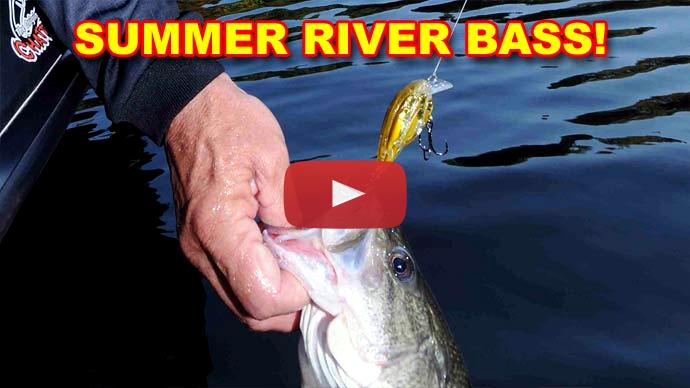
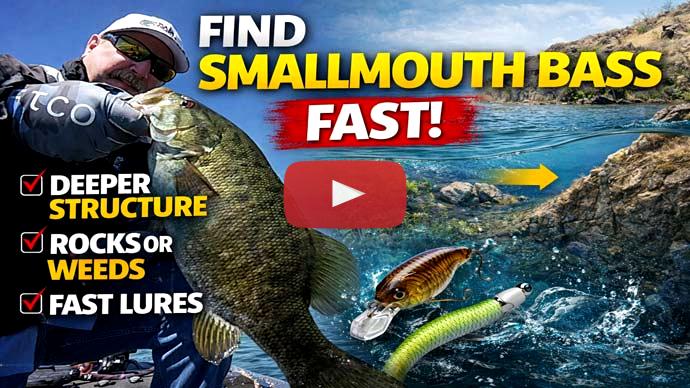
Alright, let's talk about some key areas to find small mouth and rivers in July and how to catch them.
What's really important to note is right after the spawn, actually right after June, if you're especially up in the northern climate areas, after the bass have spawned and had some time to recuperate, they scatter and what you're going to get is a couple of different things.
First of all, there's going to be some bass that are basically going to be within eyesight of where they spawned. They're not going to move very far out, they're going to be just a little bit deeper than where they were when they spawns. And if they can find some good habitat and some forage, they're going to stay there all summer long. So don't think you got to go long distances away from where you were during the springtime.
But there's also going to be some that go out deeper. They might go out in the main part of the channel or, or go maybe up to a mile or so away and find habitat there. That could be marinas. It could be off an island. It could be, you know, some things that break up the channel. Channel Bend, there's a bunch of places where they can end up in, but again then. Not going to go really super far.
Typically rivers aren't really super deep, so you can find them pretty shallow for the most part during the summer.
And then there's going to be a third group that are basically nomadic and those are the ones that are chasing the bait fish around. Wherever the bait fish go, bass will follow them, especially the smallmouth. And so they're they're to me a little bit more harder to catch because they're here today gone tomorrow.
If you got forward facing sonar, you might be able to find a, you know, a group of them and stay up on them for a while or maybe even the next day. You can still find, you know, it's a little bit easier to find. With forward facing sonar, but if you don't have that, it's a little more difficult to get on top of them. But so I'm going to, I'm going to talk about the first two groups.
So the key thing about river smallmouth is finding flats, whether it's close to the spawning area or, you know, further away, those flats can be very, very productive.
And depending on time of day and the amount of current coming through, the bass are either going to be right up on the flats or on the edges. And you have to probe to figure out where they're at.
But key things to look for, the flats, the bass get up there, they're feeding on bait fish, they're roaming around. So sometimes you'll catch a couple in one spot if you stay there. You might not get bit for a while, but then they'll come back.
That's kind of the difference with river fishing than with lake fishing is those bass kind of move around with that current. That's kind of important to keep in mind.
But you're looking for a little anomalies, looking for grass patches like eelgrass or milfoil or just some patches of grass. They tend to go around that and hunt around looking for baitfish and crawdads.
You look for like stumps or maybe a boulder or something that breaks up the current, sometimes a little divot or a ditch. Is all they need. It can, doesn't need to be big.
You know, like 8 inch 10 inch drop is a small little divot and they can get in there just enough to, you know, get out of some of the strong current and sit there and wait for food to come to them.
But those flats can be productive all day long.
So keep that in mind and when you fish it, you can get up on them see if they're there if they're not up on top of the flats and they might be right off the drop depends on how you approach it.
What I would do is crisscross it, so try the top Criss cross it and then when you go off the. Off the edges, again crisscross at different angles.
The bass can be real finicky, these small mouth bass, and they may want it from a specific angle. So you have to try it a couple different ways to see what they want and we'll talk about the baits in just a second.
But another key place to fish are. Breakwaters.
These are. Things that break up the current such as bridge pilings or ledges or big boulders or sometimes there's just a big hole in the river bottom that breaks up the current and those things can make a big difference and that's a lot of times the bass sit up in there and they'll feed all day long stay behind a bridge piling.
So let's talk about bridge pilings real quick. That could be road or could be a train trestle or something like that.
The thing about it is that they go over the river so if they're going to be at different depths depending on the. Pilings. There'll be a different depths and some of these different composition under the water.
And so one piling might be really productive and the rest can be dead. Or you might have two or three pilings on one side and another one on the other side that'll be productive. And the others that aren't are sometimes it's just the pilings in the middle.
So you've got to fish them to figure out which ones are productive. But don't assume if you don't catch any on one piling that they're not stacked on the next one over. That's the key thing.
If some guys they, they fish one or two pilings, they go, Nope, they're not here, I'm leaving and they left the treasure trove of bass that was the next piling over. So make sure that you check that out.
The way that I fish those is I cast, I get behind because it breaks up the current. And behind that piling, that's where there's a little Eddy and that's where the bass hang out at waiting for food to wash by.
So I position my boat downstream from the piling and cast up past the piling and let my offering float down to them. Yeah, it looks just like the very natural presentation and you can catch sometimes.
You can catch them on the sides of the piling too, but a lot of times once you clear that piling, you get into that little Eddy boom.
You'll see the rip current, you'll see where the between where the Eddy and the and the regular current. You'll see this riptide and usually it's right in there. That's where you get bit.
So make sure you're getting your bait into that rip current. That's the that's the sweet spot.
And same thing with islands. Islands will do the same thing. They'll break up the current.
You fish exactly the same way. A lot of times you get on one side of the island, fish that little ripp edge. And then you go on the other side of the aisle and you fish that side.
One thing to keep in mind though with these places is that. Aside from crisscrossing different angles like I mentioned earlier, sometimes this Eddy can set up in front of the object.
Yeah, You know, bridge piling is a good example.
The water comes in, they say it's a bridge piling. The water comes this way. Well, there's like a bunch of water in the front of it that kind of gets pushed against the piling and it has to, it stacks up, if you will.
And the water, it builds like this barrier, and the water starts to split on either side of the piling before it gets to the piling.
And this pool in front is kind of an Eddy and swirling around and bringing in food. And the bass will hang out there.
And same thing with the front of islands.
Now, depending on how strong the current is, sometimes you go to the back end of the piling or an island and you fish it and there's nothing there. Don't go away.
Come along the sides and the front, because a lot of times I'll stack up in that front Eddy or they'll be on the sides of the island.
So keep that in mind.
It's it's interesting, you know, if this if the current super strong, I found that that doesn't happen.
But if it's a, you know, summertime current, it can get lazy river sometime and those bass will move up along the sides and up to the front. So keep that in mind.
That's a really productive area to fish.
One other thing to keep in mind with the river fish is the weather.
Now I know. It might not be raining in your neck of the woods, but you are affected. So if there is a. A rainstorm maybe the headwaters are up in the mountains and it gets hit with a lot of rain but you're you're dry still it's going to push water that's got more color to it maybe muddy it the current will pick up get stronger it may even raise the levels of the river and that is going to reposition the fish and they can do a couple of different things here
A lot of times they move up shallower, especially if the river levels going up but they also. Seek shallower areas that can break the current.
So this may be points, and I'm not talking big points. These could be a little points that stick out maybe a few feet into the water just a little, you know, thing.
But I've seen it.
I've had tournaments where I've gone from one to the next to the next of these little indentations. This irregularities basically on the on the shoreline.
And it's enough to break up the current where the bass will sit up there and and they'll stack up when the current does that.
Another times be wing dams. Or marinas. Or any kind of. Man-made structure on the shoreline that can break up the current. They will get behind that as the current gets stronger and rises.
If the water gets really muddy, this fish might move up to tributaries where the water is cleaner.
Or you have, you know, better, you know, cleaner, especially in your area if you didn't rain, but it did upstream, the tributary tributaries in your area have clean water.
So the bass will move up into those tributaries, up into those coves and pockets and they'll stack up in there until the water starts to clear out and they move back out into the river.
So kind of keep that in mind when you're seeking out where to find these bass during the summertime because that's that plays a critical role the more you pay attention to the weather that's happening anytime it can affect the river itself upstream from you. You need to adapt where you're at.
As for baits, this time of the year, the bass smallmouth especially are foraging on baitfish and crawdads. So baits that imitate that do well.
I like I like spinnerbaits in the in river when I'm especially with fishing those flats that I mentioned, the spinnerbaits. You can crisscross and cover a lot of of area very quickly in the flats ledges too.
Throw the spinnerbait up and bring it across the ledge where it drops and those bass will come up and annihilate it.
Another bait is a Fluke. Your your standard Zoom Fluke. Just white. That's all you need. But here's the key with tricking and with with fishing it in the river.
First of all, rig it on like a four ought extra wide gap hook and you want. To just use fluorocarbon line. So it's weightless and you have fluorocarbon line and I'm using 6 LB. maybe 8 LB fluorocarbon line and that's it.
Why? Well, the current is always swirling and moving around and you can just watch it. If you're standing there, you see it kind of boil and change and it's, it's always just breathing is what I like to call it. But it's in motion.
And bait fish that are coming downstream, they get affected by that and they get kind of moved around, forced around in that in those changing current conditions.
A weightless Fluke will do that.
And if you're using a real not a not a flipping hook, use a regular sized light wire hook and we've just weightless and you've got fluorocarbon line not break because braid braid can float and braids a little bit stiffer than 6 LB fluorocarbon line in my opinion.
Plus it's the visibility is way down on it.
It makes that Fluke swirl around just like a regular bait fish. It looks a lot more natural in the water that way. And you get a lot more bites.
Just try it. Not not braid to fluorocarbon, straight up all fluorocarbon. Just try it and do it on a spinning rod. And you would be surprised at how well that works. It it you'd really be impressed with that.
And another bait that you got to have, you're fishing for river smallies is you have to have a tube.
So tube, I just fished the regular 3 1/2 inch tubes. You can go down to a 2 1/2 inch as well. Especially the bite's really tough.
Color wise, green pumpkin. Like to use the colors called old ugly or what I call old ugly's cousin which is old ugly with salt and pepper flake in it. And I catch bass all around the country on that color.
There's two ways to rig it.
One, you can put a regular ball head jig inside the the tube and fish it that way. And that's fairly weedless. And it especially you got a lot of rocks you're dealing with and stronger current. It doesn't get hung up that much in the rocks.
And because it's a ball head jig on the inside, if it does get hung up, it's easier to pop back out.
So that's a great way to just throw up in that current seam, let it float down in that current seam just naturally. Naturally, and there's along those docks, along those pilings, those wing dams and those flats.
Just throw it upstream and let it bumble its way down. Let the current pull it on down. So you're using a light, almost a slack line presentation on this.
Same thing with the fluke, by the way. You got to have slack line for it to do that, but just let it bounce along the river bottom and if it gets stopped, then give a little pop and then it'll pick up and just go downstream some more.
That can be very, very productive way of catching a bunch of bass, but another way that I fish it is on a split shot rig. Mainly because it's it, it gets hung up on rocks even less, especially if you got stronger currents.
Sometimes those you got a jig head in a in a tube. If you got strong current, it actually will sweep that jig under a rock and it'll stick. And now you're like it's not coming out.
But with a split shot rig, you've got your split shot and you got your bait away from it. And a lot of times they'll swirl around and they stay above. The the rocks and even if one gets wedged, the other will come around, pull it and pull it out.
So it's you don't get as hung up using a split shot setup plus that tube. Now flows really freely like that fluke that I just mentioned and it looks more natural as it gets moved around by the current and you can get a lot of bites that way.
So those are the the two main ways really the only ways that I fish a tube jig and I catch a ton of bass on tubes doing that and Flukes.
It's really that's about it. That's really you don't need to go crazy with the difference.
There might be one more category I would throw in there, which would be top water if the currents really slow or you've got a good slack water area behind a bridge piling or. Maybe in a Marina breaking out a walking bait like a Zara Spook or maybe a Whopper Plopper or even a popper type bait that imitates a wounded baitfish on the surface can be very productive especially if you got clear water.
Those marinas sometimes get some weeds in them. Those bass and the weeds are feeding on the baitfish and bringing something across the top can be deadly. Especially in the early morning hours it can be a blast. You can catch a ton of fish that way and who doesn't like a good top water bite especially with small mouth.
So definitely have some topwater in your arsenal.
That's really it. It's, it's simplified, it's easy. It's some people overthink river fishing during the the summer months, but that's really the key to it.
Go out there, try it and you're going to catch a bunch this summer. Hope that helps.
For more tips and tricks like this, visit bassresource.com.