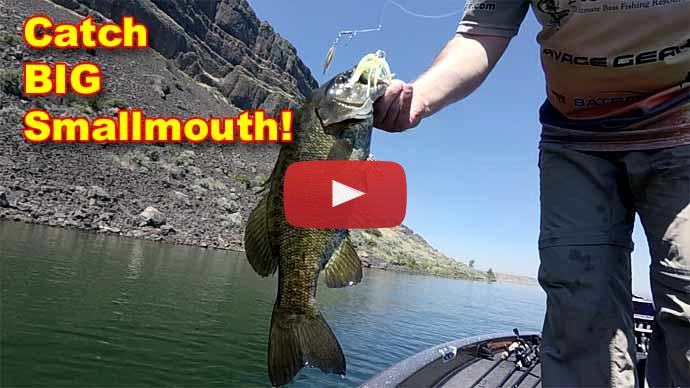


All right. You're on a new body of water that's got smallmouth in them. Cool. Well, where do you find them, and how do you catch them? Well, let's talk about that. Smallmouth, first of all, they like to be a little bit deeper water than largemouth, as a general rule. So you're going to find them in water that's...if you've got a hole, a drop, you're fishing a river, they like to be in a current break that's right near deeper water or on deeper water. You know, if you're fishing a lake, those points, those humps, those ridges, those ledges, outside weed lines in deeper water, any kind of submerged vegetation, any kind of scattered boulders, anything like that, the bass like to be there.
Now, what does that mean? "Oh, well, okay, I can just go ahead and fish deep, and I'll catch smallmouth." Well, no. You want to have a combination of the structure and the cover. So a hump that's got some weeds on it, a hump that's got scattered rocks, or a point that's got some laydowns on it, or maybe a deep weed line on it, like, a combination of cover and structure, that's what's going to attract the smallies. And when you fish it, don't just make a couple of tertiary casts and move on. The thing about smallmouth, man, they can be really particular on where they're going to sit on a piece of cover structure. So you've got to work it thoroughly.
For example, a hump. Now, a hump is not asymmetrical. It's not going to be the exact same size all the way around. For example, one side of it is in shallow water versus a deeper, if it's on a steep incline. Maybe it's a kidney shape or an odd shape, or one side of it is a steeper drop and the other side is more sloping, right? So they've got these weird changes to it, plus maybe you've got a couple of boulders on it or maybe a clump of weeds, what have you. They're going to be positioned on one spot on that hump, or that point, or that channel bend. You want to look for those areas and fish those areas. You can't just make a couple of casts and, "Oh, but they're not there," and move away. You've got to fish a little more thoroughly to find where they are situated on that piece of structure and cover.
Sunlight has a big factor in this, especially the clearer the water. Smallmouth love shade. And I can't tell you how many times I've fished ultra-clear water, and you fish the shade. That's a pattern. Find the areas, the cover, and the structure that's cast in the shadow and get your bait into those shade pockets. And typically, that's where the smallies are hanging out in. And so you can't just fish certain areas and move on. You've got to work them thoroughly.
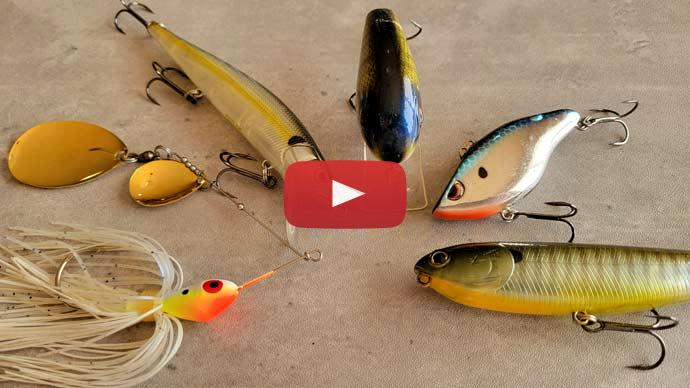
Now, how to do it? I'll use spinnerbaits. Crankbaits are my favorite. I love doing that. And you can fish it, you know, even from the shoreline. Don't assume, like, the deep side is the furthest away from you. Again, you can have a steep bank, like a hump, steep side versus a shallow sloping side. Same with a point, right? So pay attention to that when you're fishing from the bank. Your deepest area or your steepest area may not be the furthest away from you. Again, fishing with the spinnerbaits, fishing with crankbaits. And especially when fishing crankbaits, if the bite tends to wane, you can now go to a grub. I'd put it on an open jig hook, 5-inch grub, and fish it the same way I was with a crankbait, and you can tend to pick up more bites. And if the bite even slows down from there and you're not catching any more fish, go to a tube. Put it on a tube jig and drag it on the bottom, and you can catch even more fish.
So you can really work an area thoroughly with a variety of different baits. Now, if you happen to be around the spawning time, this kind of changes things a little bit. They may not be as deep. They're going to be up shallow to spawn. But smallmouth are very particular about where they're going to spawn. They like hard bottoms, like, real hard bottoms. Largemouth are more forgiving. They like a solid bottom. But if it's a little bit muddy or a little bit of dirt or whatever, they're okay with that. But smallies, they like rock, rock solid. They like to be on rocks, something a little hard. They also like to be directly adjacent to deep water. So if you've got...these flats are going to look more like a shelf with a 15-foot or more drop right nearby, and they've got scattered boulders on them, that is money. That is money, money, money. That is where you're going to find smallmouth bass spawning.
Again, those fast horizontal moving baits, like spinnerbaits and crankbaits, work really well. Lipless crankbaits are a favorite of mine. Those grubs, again, rig them on a jig head, just bring it back at a steady pace. Senkos and Slug-Gos and YUM Dingers, they can work really well too. You'd be surprised. Smallmouth really like those in this condition, in this environment. You can catch a lot doing that too. Early morning hours, smallmouth love topwater baits across any of the stuff I just mentioned. Buzz baits, walking baits work really well. I have a blast fishing these for smallies in topwater. Topwater situations in smallies are a blast, but its waning is quick. They don't do it all day long. Something about smallmouth, they only like those low-light conditions. But you can have a blast catching them on topwaters over the structure, in this deeper water. They'll come from deep water and hit a topwater under those low-light conditions early morning and into the evening. That's the best time to fish these topwaters.
So with that in mind, you can be able to find yourself the smallies on that brand new body of water you've been fishing and catch a bunch of them. Hope that helps. For more tips and tricks like this, visit bassresource.com.