


For more than six years, LiTime has developed lithium batteries, chargers, inverters, controllers, and complete power solutions for RVs, marine applications, golf carts, and off-grid living.
Along the way, conversations with outdoor users revealed a growing challenge on the water.
Paddle craft users wanted to travel farther without relying entirely on physical effort. Existing electric setups often required them to separately select and match motors, batteries, and controllers. Traditional trolling motors could lack the power needed for extended travel, while fuel-powered systems brought concerns such as noise, maintenance, emissions, and increasing environmental restrictions.
For anglers, paddlers, and small boat owners, the need was becoming clear: going electric should not mean navigating another complicated system.
They needed more than a motor or a battery. They needed a one-stop marine power solution that could bring propulsion, control, and energy together.
That need led to Argoseeker.
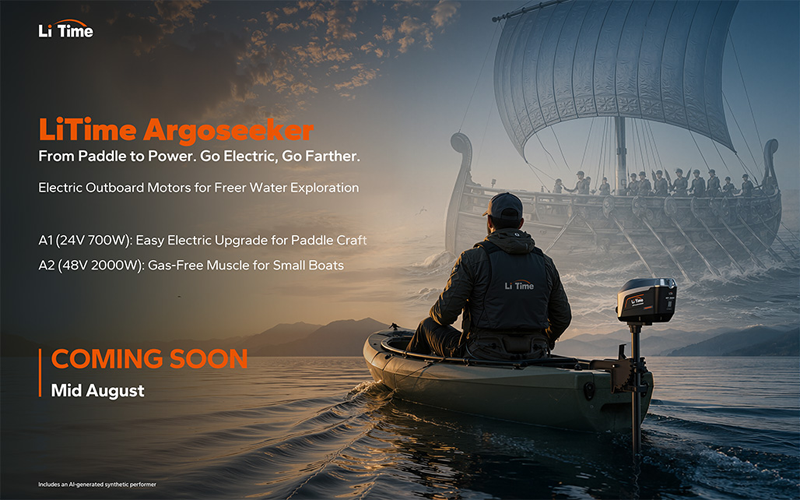
From User Needs to a New Marine Power Solution
Drawing on its experience in lithium power technology, LiTime began developing the Argoseeker Series in 2024.
The goal was to create an electric outboard system designed to work with LiTime LiFePO₄ marine batteries, simplifying the transition from paddle power to electric propulsion.
Over the next two years, Argoseeker went through continued development, testing, and refinement. Yet engineering was only part of the process. LiTime also listened closely to the people who would use the system on the water.
In September 2025, LiTime launched its first Go Electric Contest, inviting users worldwide to share their boat stories, electrification ideas, and real-world challenges.
More than 500 participants shared experiences ranging from long-distance paddling fatigue and limited exploration range to heavier fishing loads and the complexity of existing electric conversions. These insights became an important reference in the development of Argoseeker.
Early users also contributed feedback on installation, battery compatibility, control methods, and different boating scenarios, helping LiTime refine the system for real-world use.
As one participant shared:
“Thanks again for letting me be part of this journey — I truly believe this is going to change how people experience kayaking.”
After two years of development and user-informed refinement, the Argoseeker electric outboard motor series will officially launch in mid-August 2026.
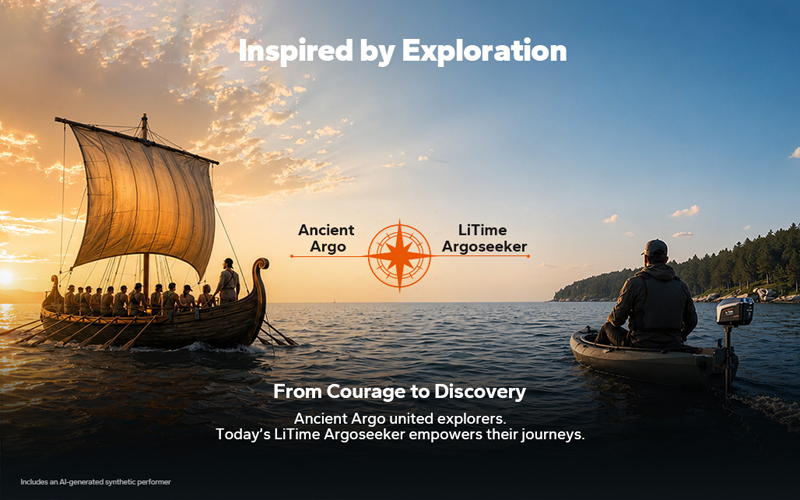
A Name Inspired by Exploration
The name Argoseeker captures the spirit behind the series.
“Argo” comes from the legendary ship in ancient Greek mythology, whose voyage represented courage, collaboration, and the determination to venture into unknown waters.
“Seeker” represents those who continue searching for new waters, new experiences, and new possibilities.
Together, the name connects the timeless spirit of exploration with a modern way of moving on the water.
Thousands of years ago, explorers crossed unfamiliar seas through shared wisdom and determination. Today, LiTime is using technology to give anglers, paddlers, and small boat owners greater freedom to explore beyond familiar waters.
As LiTime describes it:
Ancient Argo sailed into the unknown through collective wisdom.
Today’s Argoseeker empowers more water explorers to go farther.
A New Chapter for LiTime
Argoseeker represents the next step in LiTime’s evolution—from lithium batteries, to complete lithium power systems, and now to one-stop marine power solutions.
When paired with LiTime LiFePO₄ batteries, the Argoseeker motor and controller work together with the battery system to simplify the marine electrification experience from installation to operation.
The technology marks a new direction, but the purpose remains the same: providing reliable power that gives people more freedom to explore and create lasting experiences outdoors.
With Argoseeker, LiTime is bringing that purpose to the water—helping more kayak anglers, paddlers, and small boat owners move beyond paddle-only travel with quieter, cleaner, and more efficient electric propulsion.