

Reservoir bass can be found anywhere in summertime, but certain spots draw more bass.
Major League Fishing (MLF) competitor Roger Fitzpatrick has caught summertime bass both shallow and deep and on the main channel or in the creeks. However, the eight-time Bass Fishing League (BFL) All-American qualifier knows he can pinpoint bass on five types of structure based on whether the reservoir’s dam is releasing water. “One thing that makes a big difference in the summertime is that there usually is a good bit of current running through the lakes,” Fitzpatrick says. “That really changes where the fish are on any of the lakes I fish. The bass are all over, but the numbers of bass I have found typically tend to be on some kind of a current break when I am looking for schools of bass.”
Here are the five types of structure Fitzpatrick keys on to locate bass throughout the summer.
Points
“Points are breaks for that current that comes across the points and deflects the flow of that water,” Fitzpatrick says. “So, it is an ambush spot for those bass to position on.”
Sweet spots on the structure: Fitzpatrick suggests the side of the point receiving the strongest current will hold the most bass.
Best depth to fish: “Sometimes water color dictates that,” Fitzpatrick says. He notices if the water has some color, the bass will be less than 5 feet deep on the points. Usually, if the water is clear, bass will go away from the bank out to 25 feet or more.
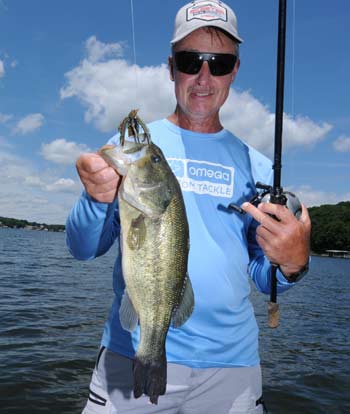
Best lures: When bass are shallow on the point, Fitzpatrick catches these fish on a glide bait, Evergreen Shower Blows topwater lure, or a 1/2-ounce Omega Custom Tackle Flipping Jig tipped with a Bojangle Baits Nos Craw or Z-Daddy craw. He favors a 1-ounce Omega Custom Tackle Football Jig tipped with a Bojangle Baits Z-Daddy craw or Nos Craw for stroking off the bottom in deep water. The 13-time MLF winner prefers a magnum-sized deep-diving crankbait when targeting schools of bass suspended out over the channel near the point. If the points have been pressured, Fitzpatrick opts for a drop shot rig with a Bojangle Baits Smoke Pole worm to trigger bites.
Best section of the lake: Points can be found anywhere on a reservoir from the upper to lower end.
Big bass or numbers spot: Fitzpatrick claims points can produce both numbers and big bass. If there is a lot of current, he can find large numbers of bass on the points.
Dominant sub-species: Fitzpatrick notes largemouth, smallmouth, and spotted bass can all be found on points.
Bluffs
Fitzpatrick suggests a bluff is a good spot for summertime bass because it offers features that allow bass to move up on the structure to feed quickly, then drop back down to the safety of deeper water.
Sweet spots: Bluff points, washout cuts, rockslides, stair-step ledges and standing timber.
Depths: From 5 to 15 feet deep depending on water clarity.
Best lures: 1-ounce Omega Tackle Football Jig and craw trailer for sunny days. Heddon Zara Spook on cloudy, rainy days around standing timber.
Best section: Bluffs are more dominant on the middle and lower ends of a lake.
Big bass or numbers spot: Both.
Dominant sub-species: Smallmouth, largemouth and spotted bass all hang around bluffs.
Humps
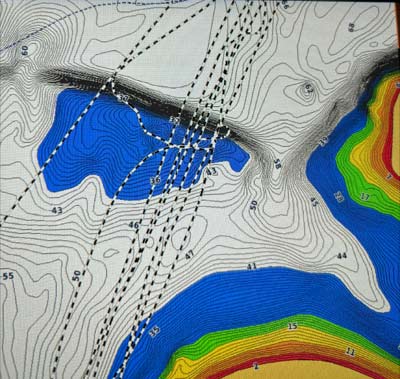
“Humps are kind of the same as points but are a little bit rarer,” says Fitzpatrick. “If the hump is close to deep water, those bass can just move in and out from that hump. If there is current, that water washing across that high spot is where the bass like to feed.”
Sweet spot: When heavy generation at the dam creates a strong current, bass will be on the shallowest part of the hump. When the current is slow, or there is no water flow, Fitzpatrick keys on the drop-off of the hump where bass suspend.
Depths: “I have caught bass as shallow as 5 feet deep on top of the hump,” Fitzpatrick says. He has also caught bass on humps 20 feet deep where the water surrounding the humps is 40 to 50 feet deep.
Best lures: 1/2-ounce Omega Tackle Flipping Jig and Bojangle Baits Nos Craw or Z-Daddy Craw for shallow bass or a deep-diving crankbait for bass suspended over the drop-off.
Best section: Everywhere in the lake.
Big bass or numbers: Both. Fitzpatrick claims most of the time he catches keeper-size bass on the humps.
Dominant sub-species: Largemouth.
Flats
“I am usually fishing flats if there is no current,” Fitzpatrick says. He usually targets flats in the late summer when the dam shuts down water flow and baitfish migrate into coves and creeks.
Sweet spots: Rocks, brush piles, standing timber and wherever baitfish are present.
Depths: Shallower than 5 feet in dirty water or 15 to 20 feet deep in clearer water.
Best lures: Square bill crankbait, buzz bait or 1/2-ounce Omega Tackle Flipping Jig tipped with Bojangle Baits Nos Craw or Z-Daddy.
Best section: Upper end.
Big bass or numbers: “When the current slows down, those flats can hold big ones,” Fitzpatrick says. “A lot of times the numbers aren’t quite that strong because the bass aren’t grouped up that much, but when you do get a bite there, it tends to be a big one.”
Dominant sub-species: Largemouth.
Ledges
“Ledges are really good when the water is a little clearer and later in summer when bass have made their way out farther from the points and humps,” Fitzpatrick says. “As the water gets warmer and the boat traffic gets stronger, the bass push out farther.”
Sweet spots: Rocks.
Depths: 25 to 30 feet deep.
Best lures: 1-ounce Omega Tackle Football Jig and craw trailer.
Best section: Lower end.
Big bass or numbers: Both.
Dominant sub-species: All three.