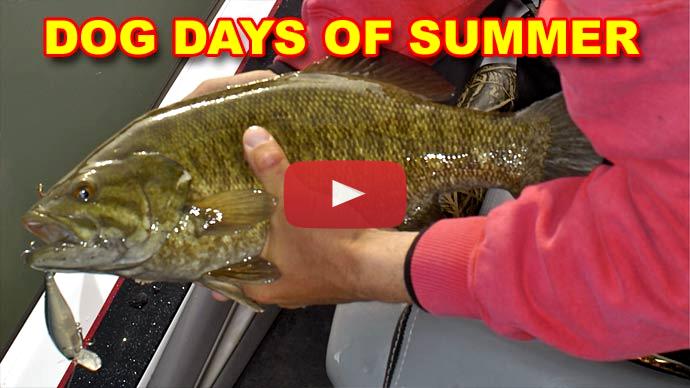
Boy, it's August and the fishing has become pretty tough. I mean, you've got the dog days of summer where you're at the hottest temperatures of the year and you've got a lot of boat traffic to deal with too. These two things combined can really make it a tough bite, really tough to fish. That's when finesse worms really shine. This is actually just...they're best suited for this condition. Let's talk about that.
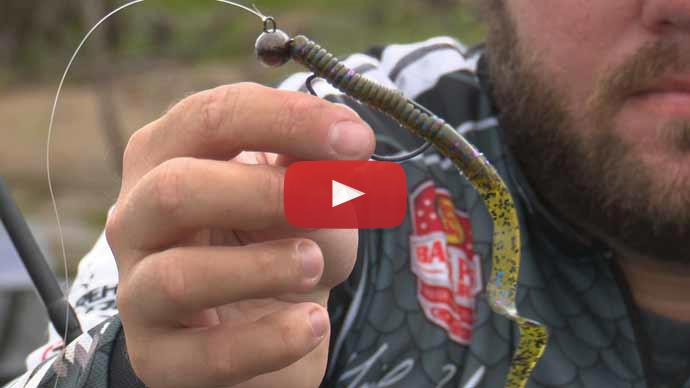
First of all, before you get too deep into it, understand that a finesse worm is about 4 inches long, 3 or 4 inches long. Sometimes they go up to 6, but typically we're talking this 3 to 4 inch long worm. Slender profile that can be grouped into basically three different categories. One is your standard taper tail worm. It looks like a real worm. That can be used in a variety of different rigs and presentations we'll talk about in a second. The second type of group is it has a little tail on the end of it, a little sickle tail or something like that, maybe a ribbon tail, that's got some action to it. It's got a baitfish profile to it that's perfect this time of year, like a 4 inch with a little tail on the end of it. That can be used in a few situations we're going to talk about here. Then lastly is the flat nose ones or the flat type where basically the front and the rear look the same. There's no real difference between the two. Those can be used for a variety of instances.
Let's talk about first of all drop shot. Drop shot is, that's going to shine, man. That's a really good technique to use right now. Here we're targeting deeper water. This can be long tapering points, humps, ridges, rock piles. It can be the outside bend or inside bend of creek channel, especially if it swings up towards the bank, the steeper banks can work really well. A lot of times you're focusing on fish that are suspended over that, not necessarily glued to the bottom. So drop shot works really well because you can get it up off the bottom.
You want to use either your basic straight tail worms or your flat worms, your flat nose worms. Those work best for a drop shot and you can rig them two ways. One is nose hook. That gives it the most lively amount of action. You can also rig them Texas rig on a drop shot. That works great if you've got some of these structure areas that's got some weeds on it and you're getting hung up a bit, you can rig it Texas rig. There's no law against that, and it enables you to work those areas without getting stuck or hung up. Perfectly fine for that.
The way you work it, you cast it out, let that weight get all the way down to the bottom and here what you're doing is you want the weight to stay on the bottom, but you want take your rod tip and just jiggle it just a little bit. The idea here is that you want to just quiver that bait in place.
So you're shaking the bait but not the weight. Keep that weight in place and just quiver it. It takes a little bit of practice because when you first do it, you're inevitably lifting that weight off the bottom, but once you get it down, you'll figure out you can keep it in place and just let it hover and just look a little alive.
That's all it takes to get those bass to come over under those tough conditions to just take it and you'll feel it. You'll feel the weight. You'll be jiggle, jiggle, jiggle, jiggle and then it'll feel soft and mushy. There'll be a little bit of weight on the end of it and that's a fish. You just lift up and there he is. Especially if his nose is hooked. It doesn't take much of a hook set to get him. You just kind of lift up and reel and you got him.
Equipment to use for this. First of all, I'm using 6 pound fluorocarbon line, no braid, no braid deleter or anything like that. I'm using a 6 pound fluorocarbon line. Why? Well, two things. First of all, braid is not as abrasion resistant as fluorocarbon when you're working rocky areas and deeper water typically is mostly rock. Second braid is too stiff of a line. There's no give to it and with this technique you need some give because you're using really light line and you're using little, teeny hooks. If you've got stout rod, stout line, strong line with no give then all the pressure is put on that little, tiny hook and you could actually rip it right out of the fish's mouth really easily.
So fluorocarbon's got a little bit of give to it plus fluorocarbon sinks whereas braid is buoyant and to give the bait the most amount of action you want a line that kind of sinks and flutters in the water versus trying to float back up. So you get a more natural action to it and that's critical in this situation. You want that bait to look as natural as possible. So straight up 6 pound fluorocarbon line is what I use. The weight is going to be like a 16th ounce to a quarter ounce. Typically no heavier than that. If you've got some current you're dealing with or some wind you can go a little bit heavier but typically it's really lightweight, very lightweight.
And the rod itself is about a 7' 3'' to 7' 6'' rod, medium power moderate action rod, maybe a fast action rod. So it's got a lot of bend and flex in it. The idea with this is that's going to let you cast it out there but also, it's going to enable you to do that wiggling action because it kind of...a rod like that's got a little bit of bounce to it already. And so it's easier to work that lure with a rod like that and then it's got that give-in it once you do hook a fish you can fight them back on that 6 pound line and not worry about breaking it off. That rod is going to do a lot of work for you in absorbing the impact of the fight of that fish as you get them back to you. So that's how you use these worms with a drop shot.
Next is on a jig head. You can fish these on a shaky head, on a ball head jig, on a darter jig, or a Charlie Brewers slider jig. These work, any of these three categories work really well. I particularly like the ones with the tail on them, the secret tail on a darter jig or a slider jig because those two kind of make it swim through the water and you can work these through weedy areas better without getting a lot of weeds stuck on it. So they do a good job of kind of swimming it through and it looks, it makes more like a bait fish. So I would use the tail finesse worms with those.
I would not use those jigs if you're fishing rocky areas. Those jig heads will wedge themselves in gravel and pebbles and small rocks and you're not going to get them out. They're just going to be stuck. You're going to have a lot of break offs and you're going to get really frustrated. And then you're going to get mad at me for suggesting it. So don't do that. Don't use them in real rocky areas. That's where I would use a shaky head or a ball head jig or maybe even a small football head jig.
We're talking lightweights here. We're talking 1/16th to 3/8th ounce at the most. Usually, 8th ounce is my go-to. That's where I am with all these jig heads. Real light. So you get that nice, small, slow fall which is what you need during these tough conditions. Plus, you can gracefully and slowly crawl it across the bottom and it looks natural. So these ball head jigs, especially, these football type jigs, shaky jigs, that's what you do with these worms. You can put them on Texas rig or an open hook either way.
If you're working the outside weed lines or through the weeds, then you want a Texas rig it. But typically you're fishing outside weed lines, deep aquatic vegetation, humps, bridges, rock piles, long tapering points that go into like a deep channel, channel edges, these type of things. And the key with working them here is to work them very slowly. You're crawling it on the bottom. You're not hopping drop and working them hard. Just slowly crawl them on the bottom.
And so for the darter head and the slider jigs, you want to cast those out and kind of reel it in a little bit as it falls so it comes at an angle. Let it hit the bottom. Let it sit a little bit. And then lift up again while reeling up that slack and let it glide back down again. But with the other ones, you're crawling it on the bottom very slowly and letting the fish find it and pick it up off the bottom. So your gear is going to be a little bit different with this. It's going to be a little more stout.
Here you're using a medium power fast action rod. You're using 8 to 12 pound test line. Here you can use braided line if you want because you're fishing around those vegetation areas. So braided line works really well for vegetation. So you can use that. Typically, these jig heads have a little bit stronger hook on them so it can withstand the rigors of the no stretch and the braid. So you can do that.
I still stick with fluorocarbon just because I'm fishing clear water and fluorocarbon is less visible than braid. It still has that give. And these are still small baits. Still, the hooks are a little bit small and the wires are thin. So I like to put everything in my advantage so I go straight up fluorocarbon with these. I sometimes go down a 6 pound line. Sometimes I'll use the exact same line. But you can go up to 12 pound on these and just work it slowly through these areas and pack your patience.
That's the key to working these baits under these conditions is work them very slowly. We're not used to working slowly as bass anglers. So when you're working from the bank this really lays into your advantage big time because you're not trying to figure out where to go next and moving the boat around and all that stuff. You can stay in one spot and work it very, very thoroughly this way from the shoreline.
Another way to fish these worms is with a Texas rig. A Texas rig works really well when you're fishing shallow aquatic vegetation. So for these reasons, I would use the straight tail worm. I would also use the ribbon tail because it mimics a baitfish. And you're using really lightweight here. Again, you know, 16th ounce, quarter ounce, nothing more than that. These baits really have no appendages to them. So a quarter-ounce weight is super heavy. An 8th ounce is even better.
I wouldn't really want to be hesitant to go more than an 8th ounce. It's going to drop through the water really quick because there's very little resistance. But you want to work these around the edges of aquatic vegetation. Pitch them into the holes and the bends and around aquatic vegetation. With a Texas rig it's going to pull through the weeds real easy and you're not going to get hung up.
Because you're around this kind of cover you're going to want to heavy up a little bit more. You want to use like a medium heavy rod, fast action tip, 10 to 12 pound line. A braid would be excellent in this condition. And pack your patience again. You're working it slowly. Don't think about a large-size creature bait that you normally do where you pitch and flip and move and down. Take your time and work these areas thoroughly. And with those two different types of finesse worms, you're going to do really well.
Now the next is a wacky rig, specifically, a weightless wacky rig. This is where I would use the flat worms. You know, the flat on each end? That's the kind I'd use the most here. They have a little bit of action to them. You just poke the hook through the middle one time. So this is a shallow water technique. Unless you've got the patience of a saint to be able to let it fall all the way down 20 feet or 15 feet, it's going to take a long time to reach the bottom. Fish it in shallow areas.
This is where skipping it under docks. The fish will get up under there, especially, the big docks that got real shady areas and it's got aquatic vegetation around it. They like to hunker down on those areas during this time of year. Skip it up under there and just let it do its thing. Let it fall in slack line, so it has a vertical presentation. And a lot of times the fish will nail it before it hits the bottom. For that reason, you're using a little bit shorter rod here, 6 foot 6, 6 foot 8. It's easier to skip a bait. Maybe under overhangs. You know, trees are hanging over, vegetation.
Maybe the water's come down a little bit and you got a little pocket underneath what used to be flooded vegetation. Those type of things. You can get it under those over hangs. Skip it with that rod. So a shorter rod makes it easier to skip. You're using 10, 12 pound line. You can use braid if you want. That's fine. I like to use fluorocarbon. It's my go-to because again, I'm using a small hook, like a size 1. A real small, maybe a 1-aught hook. Nothing any bigger than that.
So again, a small worm. So you don't want to overpower it. You can actually rip the worm. The larger the hook, you're going end up ripping the worm more. So use that setup and you can catch a lot of fish that way. And have a blast. Even with the boats and all the traffic and all this hot summer sun, you can still catch a bunch of bass using these techniques. Hope that helps. For more tips and tricks like this, visit bassresource.com.