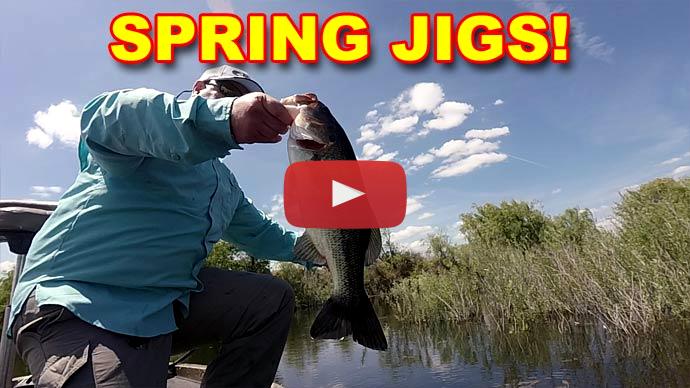
Hey guys, Cliff Pirch here for BassResource.com, and I want to talk about a few things to throw in the spring.
When we're talking about spring fishing, obviously there's a wide variety of time frames. You've got some pre-spawn, spawn, post-spawn, and you kind of come into that shad spawn—a lot of different techniques. So to talk about 3 is really pretty minimal in the overall spring fishing picture. But I'm going to talk about three things that I would use when you see the bass start pulling up to spawn or you know they're spawning, even if you're on a place where you can't see that well. I'm going to talk about 3 soft plastic baits that I really like to throw no matter where I'm at in the country.
So the number one—or just the first one, I don’t really necessarily have an order—is a Senko. It’s a six-inch Senko. Almost everybody has thrown a Senko somewhere in the country now. And I like the six-inch; it just gets a... it's easy for me to cast a long way, it's easy for me to control in a short cast. It's a good way to target the magnum, fully biggest fish in the area and gives them a great offering.
I’ve got it on a 5/0 EWG—this is the Nano Alpha EWG from Gamakatsu. I'm throwing it weightless. I’ve got it on a little fluorocarbon leader—about a 5-foot leader. This is 20 lbs. I'm fishing around heavy cover like grass mats, grass holes, places where you’ve got heavy brush. I’m talking about kind of high-combat, shallow water, big fish spawn fishing. I like it on a braid-to-leader combination. This is a Phenix Super Flipper. I want a lot of power. If I want to hook a 10-pounder in the grass or in the trees, I want to be able to move that fish and get it out of there.
So a Senko, guys, has just stood the test of time. It’s one of the best bite-getters there is, especially when you get fish into that shallow water column. This one’s weightless—there’s a number of ways you can rig it: Neko rigging, jig head, weightless. This is weightless and weedless. It’s going to fall horizontal, have a nice shimmy as it falls—and big fish cannot stand it. That’s a great way to catch them. I can’t tell you how many big fish I’ve caught on that over the years. It’s one of my go-tos for spring fishing when we’re talking about fishing around the spawn. That’s one of my favorites—and one of the bass’s favorites—and that’s why.
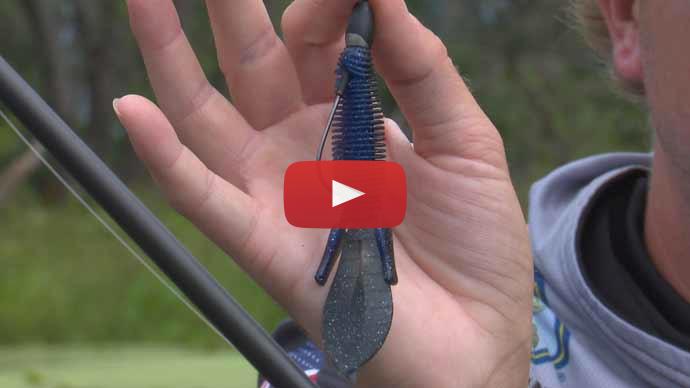
Another one I’m going to use, guys, that’s really a good one is the Fighting Frog from Big Bite Baits. When I’m sight fishing and specifically looking at fish, this is a great way to get bit. The Fighting Frog—I’m going to use a couple colors. One, I’m going to use a bright one when I can see it and want to be able to see the bait. Or if I need a little more natural approach, I might go with a watermelon color like Tilapia Magic or a real natural bluegill-looking color. Sometimes that gets good bites. Or a crawdad color gets bites too.
But this one here is a white one. And the reason I use white is I want to make sure that fish has got it in its mouth. Because a lot of times I’m sight fishing with it, I’m going to pitch it out, and when I know that white disappears completely, I know that fish has got it. I’m not going to foul hook it, hopefully. So that’s why I like that bright color—it’s mainly for my benefit, not for any other reason—just so I can see that the bait is in the fish’s mouth when I’m looking and visibly sight fishing.
That’s the Fighting Frog. I’ve got it on heavy, heavy gear. This is a Phenix extra heavy. It’s a 7'7" extra heavy Feather. So this is full-contact gear. I’ve got it on 20-lb fluorocarbon. I’ve got a little 3/8-ounce head and I might go up to a 1/2-ounce head a lot of times just to make it happen faster—get there faster. If you’re fishing just dirt shallow, you might go a little lighter—like 1/4-ounce or 5/16ths. But that’s my setup for sight fishing a lot of the time.
I’ve caught 10-pounders in Florida, Texas, California, all fishing that one right there. That’s a good one for you. That’s the Fighting Frog from Big Bite Baits. That’s probably my number two sight-fishing bait.
And one of my other favorites—oh, the fish are boiling right over there—one of my other favorites is a drop shot. Again, we’ve talked about it in other videos. It’s always on the front deck. But in the spring, this is a great way to target a specific spot. When you see a fish on a bed or guarding a little area—maybe defending some territory for some fry, or just on a laydown, a stump, a rock—a drop shot is a great way to catch that fish. Put it in the strike zone and keep it there.
The thing I like most about the drop shot is I can impart action without bringing it out of the strike zone. Now with the Senko or the Fighting Frog, I’ve got to impart the action and it moves out of the strike zone, so you’ve got to recast. And when a fish gets used to seeing that, sometimes they’re hard to catch. They know that thing’s going to leave the strike zone. A drop shot is something I can still impart the action when it’s in the strike zone, and it doesn’t leave the strike zone. As long as I’m not lifting that weight off the bottom, it will stay there and I can keep it doing what I want it to do.
It’s a great way to get big bites. It’s a great way to get the most bites. And sometimes, it’s a great way to get those stubborn fish to bite when they’ve seen all the other stuff. You just pitch a little subtle drop shot in there.
Now, sometimes it’s my first cast because I know it’s a subtle little deal. It’s going to get in there, they’re going to see it, not want it there, bite it, and swim it off. Other times it might be my follow-up bait if I’ve worked on trying to catch some fish with my Senko and my Fighting Frog. Then it’s a great follow-up bait to try to just, last-ditch, try to get that fish on your drop shot. Sometimes you back up and make a little longer pitch, leave it in there, leave it in that bed or in that strike zone, and it will get the bite.
So that’s my three favorites. This is the Cliffhanger worm, guys. We’ve got the new 6 1/2-inch one. In the spring, generally I like the natural colors. Unless you’re fishing dingy water, and you’re even spawn fishing in dingy water—then I might go with black or double purple. Or if I want to be able to see that bait—if you’re up close enough to where you can see the bait—one of my favorites has become the green pumpkin chartreuse. That chartreuse underside allows you to go, “Okay, he’s fully got it in. I watched that bait disappear in his mouth.” It’s a good indicator for me to know that he has bit that worm and I can go in and set the hook without foul-hooking the fish. So that green pumpkin chartreuse has really become one of my favorites in the spring.
That’s the Cliffhanger from Big Bite Baits. I like it on spinning gear unless I’m fishing around super heavy cover—and a lot of times in the spring, I will be. So I might beef up my setup and throw it on a baitcaster with, say, 15-lb test, making those pinpoint casts. And that’s one time of year where I will beef it up a lot.
So guys, I hope those are some good tricks for you fishing in and around the spawn. It’s a fun time of year. You catch some of the biggest fish of the year doing that, and man—I can’t tell you how many great memories and how many of my biggest fish I’ve caught during that time of the year. So I hope this works for you and hope you go catch them, guys.