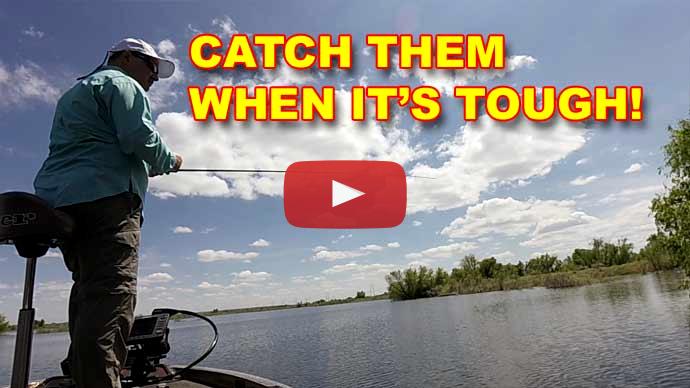
You know, when the water temperature is really cold or really hot, or you're facing some dingy water conditions, a lot of fishing pressure, or even seasonal changes, fishing can be really tough, and sometimes it's hard to get a bite.
Well, during those challenging times, there's three different methods that I use to catch fish under those tough conditions. First one is finesse. That's kind of the standard go-to for most people, and for a good reason, it works really well. Finesse tactics, typically, it's a 7-foot-1 spinning rod, and you're using 6-pound fluorocarbon line. I like to use Seaguar Tatsu line for this, no braid. I want to use straight-up fluorocarbon line. First of all, visibility is less.
Number two, it sinks with the bait, and so it gives the bait that natural feeling. And lastly, it has some stretch to it. Not a whole lot. It's not super stretchy, but it has a little bit of stretch to it, and when you're fighting a fish on a little bitty hook that can pop right out. If he's got too much leverage, well, that little bit of stretch is what you need.
You got any amount of braid in that combination, the braid has no stretch at all, and so that fish can use that as leverage to pull free from the hook. So I just use straight-up fluorocarbon line. And just a size 2500 reel with a really good drag system, you're good to go.
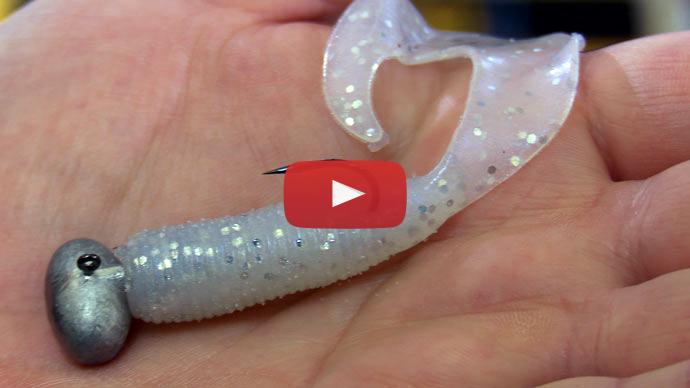
For the baits, you're using smaller baits, like a tube bait or a grub, or maybe a 3-inch grub or maybe a 4-inch finesse worm. If you notice all these things, even a leech, 2 to 3-inch leech, these things, they don't have a lot of action to it. And when the bass are in these pressured conditions, in these tough conditions, the baits that have not as much action to them tend to work well when you're doing a finesse presentation using a drop shot or a split shot.
And you can work the area very slowly and methodically and barely move the bait as you go. Although with the split shot, you can move a little bit faster, you can cover a little bit more water. But for the most part, those little bite-sized snackable baits, that's what attracts the bass. That's what they want to get. And they may not be in the mood to chase down fast-moving baits, but they can go after that. And you can fish them in deeper water here, points, ridges, creek channels, sharper drops, banks, steeper banks. Those are the type of things I would target with these finesse tactics.
Keep in mind that finesse doesn't necessarily always mean small plastic baits and drop shot and split shot. You can also downsize your hard baits. A lot of folks forget about this, but small crankbaits, the smaller versions like a 1/4-ounce crankbait, a 1/4-ounce spinnerbait, the smaller-sized topwaters, and so on and so forth, those can work very, very well. They can be very effective. Sometimes the bass are just chasing smaller-sized bait, and you're using too big of a bait.
Or when they get these tough conditions, they may not want a bigger bait. And so these smaller baits can work really well, and you can use them to your advantage. So make sure when you include your finesse arsenal that you are looking at your hard baits, and you can have some options to downsize and use smaller versions because that might just be the ticket.
Now, another way to go after these fish and catch a few is to generate a strike. It's what I call force-feeding the bass. It's a reaction-type technique. Here, you're giving the bass a very little window opportunity to bite the lure. You're giving them very little chance to look at the lure. They have to react, or it's gone. So this technique relies upon a very fast-moving lure.
So here, you're using typically hard baits, spinnerbaits, topwater, buzzbaits, crankbaits, so on, right, and you're moving quick. You're covering water, and you're moving very, very quickly. And you're keying in on that bass's predatory nature and then instinctive reaction to just hit something as it goes by. They don't really even know what it is. It's just moving. And sometimes, that's all it takes. It's just speed up your retrieve. Sometimes, these bass are seeing the same baits come by all the time at the same speed, and so something we can buy them is something different, and they react to it. So moving your baits really fast when the conditions are tough, sometimes you can force-feed those bass and force them to bite your lure. So think about that next time you're confronted with tough conditions.
And then, finally, another one which seems to be the opposite of everything I've just been saying, but that is go big. Go with larger size baits. A lot of times, these lakes, especially the heavily pressured ones, you'll go to the tackle store anywhere near there, and all the baits are about the same size. That 3-inch to 5-inch size bait, everything, plastics to hard baits. They're all basically the same exact size. And those heavily pressured bass, well, they become accustomed to it. So what do you do? Go big. Go with 8-inch, 10-inch, 12-inch worms, the large 3/4-ounce Mop Top Jigs with a Space Monkey attached to it. Big, bulky type of a jig.
Larger size crankbaits. Go with the larger swim baits too, those bigger ones, those 6 to 8-inch swim baits. The same with topwaters. The full-size large mega topwater baits, big, double-bladed buzzbaits, stuff that create a lot of commotion. The bigger, the better. And again, move it very quickly. So now you're kind of combining what I said earlier, a faster-moving bait, but this is a larger profile.
These bass aren't used to seeing these large baits. A lot of bass anglers shy away from that. So now, most of these bass are seeing this brand new when you present it to them, and it's different enough that they're not accustomed to biting it. They're going to go after it. They're going to bite it. So a larger bait oftentimes is a ticket.
Sometimes, we just go to finesse, and we don't get a lot of bites, and we stick to finesse. But think about it. If you speed up the lures that you're using and/or if you upsize to larger baits, that might be the ticket if those small baits and finesse tactics aren't working. So think about that next time you're confronted with tough conditions. I hope that helps. For more tips and tricks like this, visit bassresource.com.