Well, it's cold out. It's the middle of winter. And bass fishing can be pretty tough as often this is one of the toughest times of the year to be fishing. The bass just really aren't all that aggressive right now.
So how do you get into bite? Well, a couple lures you can use and the way you use them can often trigger a bite. What am I talking about? Well, let's talk about crankbaits.
Yeah, I crank baits are fast moving lure typically, and they're not really associated with fishing in winter. But I've learned over the years I've caught plenty of fish in the dead of winter on crankbaits. The difference is, is how you fish them.
First of all, if you're fishing in deep water, you want to get a lure down there that fishes deeper than there you're fishing. So say you're fishing in 20 foot of water, get those crankbaits that go 25 foot or deeper. The goal here is. Two things.
One, you want to fish it relatively slow. So moving it slowly on the bottom, if you move it real slow, it's not going to reach its complete diving, diving depth, right? So you got to fish it a little bit slower than normal. So you fish it a crankbait that dives deeper than where you're fishing.
And 2nd, you still want to bounce it off things even in the winter time. You want it to hit a rock or a stomp or just the bottom and then hit it and bounce off that. In the winter time though, a lot of times what triggers a bite is once you hit something like that, you pause. Don't just keep reeling, pause and you know a count of 2-3 seconds and then reel up on again. And a lot of times when you start to reel again, there's a bass on the other end. They'll hit it during that pause. So fishing it slower and longer pauses when you hit something is kind of key to catching them when they're cold.
Now you can also experiment with fishing faster and keep on going. When you ricochet off something, sometimes you can trigger a reaction by it even in the coldest of water. So it's not to say they won't hit that you can certainly try it and see if that works, but typically that slower way works better.
Crawdad patterns work better. And also a couple tricks. What I like to use is those suspend dots or suspend strips. A lot of crankbaits, when you stop and they pause, they float up. This time of year you want it to be neutral density, right? Just neutral buoyancy and let them just sit there and hang. So use some lead strips, put it on the belly of the crankbait and that way when you pause it, it doesn't start floating up on you, it just stays there. Plus you can fish it slower. That way when you add weight to it, it's not you're not fighting it to come back up, you can continue to fish it slower. So those suspend dots work really well on crankbaits this time of year.
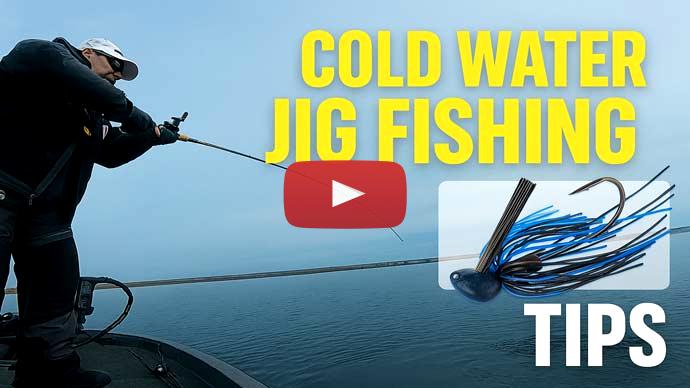
Now jigs are an all time staple. You can use them all year round. Winter's no different. Jigs work really well. There's three main jigs that I fish with during this time of the year. One of them is the Arky Head, which is this style here. If you haven't, you're not familiar with it, but you can see here is just kind of a straight up, somewhat bullet head, but it's kind of what I call sled head. But you can see. Its shape here, it's kind of a see that? Yeah. That's kind of a Jack of all trades, man. You can fish this jig pretty much everywhere. It's going to come through it really well. So if I was going to have one jig, it would be this being efficient in weeds and then kind of cover or drag along the bottom. It's going to do a really good job. So this would be like my first choice.
During the winter time, my second one would be a ball head jig. Like a finesse jig like this one here. See that ball head? That. Works really well in rocky bottoms and hard bottoms, which typically you're fishing this time of year, you're fishing deeper water this time of year, 20 foot 30 foot 40 foot deep. There's not a lot of vegetation down there. It's mostly rocky bottoms. And this round ball head jig comes through rocks really well. And if you get hung up because the eyes on the top of it, it pops up pretty easily. So you can get it unhung without having to break it off instead. So this is a good choice to use in deep rocky areas like fishing points humps, rock piles, ledges, drop offs, those are the areas that would be targeting.
And then the other jig I'd be fishing would be a football jig, you know, and it's called the football because, look, it looks like a football. I mean, come on, you know, let's name it what it looks like. So football head jig works really well. When you're dragging it on the bottom, you crawdads are a staple of the bass's diet. And same thing during the winter time. Crawdads don't hibernate. They do bury up in the mud sometimes and become inactive, but they come out to feed, especially if it gets warm out in rocky areas like riprap or rocky points, they warm up quickest and you get a little stretch of warm weather and outcome. The crawdads and that football jig, you just crawl along the bottom. Then it wobbles back and forth and mimics a crawdad and you get bit a lot using football jigs.
Couple things that I do during the winter time. Is I use a different trailer. Trailer in this instance, see this trailer. It doesn't have any edges or flanges to it or anything. It's pretty flat. As opposed to a lot of trailers you can buy these days have like a lip or an edge on the craws and that makes them flap around and move a lot. But in the winter time you don't really want that. You want less movement. So a trailer like this works really well. It's just it floats up and it just it doesn't have a ton of action.
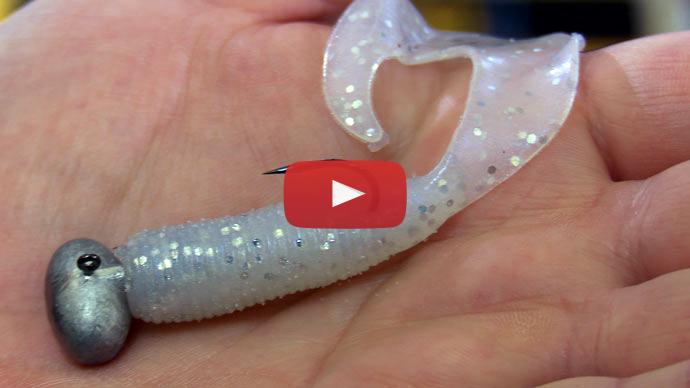
So I'll use a trailer like that or maybe even a little craw, a little small crawl imitator. I put this on a, you know, on another finesse jig, a little ball head jig. But look at this. Just a little small. Little crawdad, you know, and this looks, look at that. I mean, come on, man. That's a just a Scooby snack for bass, right? So play around with your trailers just, you know, get a little bit smaller size sometimes and that's all it takes to get bit.
An old standby old staple is the Carolina rig. It's been around for decades and it still produces bass. It is something you got to have in your arsenal and learn how to fish it. Just put on a six inch lizard on the back or put on a four inch lizard or maybe even a straight tail worm. In the winter time, that's, that's money, man. That is money.
But couple things about fishin the Carolina rig, some people don't do, I think they kind of drifted away from it. So let me remind you here, if you if you don't fish at Carolina rig that often, number one is your leader line right from the weight to the bait. That should be monofilament. A lot of times we're we're using braid to the weight and people will just put on fluorocarbon because they've got plenty of fluorocarbon laying around. They use that. Problem is fluorocarbon sinks. Monofilament floats and you want to keep the bait off the bottom. That's the key to the Carolina rig is the more you keep the bait off the bottom, the better visibility it has and the more bites you get.
So monofilament helps keep the bait off the bottom. It's not super buoyant, so it's not going to lift it off the bottom per se, but it's going to help keep it off the bottom. The other thing is to use a smaller thin wire hook. A lot of times guys put a flipping hook on there because they're using braided line. Well, that extra weight bogs it down and drags that bait down on the bottom. So a lighter light, light hook paired with monofilament line helps keep that bait off the bottom. Every time you lift that Carolina rig and drop it, that bait comes up and stays up and kind of slowly falls a lot slower that way and stays up off the bottom than if you would do it the other way. So quick little trick trick for those deep water baths in the winter time.
Bait that works really well this time of the year is the Ned Rig. I mean, you've been fishing the Ned rig all season long, all year long. Don't put it down. It keeps working even during the winter time. One of the key things though is of course you can fish it with a little, you know, 3 inch stick of plastic. Works fine. Nothing wrong with that. You can catch plenty of fish doing it that way. You've had plenty of practice already this season, stick with it. That still works.
However, you might want to swap it up a little bit. Bites are few and far in between. By this time the bass have seen plenty of Ned rigs, so maybe try a little bit of different plastic. For example, you know this this little small craw trailer that I have on this jig that I just showed you earlier. Use that. Use a small craw instead of a stick of plastic or a three inch fluke. You know, something small or a little 4 inch brush hog or a finesse worm, maybe a four inch finesse worm. Something different that the bass aren't used to seeing can make all the difference this time of year with a Ned rig.
Again you're just fishing it nice and slow on the bottom with long pauses in between. The longer the pause is the better and the slower the better this time of year. And with all these baits, you're still, you're fishing it in deeper areas, 20 to 40 foot, typically rocky bottoms or channel breaks, ledges, humps, ridges, long points. Those are the things you're looking for.
But concentrate on the areas that are close to spawning areas. Those bass, they don't want to travel really far unless they have to for the springtime. And when they feed in the summertime, they kind of stay in the same general area as a general. There are edge cases where bass have been known to travel miles and miles away. It's not totally uncommon. But the larger concentrations of bass are going to be near those spawning areas.
So if you can find those deeper area with all that structure and maybe even some still some green weeds in deeper water that's near those spawning areas, yeah, that's money. Those are the places you want to fish these baits.
So. Hope that helps. For more tips and tricks like this visit bass resource com.