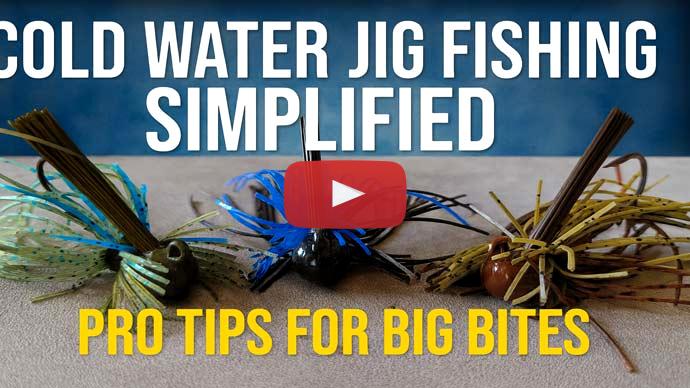
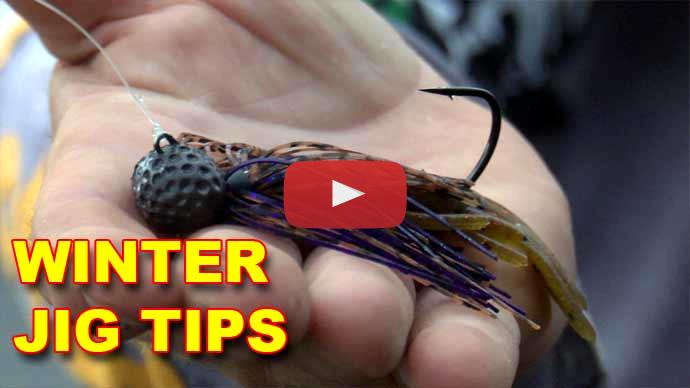
Winter time and jigs go together like peanut butter and honey man, or peanut butter and Jelly, take your pick. Jigs work really well in the winter time as they do year round. Winter time is no different. So the difference is the type of jigs you use, where you fish them, how you fish them, and some of the tweaks you can make to them. They'll make them more productive this time of year. So let's talk about a couple of the more productive style of jigs first.
One of which is the Arky head. Arky head is like the original jig. Right, that's that's this, that's kind of a sled head design. See that? It's just kind of a rounded. Perfect, right? This can go through just about everything. This is, like I said, the first design. You can go through weeds, go through bushes, rocks, does a pretty good job. The hook stands up so that when it sits on the bottom, the bait sticks up as well. Pretty cool. This actually is the type of jig I've only had one kind of jig for the winter time I'd be using an Arky style.
But there's others too. For example, the ball head jig oftentimes comes as a finesse version, like this one. But a ball head jig works really well in rocky bottoms. And when you're fishing deep like you do in the winter time, a lot of times you're fishing rocky and hard bottoms and that ball head jig comes through that better without getting hung up very much. And if it even does get hung up, the eye is on the very top so it pops out really well. It's a great way to fish this type of cover without fear of getting hung up a whole lot. So it's a very productive way of fishing them.
Another type, if you happen to have a lot of weeds in your area, they don't really die out as much and you have more shallow lakes. You want to go with this bullet design, right? This one, I don't have a skirt on it right now, but you know, this little bullet design works really, really well, OK. That’ll snake through all the weeds and the weeds, you know, they're not that thick right now, but it'll it'll snake through the weeds a lot better without getting hung up. So that's a good design to use if you're fishing weeds.
And finally, you know the football jig, right? It's called football because look at that. It looks like a football. You know, that's exactly what it is. So the football jig, this works really well fishing the bottom. You're imitating a crawdad with this, right? A crawdad just slowly moving on the bottom. This year, the crawdads don't move really fast. So taking a football jig or a wobble head jig that's very similar, you just bring it along the bottom and it just slowly wiggles back and forth and it looks like a crawdad just slowly making its way. Use long pauses with this one, by the way. But those are like the four main jig heads that I use for this time of year.
As for color, the old black and blue works really well. Black and chartreuse the green hues and the brown hues are your basic colors and they're very productive. You don't really need to deviate too far from that. But one of the things that you can do is carry an arsenal of skirts and different colors of skirts as well as different skirt material. The silicone ones are the most popular. You have the most variety of colors available. Occasionally those fish want something a little bright and flashy, like a fire tiger or some something with a chartreuse on it or a little bit different color than what you the stock colors that I just mentioned the browns and whatnot, but also rubber. Rubber this time of year tends to work a little bit better.
You know, the silicone tends to I mean just the way that moves in the water, the cold cold temperatures, the rubber tends to have a little bit more movement to it, especially when you drop a jig, you know, like an Arky jig that's got this, you know, look at the skirt. I mean look at a long it is. Just lots of skirt material when it's made out of rubber. When it hits the bottom, that rubber just slowly opens up and looks alive. You don't even move it at all. Just do that and sometimes that is the difference between getting bit and not bit. It's just the same color but a different skirt material. So make sure you have plenty of that.
Also, scent. Adding scent to your bait in my opinion doesn't really attract the bass so I don't call it an attractant, but oftentimes in my experience is when the bass picks it up, they tend to hold onto it a little bit longer and the bites sometimes are very, very subtle, so. It gives you that a little bit extra time to feel that bite and set the hook. So I just use, you know, like MegaStrike, put that on there and it works really well. You know, it's just, you know, it can't hurt. I, I seem to get more, more bites that way, mainly because I can, I can feel the subtle bites better and get better hookups.
Trailers are another thing to experiment with this time of year. First of all, I don't like trailers that have a lot of action to them. A lot of times you can get these trailers that have flanges on the edges of their claws and it makes them move and flap a lot more. This time of year I don't want a whole lot of action, so I tend to get trailers that don't have that on them. For example, like this one from V&M you can see here. See if I can't get that, see it doesn't have any flanges on it. It's this straightforward craw and because of that, it doesn't have as much action to it, which is perfect this time of year. That's what you want.
But you can also play around with different other types of trailers. For example, a craw imitation here I've got a, you know, a finesse jig and I put a little craw on the end of it. See that? Look at that. That is money. It looks like a little crawdad crawling on the bottom. You know, you catch a lot of fish that way. A lot of times the guys aren't fishing stuff like this. It's something different and it you get more bites.
And also. Different sizes of trailers because the different sizes can change the fall rate of the bait, right? So sometimes a much slower, slower fall is what you want. So a little bit bigger or in this case this craw trailer I showed you is hollow in the middle so it floats a little bit more. It gives a little bit slower fall rate or a smaller trailer can make it a little bit fall a little bit faster and sometimes just that little subtle change is all it takes to get bit. You can also make sure you have an arsenal of jigs with. Different weights, same thing about the fall rate. The weights make a big difference.
You know, the lighter the weight, the slower it's going to fall, obviously. But also if the fish are just biting it off the bottom and picking it up off the bottom when you're dragging it, then you don't need to have a slow fall rate. Get a heavier jig, get it on the bottom as quick as possible and drag it along the bottom.
Another tip you can do is get some tungsten head jig heads. The tungsten. You know, it does two things. First of all, tungsten is a little bit more sensitivity. You know, lead jig head is kind of deadens that feel. And so a tungsten, you're going to be able to feel some of those subtle bites better and you're also going to be feel the bottom contours in which you're dragging along the bottom a little bit better. Get a better idea what's down there and how to fish it. But also tungsten, it makes a little clicking noises when it goes along the rocks and a lot of times what I like to do is I take a tungsten jig head and I’ll bang it on the rocks. I'll lift that up and drop it. Lift it and drop it. Like use 1/2 ounce or even a three quarter oz jig head and Bang Bang, bang, bang and make that clicking noise and then stop. And then I'll slowly drag it again.
Now, why do I do it that way? Well, lifting and dropping, lifting and dropping during the winter time is typically that's too much action. You're not going to get bit by that, however. Sometimes the bass they, you know, they're not in a mood to bite, but you can appeal to their sense of curiosity and by making that clicking banging noise with a tungsten jig head that's going to attract them. They're going to come. What is that noise? They're going to go check it out. They'll swim over to it and then they'll see your jig move and slowly crawl on the bottom and they'll go, oh, food and grab it right? It's it's a way of kind of enticing or almost forcing them to bite. So don't be afraid to experiment with that. It's kind of a cool little trick that I like to use.
One other change you might want. To do is this time of year you don't have a lot of weeds or should I say even when you do have weeds they're not as thick as they are in the summertime. So what I like to do is I take the weed guard for example on this bullet head, which is designed to go through weeds and I will trim it see that I'll trim it so it just barely touches the hook point you don't need a big long weed guard just you know trim it down a little bit so it it comes through still but your your hook up ratio is better and those. Bites again are very subtle. Sometimes they just mouth it and so we that weed guard can get in the way of a bite and this will help you get a little more bites.
So I hope that helps with those tips and tricks. You should catch more fish. For more tips and tricks like this, visit bassresource.com.