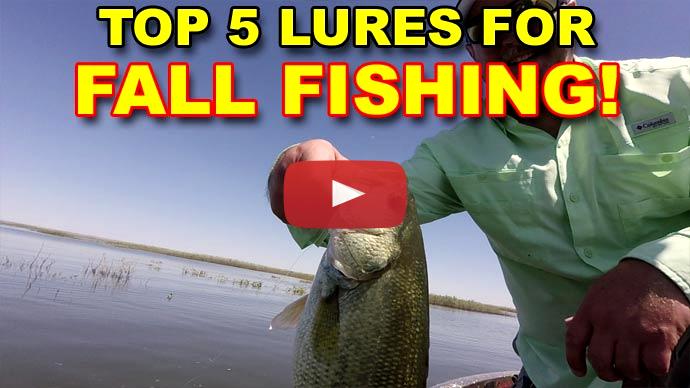
Hey guys, Bassmaster Elite Series pro Wes Logan here going to talk about grass fishing. My favorite, all-time favorite time of year to grass fish—that’s going to be in the fall. That’s going to be anytime from September, depending on where you’re at in the country, to when it gets cold—like cold, cold—because the grass will kind of stay around. But it’s really when it’s starting to die off, and it’s when I really feel like the fishing is probably the toughest, but I feel like it can be the most rewarding. I’ve made a lot of money, I’ve almost won two Elite Series tournaments in the fall on grass lakes, so I feel like I kind of know what I’m looking for in a tournament aspect.
The fishing is a lot tougher, but when you figure out exactly the kind of deal they’re doing, it can be very rewarding. Kind of breaking it down, from the whole year—springtime, we’ve got wintertime—it’s basically dead. It starts getting warmer, the water warms up, it’s getting more sunlight, the grass starts growing. It’s not quite topped out yet. You get into the summertime—you get in that June, July, August—it’s the dog days, it’s hot. That grass is really growing, kind of like the grass in your yard in the summertime. The grass just grows a lot faster. It gets real lush and full and green. You start getting those shorter days and those colder nights, that water temperature starts dropping, that grass starts dying off. And what that does is it creates opportunities to fish that grass different ways than you’ve been able to all year.
I’m going to break down—there’s not very many techniques that I like to do, but they’ve been very successful to me, and I kind of just stick with those and try and find the area that I can do it in. There are going to be two trains of thought that time of year. The number one most obvious is going to be schooling. The fish love to school in that dying grass, in the isolated clumps. The reason for that is the bait’s present—you’re going to get a lot of shad start getting onto these grass flats, like back in these creeks, on these flat creeks or flats in the backs of these creeks. You’ll see big balls of shad up on the top or whatever your forage may be, and you’ll just see fish constantly schooling on them.
But those can be some of the hardest fish to catch all year because they’re focused on such little bait in the fall, and that can be a problem. Not with grass, but if you have grass, that’s where it’s going to be the biggest problem. I like to throw little bitty buzzbaits. I’ve got a buzzbait tied on here—this is a 3/8. This is not necessarily the one I’m going to be throwing. I like to have a lot smaller profile. We’re about to come out with one with Ark Fishing—I have an 1/8 ounce coming out, it’s going to be really good for that. Just a really small, compact profile—very, very quiet. It’s not very loud. I mean, it just mimics those inch-and-three-quarter to two-inch shad that those fish are trying to key on in the fall.
I’ve seen six-pounders come by my boat with their mouths open eating inch-and-a-half shad, just sucking them in like a vacuum. Those fish are very hard to catch. If you don’t get there first thing in the morning, it’s really hard to trick them. But that’s one way that I really like to do it. Very small buzzbait, very natural color—I don’t want a lot of flash. I’ll even throw a black blade sometimes just to have no flash and just have some commotion on top of the water. Really cool way to catch them if they’re doing that deal.
But the deal that I really like to look for—I like flipping grass. I like punching grass. That’s when I’ve had my most success. I’ve got one rigged up here. This one’s on a 1 oz weight. I do it on 7'10", it’s my Knockout rod in my signature series. It’s a 7'10" heavy. It’s a little bit shorter handle than most pitching rods, so I have a little bit shorter arms and it’s not going to get caught on my sleeve a lot as I’m flipping all day. This is a technique that I’m going to put the rod in my hand and not pick up all day.
The reason I’ll do that in a tournament situation is I’m just looking for five to seven bites of the biggest ones in the lake. What I’ve come to find out in my history of doing it is—you’re going to find a stretch. If you’re flipping mats, there are two different trains of thought. You’ll have a straight line of grass that could be possibly on a creek channel or a river channel where there’s a hard edge—like it’ll literally be a wall of grass, hydrilla or milfoil or anything like that.
You’re going to want to figure out—those fish will set up so far off that edge. It may be a foot in, it may be three foot in, depending on how far the grass goes or the depth of the water. I like to start out—if I get on the stretch, I’ll put my trolling motor down and I’ll flip 10 or 15 flips a foot in. I’ll flip 10 or 15 flips three foot in. I’ll flip 10 or 15 flips six foot in. If I get a bite on one of them, I won’t try the rest of them. I’ll do that for a length of time. If I don’t get any bites, it may have been a fluke—I’ll go back to the process I was trying to break down. It’s just a really good way to cover a lot of water doing this technique and try and break it down because they’re very patternable. If you can figure it out that time of year in the grass, they will most likely all set up the same. They won’t all be within one foot and one inch, but you’ll get a judge of where they’re wanting to be.
From a weight standpoint—this is an ounce—it’s really just going to depend on how thick the grass is. That time of year, it’ll start to die off, so you’ll have that hard edge. Here’s some juice: you’ll have the hard edge, and what’ll happen is—it’ll be topped out up into the mat, and there’s going to be a back edge. That fish doesn’t care if it’s a front edge or a back edge—it just wants to be on an edge. More than likely, the majority of the bait is going to be in the mat. So if you can picture it, you’ve got the mat, you’ve got the hard edge out here—there’s an edge on the inside under the mat that’s covered with shade where the water’s going to be cooler. Majority of your bites come on the inside edge.
So if you can ever figure out where that edge is and you’re flipping, that’s where all your bites are going to come from. Depending on how thick that mat is is going to determine what size weight I use. I never go heavier than an ounce and a half. I don’t like a 2 oz because I lose a lot of fish on it. I feel like there’s so much tungsten, and when you bow up on one, that big piece of tungsten has a bad tendency to pop that fish’s mouth open and you don’t get a good hook set.
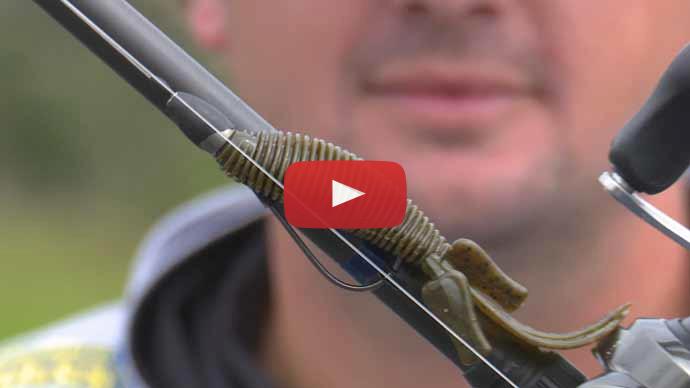
So the highest I’ll go is 1.5 oz. If I’m not getting through there, I’ll just change my baits out to get a slimmer profile or cut the legs off it—just get something that goes in and out the easiest. I like a Z-Craw Junior from Zoom—that’s what I’ve got rigged up here. It goes in and out really well. A Z-Hog Junior is really good too, especially if it’s hard to get through because it’s more streamlined.
Not very many colors I go through. I’ll throw the natural one or black and blue. It kind of just depends on forage. If there’s a lot of shad, I’ll do the black and blue. I don’t really have any scientific reasoning behind that—it just seems to work better for me.
Punching is a hard technique to commit to, but once you start figuring it out, it’s really fun. The stuff you use—the rod, the reel, the line, the setup, the hook, the weight—everything works together. It does with everything, don’t get me wrong, but it’s really critical when flipping grass. You need the right rod, you need the right reel, you need the right line.
My setup: 7'10" heavy Knockout rod, 60lb FX2 Sunline braid, Ark Gravity reel 7:1. I don’t like a real fast reel. We make an 8:1—I don’t use it flipping. I feel like I lose a lot of power and torque, especially on those really big fish in those mats. I’ve had situations where I tried the 8:1 and I’ll get bowed up on one and nothing will move. I can’t turn the reel. The handle turns, but the spool won’t turn because there’s just not enough torque. So 7:1 is the best I’ve found. Still fast enough to get the bait in and out, but I’ve got enough torque to get that fish out of there. I use a Gamakatsu Heavy Cover Flipping Hook most of the time.
The 1/8 oz buzzbait is a really good way to catch them. One I didn’t mention—I just thought about—I don’t have it laying out here: you can sometimes catch them really good on a small popper. But I like to work it kind of like a walking bait. When I say small, I mean the smallest profile you can find to try and mimic those shad. Because if you get out there that time of year, you’re going to see those small shad from that shad spawn in the spring. That fry’s grown up a little bit, and that’s what those fish really key on.
So small topwater and a flipping bait. I kind of go away from the jig because of how thick the mats are. That’s when I like the Texas rig—the heavyweight. It’s not the easiest type of fishing, but it can definitely be the most rewarding. In a tournament situation, you’re only looking for five to seven bites, and that’s the best way I’ve found to catch some really big ones. So next time you’re out there, check that out, and good luck.