Hey guys,
Matty Wong, Elite Series pro here and also an educator on Bassresource.com. Hopefully we're coming at you with some new information for you, but if not, if it's a technique that's something you're already familiar with, maybe a couple little nuances that you might be able to pick up on.
Today we're going to be talking about NEKO rigging in the fall and everything that it takes for this technique—how to set it up, what rod I like to fish it on and what reel, what line, what hook—all the elements when it comes to this very specific and very special finesse technique called the Neko rig.
Now some of you may ask, is it Neeko? I've heard it been called that before. It's named after a cat and in Japanese Neko means cat because, I guess, the way that it looks as it crawls through the water—but I'm not quite sure. I just, I like to fish the technique. So that’s what it is.
First of all, I'm going to talk to you about the rod that I like to utilize. This is the Megabass Orochi X10, and this specific model is called the Medusa. Now there’s a couple different rods that you can utilize, but I like to use a medium to medium light spinning rod that's anywhere from that 6'11" to 7'2".
This is a 6'11", 1/8 ounce to 3/8 ounce rod that has a Stinger tip—a section of the rod tip that's extremely, extremely slow action that then transitions into a harder, faster taper and then shuts off with the backbone, allowing you to make long casts with a light finesse worm and maintain sensitivity throughout the entire cast. That’s why I love using these Megabass rods. They’re literally the sports car of fishing rods, so if you want to check out a high-quality fishing rod, look no further than the Destroyer line or the Orochi line by Megabass.
Hopping right into the reel—this is a 3000 size reel. I like to utilize a 3000 size reel on a lot of my finesse techniques because the arbor size is a lot larger. That means you have a lot quicker and a lot faster line pickup, and also your drag system’s a lot smoother than some of the smaller reels like a 2500 or 1000 size.
Now line is a very important element to this whole technique. I like to utilize this pink braid called Almight, and it’s a sinking line by Sunline. I like to use the 16 LB test, and this line right here has a thinner diameter than traditional braided line. And it has a sinking core. So instead of having your braided line that floats on top of the surface, this line goes straight down under the water, giving you a better connection to your bait—about 20 to 25% more sensitivity when it comes to detecting what your bait's doing at the bottom of the lake.
Now from the braided line, I like to utilize a connection knot to fluorocarbon leader. My favorite type of fluorocarbon leader is called the FC Leader by Sunline as well. It is a little bit more rigid and it also has more abrasion resistance, which is really important personally when fishing the Neko rig, because you’re fishing it on the bottom, you’re fishing it around cover, and you want to be able to set the hook and bring that fish into the boat or onto the shore without having to worry about rubbing your line and breaking off on a rock or a stump or brush pile. So that’s why I like to utilize the FC Leader.
When tying the leader material onto your braid, I only use about 6 to 8 feet long of a leader. I’ve found that the bass aren’t really looking at the length of your leader—they’re really focusing in on the bait itself. So try not to get too wrapped up in the length of your leader material.
Now, in the fall specifically, I like to use a smaller worm. Why? Because the shad and the forage are typically smaller in the fall as they’re starting to push to the backs of pockets. So depending if you're on a natural lake or a highland reservoir, these fish are starting to transition to these fall patterns, pushing off the main lakes back into creeks, following these baitfish as they’re starting to die off and starting to do their pattern as it gets closer and closer to winter.
And in the fall time, you’ll find a lot of the bait is a little bit smaller. Still, it’s kind of a little note that I’ll take from the fly fishing scene called match the hatch. And right here we’re fishing a lake that has maybe 1 to 2 foot of visibility, so I like using a little bit of a darker color—straying away from a little bit more natural colors. But not to say that natural colors won’t work—just utilizing a darker color when the clarity isn’t the best.
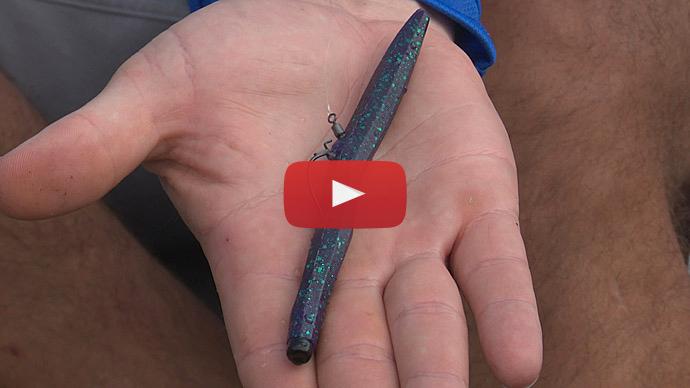
Right here, this hook is called the Antenna hook by Gamakatsu. It has these fluorocarbon keepers and also these two little fluorocarbon weed guards. That’s calling it the Antenna hook. I like to take my hook with the bottom side of this worm facing down. I will go in about halfway and then straight out, making sure that the hook tip is facing straight up. That is really, really important when it comes to this technique.
Another way to hook it is just straight in the middle of the bait. It gives it a different action as you’re starting to pull it, but that’s something you can kind of play with as you’re starting to get more and more into this technique.
Another way that you can Neko rig a worm is—you put the nail weight in the nose and, utilizing the Antenna worm hook, you will then Texas rig the worm just like this. And so the very tail section of your worm has the hook in it and the weight is in the nose. You’re able to thread this through deep cover or rocks or whichever isolated stuff that you choose to fish with this rig.
The cool thing about this technique is there’s no right or wrongs—there’s just little things that help put more fish in the boat.
Now in the fall, I think it’s really important to utilize a lighter weight because you’re fishing more in the backs of the pockets. It gives the fish a longer time to see the bait fall, giving them a little bit more time to look at it versus it just ripping by their face—maybe getting a reaction bite in the summer or in the springtime. So that’s a little tip that I like to utilize when it comes to fall time rigging.
But that is the whole setup right there, folks. We got the reel, the braid, the line, the hook.
One very important thing that we’re going to talk about is your nail weights. So right here I have an assortment of a bunch of different weights. I got everywhere from a 3/8 ounce all the way down to a 1/16. And you can utilize tungsten, you can utilize lead. But the good thing about lead is that if you’re wanting to use an even lighter weight, you can take your pliers and you can break off a small little piece of nail and put that in your worm. Little Gamakatsu G Box makes it easy to keep all those things all nice and organized.
But hopefully you guys learned a little tip or two about rigging, and it’s a little technique that if you’re not familiar with, you might want to take a look and give it a shot. Might end up putting more fish in the boat or onshore for you.
See you next time.