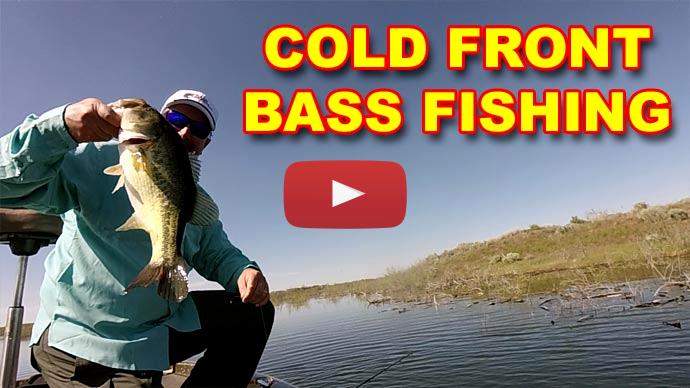


You’ll learn where bass position after big storms, how to adjust when the water’s dropping, how to fish mud lines and clearer backwaters, and what lures to throw when visibility tanks.
Hey, if you've been fishing long enough. Then you've had to fish after a heavy rain, right? And sometimes that can be really difficult situation. So let's talk about that.
First of all, if you've got a day or two of heavy rain that comes through, you could be faced with post front conditions that might be associated with a front without rain coming through. And the best way to tell? Is that the skies clear up, you've got blue skies, the wind kind of dies down if not completely goes away, and the air temps are a bit cooler. Yeah, that's classic post front condition.
What you're going to be met with are bass that are in a neutral to negative feeding mood. So what it often does is that it pushes the bass real tight to cover or even in it. So if you're up shallow, flipping and pitching a jig or a worm or some kind of soft plastic that doesn't have a lot of action to it is usually the key to getting a bite.
You've got to fish your bait real slow and just let it sit on the bottom. A little bit of movement, let it sit. It takes a lot of patience, but you can coerce a bite out of them by fishing that.
One thing to know though is that sometimes you know the bass that are deeper, they don't get as affected by a front than the ones that are shallow. So if you're not able to get a bite out of the bass that are shallow, break out your finesse gear and use small baits, 4 inch baits and drop shot, split shot rig, Ned rig. Neko and go out there and fish deeper water and deeper structure like deep points or humps or maybe a Creek channel.
They'll back off to that and those fish will be a little more active and you might be able to coerce a bite out of that, right? So that's a couple things to keep in mind if you're met with those conditions.
Now, whether it's a warm rain or a cold rain. That can have a big impact, for example, in the spring and the temps are just warming up. If you get suddenly an influx of heavy rain and the temps go up during that rain, say for example the tropical storm or something or you've got. You know, a front system that came from warmer weather, and now suddenly you've got a rise in warmth.
Warm rain tends to warm up the lake faster than anything, even direct sunlight. And in the spring, that's a good thing. That's going to bring everything up shallow. They're going to get active and you're going to some of the best days I've had, I've had right after a warm rain.
Conversely, if you have cold water and cold rain, it can have the opposite effect. It can actually neutralize an active bite, especially in the fall if you've got really warm surface temps and you've got this cold rain that comes in for several days, that can actually cause a turnover.
And turnover is when you've got cooler water on the surface and warmer water underneath. Heat rises, so turnover is that warm. Warm water is going to rise to the the top and the cold. Cold water is going to drop. It's going to mix up everything. It's going to bring a bunch of debris and detritus from the bottom.
Decaying matter and oxygen levels are going to go down. Visibility is going to go down and it just shuts the bite off. It really does. And that's going to last a week or so. So pay attention to that, particularly in the fall if you've got that cold rain that comes through, it could be a bad situation.
Now the intensity of the rain can have a factor too. You get heavy, heavy rain for a day or two and maybe even more. That can do a couple of things.
First of all, it can raise the lake level, and that's not a bad thing. The lake levels going up, the fish will move in to that shallow area almost immediately. I mean, I've seen it where it seems like their backs are sticking out of water. They'll be like 6 or 8 inches of water. They'll come right up with it.
And because there's a lot of insects and new vegetation, they just like to get up right in there right away and that can be a heyday. So it's also important to note that because of the water's rising, you want to follow those fish and get right up in there with them. And sometimes it's flooded areas that you may not fish very often at all and you may not think the fish are there, but they they do they get right up in there.
However, the powers that be decide that they want to open the floodgates. They could be dropping the water levels even though you've had a heavy rain, it could be dropping.
So don't assume that your water levels are going up. If the water levels are dropping, the bass will get out of that shallow water as quickly as possible. OK, preservation, self preservation is a key factor. Even if they're spawning, even if they got a bed, they will abandon it in order to survive. It's just plain old survival instincts.
So if the water levels are dropping, those bass will scatter and disappear out of the shallows and maybe seem really. Difficult to find them.
But if they are doing that and they got the floodgates open, that also means you've got additional current. And so if you've got current going through those bass are going to set up on points that on humps, they're going to set up on bridge pilings, other things, that break the, you'll have other current brakes.
And feeding on fish coming through there, little bait fish. So you could, they can stack up on that. And so instead of banging the shoreline here, you might want to pull out a little bit deeper and find those current breaks.
Even if you got a natural lake that doesn't have floodgates, natural lakes have, you know, water that's coming in and they've got an outflow. OK. If you're used to fishing that lake all the time like it's your home water, you get a heavy downpour. It could create some current coming through. You might have a higher water levels, cool, they're up shallow and you've got current. So look for things that they can set up on whether they may not normally be there any other time of the year, but with that current. They may position them a little bit different, so be aware of that and try fishing some areas that you've not had very good success at in normal situations.
But that heavy rain may change things on you and you might find yourself having a heyday.
Another thing that that heavy rain can do is muddy up the water. It can dirty it up quite a bit. And if you're fishing a river system, the water's flowing through there.
Those back eddies and coves, those little pockets, they may not be as muddy as the main channel, the main river. So that's where I would target. Get this, get away from the muddy areas and fish those clear waters and you might have a mud line. Really a real clear mud line between those areas.
And you can fish those mud lines like you would a weed line, right? With crankbait, spinner, baits, top waters. Just fish it like you would any other kind of cover. You'd be surprised.
Sometimes a bass sit up there in the mud line. And they dart out in the clearer water feeding on forage and bait fish. So make sure you fish that mud line.
Now. It this is this next piece is really depends on how many days after the heavy rain you fish. But those tributaries in feeder creeks, they're going to be muddy. They're the ones that actually end up muddy in the water at first.
But as the days go by, then the clearer water is going to 1st appear way up in those feeder creeks, way up in those back eddies. And it's got this, those channels where the water's coming in.
Those will clear up first. So if you're fishing that muddy water, you're not catching very many fish. You can go up in those feeder creek areas and up in those back end of those bays and you can find cleaner water and you might be able to catch a bunch of fish that way.
If you still can't find any really clear water and you fish in muddy water, then fish baits that are real flashy. That have a lot of vibration and noise, right? Crankbaits with a lot of rattles in them.
Spinner baits with single Colorado blades, you know, thump, thump, thump, thump, thump, thump, you know, get that vibration going. Something those bass can hone in on using the lateral lines rather than sight.
That's the thing you want to fish. Worms with giant tails on them are, you know, got a lot of flappers to them, make a lot of noise, a lot of action, a lot of vibration. Those are the things you want to fish in those muddy water situations until the situation cleans up, the water gets back to normal again.
One other thing I want to mention too is if a front comes through at night. And you get the storm that comes through at night. This is the thing I've noticed. Is if you've got a lot of lightning and thunder associated with it.
At night, all that in my opinion, but you get a lot of flash, flash, flash, flash, flash from all that lightning and that spooks the bass. I've had tournaments where I've caught a bunch of fish up shallow and active biting done, had a good day and then a thunderstorm rolls through at night and that next day they are gone. They're just not there at all.
And the water temps are close to being the same. You haven't had a lot of rain come through. But I think that lightning is kind of like paparazzi, man. They just like don't like the limelight they want. Out that's my opinion have you guys had the similar experience I'd like to know that you know leave that in the comments below I believe that it's because if you have a thunderstorm come through in the day you really don't I haven't experienced that kind of change if it comes through in the day if those fish were shallow they're still shallow afterwards usually unless it's a big low that's come through we've had that post front condition that I mentioned earlier but typically they don't scatter if a thunderstorm comes through in the day but at night I think the. Flashing Lights, that what’s spooks them.
You tell me. Have you had a similar experience? I'd like to know.
But with that information, you should be armed well enough to be able to fish after heavy rain and catch some fish.
Hope that helps. For more tips and tricks like that, visit bassresource.com.