It's July, which means a lot of you guys like to start fishing deep this time of year. Why? Well, there's a good chunk of the population of bass that are deep. Now, deep meaning usually deeper than 15 feet deep. And when you're that deep, typically, you're dealing with rocky bottoms or hard bottoms, which is the topic of today's video.
Now, you got to find the good stuff first, and that means spending a little bit of attention with your electronics. The best way to find these good solid hard bottoms is take your depth finder. Whatever depth you're at, double the range on your depth finder. So let's say you're at 17 feet deep, set your range for 40 feet deep. What you're looking for is another line that's twice the depth. So you're at 17 feet deep, you've probably got a good solid hard black line. Good. Thirty-four feet deep, you might see another line. The more distinct, the darker, more solid that second line is, the harder the bottom is. Now, why is that?
Well, what a depth finder does, basically, it pings a little signal, it bounces off the bottom, and it comes back, and it hears that ping. It measures the time between when it sends it and then receives it, and that's your depth. Well, when you have a hard bottom...well, let's say this, when you've got a soft bottom, pretty much most of the bottom absorbs that sound, but there's still enough to bounce back to your transducer. But when you have a hard bottom, well, the bulk of the majority of that sound signal comes all the way back to the boat. Now, it hits your hull and bounces back, hits that hard bottom, and bounces back again. And you've got now double the distance, hence, that second ping. So that second line that's twice the depth of what you really are at, that indicates you're at a hard bottom because you've got that bouncing back and forth, good solid, strong solid surface. So that's a quick little tip.
I'm sorry, you guys, from the shorelines, you don't have a depth finder, but another way is just casting out there and you can feel. You can tell when you're scraping on bottom and when you're digging on soft bottom. So just cast out there until you start finding a hard bottom. That's a poor man's way of doing it and how I used to do it for years. I used to fish out of a rubber raft. No depth finder at all. So I just cast out and feel and figure out what's on the bottom. That still works today.
But once you find that hard bottom, the next thing is you want to find stuff that the bass can relate to, typically in the form of boulders, but you can find stumps out there, maybe standing timber or laydowns or other type of debris where the bass can hug up against and nestle against. When you find cover on rocky bottoms like that and solid rock bottoms, you got to fish them. That's where the bass are going to be at. So, how do you go about doing it?
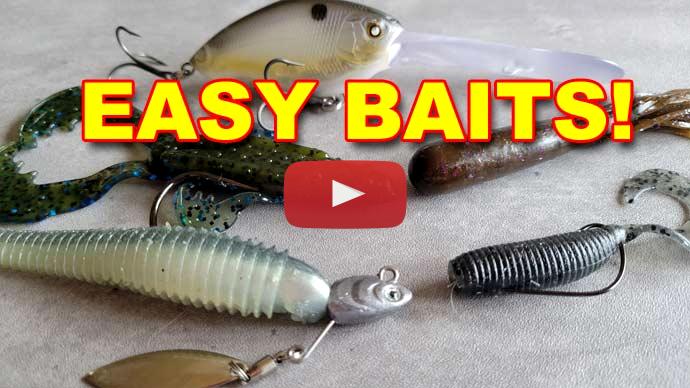
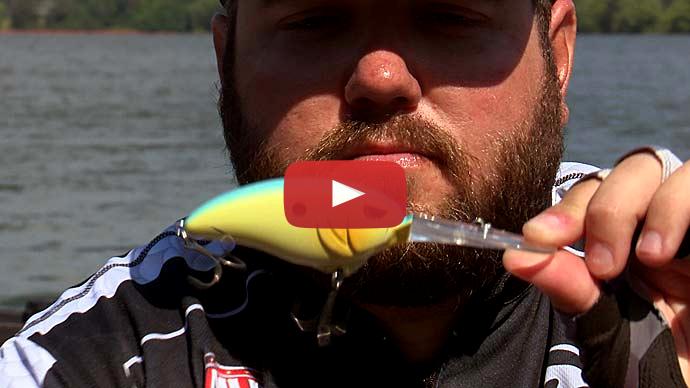
Well, the first thing that I do during July is break out the crankbaits, man. You want to get a crankbait that goes down deeper than the depth you're fishing. So let's use that 17-foot example again. Grab a crankbait that dives down to 20-foot depth. Why? You want it banging and ricocheting off the bottom. When it does that, it's doing this. It's bouncing. It's hunting. It's acting erratic. It's crazy on the bottom. If you've ever seen it, it's like, "Wow, this is nuts." And it's just vibrating like crazy in your rod. Well, that drives bass baddie, man. They can't stand it. And a matter of fact, say you can only get a crankbait that only does 15 feet deep and you're at 17-foot. Hopefully, you can find a boulder or two that's sticking up off the bottom that you can hit and deflect off of that, even still, that erratic action, that quick change of direction can trigger a strike.
But a lot of times, if you're just cranking it straight on through, you don't get a lot of bites. You can still catch bass that way, but you catch more if you can impart some kind of erratic action. Even if you're not able to bang it against things, you can twitch your rod tip. You can stop and pause and wait a couple of seconds. That stops the bait. It starts to float up, changes direction. Then you reel down again, and it changes direction again. Anything you can do to impart that action can get a bass to bite.
Now, typically, those are hunger bites, but when you're digging in all down the bottom and it's going crazy, you're more or less forcing them to bite. You're actually triggering a bite because bass, they are also very curious. When something's going crazy down there and they don't know what it is, they can't touch it and feel it to figure out what it is. They've got to put it in their mouth to feel it. And a lot of times, you're getting a curiosity bite. So doing that raises their curiosity. They'll come check it out, and they'll nail it just to check out what it is, and you've got yourself a bass. So try that with your crankbaits.
Now, of course, you want the crankbaits to have the color of the forage that's in the lake. So that could be your perch, bluegill, particularly. Bluegill are really predominant right now, and that's what the bass are really keying in on. Shad, of course, if your lake has shad. And also crawdads, sculpin, those other forage that the bass are keying on. If you're fishing primarily smallmouth, then you can throw in a chrome with blue back or a chrome with black back. Smallmouth really like those for some reason. And that's it. You don't want to go too crazy with your colors right now in July.
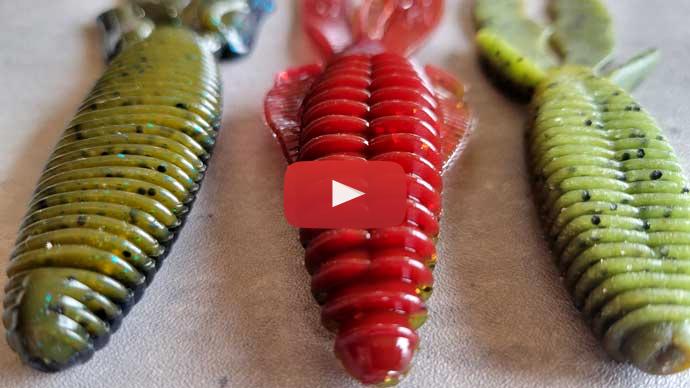
But sometimes bass aren't aggressive. They're just not in the mood to deal with that stuff. And banging and making all the crazy noises actually scares them away and spooks them. When that happens, you've got to slow it down a little bit and drag something on the bottom. That's when I break out a football jig. And I put a hula grub on the end of it, a five-inch hula grub. Typically, it's either smoke with pepper flake or it's cinnamon and black flake. Yamamoto, the color is called 176, it's kind of a brown color. It resembles a crawdad. And you throw it out and let it drop all the way to the bottom, and you just drag it. Just drag it across that hard rocky bottom, occasionally pausing it. If you come across something, pause it and kind of rock it back and forth with your rod. You're trying to tip it on the football jig, making it kind of look like a crawdad kind of wavering on the bottom. And a lot of times, the fish will just pick it up off that, just by that action.
Now, one other trick you can do with a football jig, I've never seen anybody talk about this one because I discovered this one on my own. All right, I've already started it. Cat's going to be out of the bag. I'm revealing a big secret of mine, guys. I don't think any YouTuber or anybody else has ever discussed this. I haven't seen anybody talk about it. So if you hear about anybody talking about this, look on the date on the video. They've probably got it from this one. Not that I'm claiming originality here, but I don't hear people talk about this technique. But it works.
So what you do is you take a football jig, you want at least a half-ounce, three-quarters, even better, and you get in on those rocks. And what you want to do is you're going to lift up and drop, lift up and drop, lift up and drop. What you're doing is you're banging it on the rocks. Just bang, bam, bam. And then you pause it, and then you start to drag it again. I believe that sound triggers that curiosity again, and they come out, check it out, see what it is, and then they see this thing crawling on the bottom, and they nail it. Okay? You draw them in with that sound, and then you move it, and they nail it. Sometimes they hit it while you're banging it. Sometimes a fast bang, bang, bang, bang, bang, and tap, tap, tap, that sound, and then you pull it across, and boom, there it is. Just something I picked up on one day, just kind of screwing around, and sure enough, it worked. And it consistently works, especially in July. So give that shot a try.
Now, there's a lot of action involved in all that. Again, so if the bass bite is even down, so you've got a front that's come through or for some reason the bite's really shut off, that's when I resort to an eighth-ounce ball head jig, and I'll put either a four-inch or five-inch finesse worm on it. Sometimes I'll rig a tube, a three-inch tube, and just put a ball head jig inside the tube. And get that down there on the bottom and just drag it on the bottom very, very slowly. Okay. A finesse worm and a tube, they don't have a lot of action to them, and that kind of mimics the disposition of the fish if they're inactive or not in a feeding mood. You just slowly drag it with pauses in between and feel for that bite. Every time you lift up on the tension, feel for it, and there might be a fish on the other end. A lot of times, it just gets heavy. They're not going to aggressively grab it and dart off with it and pull on your line. You're just going to feel a heavy kind of spongy feeling.
If you want to practice that bite, take a rubber band and put it between your two fingers and stretch it. You'll feel it. It's a pressure bite. That's the best way I can explain it. It's just this pressure you feel. And after a while, at times, you'll think it's a log or you've got hung up on some rocks or maybe some weeds, but after a while, you'll begin to figure out, you'll notice there's a difference to it. And that's a bite. And swings are free, guys. They're always free. So even if it is a weed and you swing on it, okay, well, it wasn't a fish. But I can't tell you how many times I thought it was a weed, I swung on it, and it was a fish. So don't be afraid to set the hook even if you're not sure if it's a fish or not because you might be surprised.
So with those tactics in mind, you're going to catch a bunch of fish off rocky bottoms this July. Hope that helps. For more tips and tricks like this, visit bassresource.com.