

You’ll learn what color is the ultimate all-around color, when dark silhouettes out-perform bright baits, how translucency matters in clear water, and why certain colors shine in spring, deep water, or when targeting smallmouth.
Choosing lure colors can be a daunting task, especially when you're trying to figure out how to match the water clarities. So I'm going to make it really easy for you today, really simple.
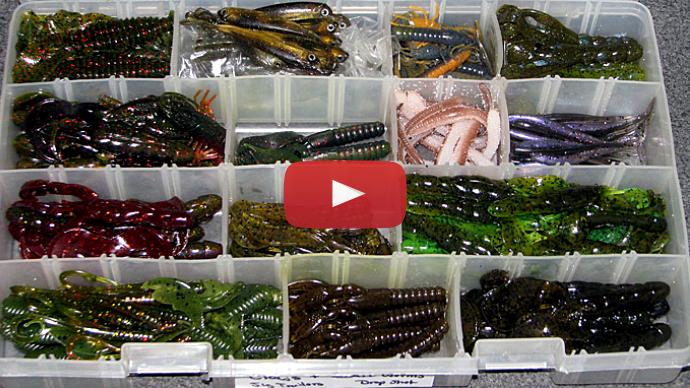
Let's start with plastics with plastic baits. Really the go to color no matter what is green pumpkin. So let me show you a couple different baits in green pumpkin, just so you know what that is.
But here we got the. Missile baits, Mini D bomb, green pumpkin. We've got the V&M baits trailer. Same color green pumpkin. I even got a tube bait here. And in green pumpkin, this has got some. Pepper flake in it, all the same thing.
OK, pretty much every manufacturer that comes out with a plastic bait. Comes out with a green pumpkin because it's so popular and it works so well under various conditions. If you're going to have one lure color for plastics, it would be green pumpkin, but dive into it a little bit deeper.
If you're faced with muddy conditions or it's just dingy water, or perhaps it's cloudy out and really dark skies and not much light penetration, then the darker color actually works. Yeah, I know. That sounds really weird.
Dark colors like black or black and blue, they show up as a silhouette in that dark color, in that dark water in the dark light. And it actually shows up better.
So something like this, this is another Missile Baits D bomb. And you can see it's it's, you know, blue on one side and then we've got black here on the other side. So this is a perfect example of the right kind of bait to get when you're faced with really dark or muddy conditions. You want a darker bait like this, OK?
On the other hand of the spectrum is really clear water, especially bright sunny days, but even if it's cloudy out. Clear water can be a challenge sometimes. Well. It's not that hard.
First of all, watermelon seed. Right, your watermelon colors. So like these two, this one's here is a rage craw watermelon. You can see it's a little bit lighter color than the green pumpkin.
This one, this is the Missile Baits D bomb. And you can see, see my fingers behind it. See how translucent that is? It's just a much lighter color. There's still a kind of a green shade and this one, this one has, you know, some red flake in it.
So does this some red flake, which is great. So watermelon seed red flake, great color.
If I was going to choose a color for clear water, that's the one I would use, but two others that are really good.
If it's kind of cloudy out, I like to go with the smoke. So this is a. Yamamoto Baits Twin tail grub. And you can see it's pretty transparent. So. Smoke is really good.
And then this one here is some Missile Baits. Right. So I think it's called Missile Dawn or something like that. It's kind of a purple color. Really good. This is great for drop shooting, split shooting any of your finesse tactics, a worm in this color and really clear water, especially in the fall. Killer, killer, killer color, you know, so make sure you have that if you're faced with some clear water.
So that's your plastics.
For jigs, jigs is pretty well straightforward. It's actually it's easier. So again, when you got clear water or any color really, the green pumpkins work really well.
So here's a green pumpkin with that same V&M trailer on it I showed you before. It's just kind of a green pumpkin color. Perfect for any kind of situation, but I like it for, you know, clear water.
And then when you're. If you want a color that matches for like everything to your black and black and blue, this one's got some purple flake in it or purple strands in it, but it's mostly black and blue. That's like your bread and butter. It's like for all kinds of of bass machine.
Peanut butter and Jelly is another color, which is a brown and purple color that a lot of people like to fish. And if you hit with really dingy muddy water, I'd like to give a little bit of splash of color into it. So black and chartreuse is what I would do for jig for that, just to give a little. Little added attraction to it, but that's really all you need for jigs.
You don't need to go too hog wild and bunch of other colors.
So for hard baits, there's really 3 variables. That's the water clarity. How bright the sun is. And your bait fish, what kind of forage is in that lake?
So let's talk about top water. First of all, it's actually a lot easier with top water. So we'll start with that top water.
Really what you want is a white belly. I mean, that's like universal. Again, like on the green pumpkin analogy.
So here's a Sammy. It's in a frog pattern. This is a pop R, It's in kind of a trout color. But look, they both have white bottom. It's just the white shows up a lot better on top water baits than most any other color.
So it's something that I would use regardless of the water clarity, but it works especially well if it's clear.
But if you've got, say, for example, perch in your lake, then maybe go for, you know, here's another popper style, but the bottom's got that orange yellow belly. That perch. So something like that would work really well in perch waters.
And other colors that you want to go with. If it's kind of a I get some dingy water, a little bit of muddy, but mostly just kind of stained dingy water, then a muted color. So something like this. For your jerk baits. So it's just kind of muted. It's just not very flashy at all, kind of dull color and it's a shad. You know, so you want to match your bait fish.
So here's your shad pattern in a muted color. Perfect if you got shad in your leg, however.
If you got a bright sunny day, then something that's really flashy, that really reflects all that sunlight. So like these two colors, nice and flashy. See that They're almost Chrome. Not quite Chrome, but they've got a lot of flash to them. It works really good when it's sunny out.
If you've got really Clear water, then you want a bait that's got some. Transparency to it. So here's Azerisbook, as you can see, you can see through a little bit. OK, and here's another jerk bait. And you can kind of see through it.
So some translucent, I don't call it transparent, it's not clear like you can see through a window, but it's you can see the light through it a little bit that's. Kind of what you want for Clear water.
For crankbaits, it's very similar, but you've got a little bit of added. Forage in there. We'll talk about that in a second.
Let's talk about spring. Spring is notorious for red. It's, you know, in less than 5 feet of water, red shows up really well and the majority of the bass are up shallow, less than 5 feet of water. So red is a great color to have in your arsenal.
Here I've got a couple of crankbaits. I've got a rattle trap here and a bomber, both red. OK. I mean, you got to have them. If you're fishing the springtime and you're fishing crankbaits, you should have red ready to go, but also crawdad colors because in the spring, that's when the crawdads start to get more active.
They come out, they're more available to the bass, and they're going to be gorging on crawdads. So having a variety of crawdads, you saw one just now. Both of those were in the crawdad pattern, by the way.
But here's two others, a brown. And. A green also most like green pumpkin. Look at that. We're seeing a pattern here, but green pumpkin in brown and then the red shade crawdad patterns, those you got to have handy in the springtime and even during the summer and fall, having the brown and the and the green pumpkin crawdad color crankbaits, bass are feeding on them all during the warmer months. So definitely have those in your arsenal.
The rest of it has to do with. As far as crankbait is what's the forage in your leg? So if you have a lot of shad in your leg for example. White colored crankbaits or shad pattern crankbaits.
So like this one here, it's a white crankbait, a little bit of a color on the back, but you know it's got the dot on its shad. So having a bunch of shad color crank bits can work really well.
However, if you or well, let's go a little bit. This one here first.
Bluegill are in every lake and river around North America, so you got to have bluegill. So here's a bluegill pattern. Really beautiful. Actually. I really like it.
But this is a good bluegill type bait and if you're in the northern climates, perch is really prevalent. So perch color, this is a really nice looking perch pattern. So have those handy and ready to go for your crankbaits.
Now, there's always exceptions to the rule, and one of them has to do a small mouth. Small mouth, like bright, gaudy colors. And regardless of water clarity or how bright the sun is, they like something with a splash of color or just something really bright and obnoxious.
So I've got a couple of baits here that I have ready to go. All the time.
So Fire Tiger. First of all, Fire Tiger is a great color to have in any crankbait. Have those ready to go.
If you're fishing smallies, definitely fire tiger pattern or like this is a. I think this is called the parent color. Again, bright gaudy colors, but small Mouth crave it man. They they love this stuff.
The other thing small mouth actually really love is the Chromes. So I've got in rattle traps Chrome with blue back and Chrome with black back and you can see these are beat up. Look at this.
The finishes on them are just marred because the smallies just beat the snot out of this. They love Chrome with black back and Chrome with blue.
I find it a little bit Clear water, a really Clear water. They like the blue and if it's dingy or maybe it's cloudy out, they like with the black back. I can't explain it why, but I just know that that's what they like.
And then finally. In your body of water, if you got walleye or perch or something like that. When it gets your deep diving crankbaits, the colors become muted. And they're not as vibrant, and it almost becomes shades of Gray.
So what I do, one of the things I like to do is going back to the dark colors when it's muddy out or dark colors when it's cloudy out.
I do a dark colored crankbaits that are perch pattern. So these happen to be black and purple. And they basically just become the pattern. You can barely see the pattern on this one.
I don't know if you can see the pattern on this very well, but. They they got a perch pattern to it. And. When they get down there deeper in that 10 to 15 foot zone, most of the color washes out.
You just see the perch pattern on it and it works really, really well. So think about that.
When you're fishing the deeper diving crankbaits, sometimes it's more of the silhouette in the pattern, scale, color of the. Forage in your in your river lake more so than the actual resemblance of it, like the the perch I showed you earlier.
Like like this one, like you know, this is more realistic, this is more for shallower conditions in Clear water. Our realism makes more sense, so armed with that information, you should be able to choose the right color depending on the water clarity for a variety of baits.
Hope that helps. For more tips and tricks like this, visit bassresource.com.