Well, winter is finally disappearing in the rearview mirror, and spring is right in front of us. It's still not quite spring yet. We're still dealing with cold weather and cold water. But the fish are moving and they're getting active. So what are the ways to get them right now?
First of all, let's deal with the cold because you're out there trying to get some bass that may be unwilling to bite, that might not be in an active mood here. You're trying really hard to get them to bite, plus you're dealing with the cold temperatures. And if you're cold and wet and uncomfortable, your mind is not going to be focused on fishing as much as it should be.
So first of all, you know, invest in some quality clothing, outdoor gear. There's plenty out there from AFTCO and Simms, Whitewater and plenty others that make some really good quality outdoor apparel. Just make sure that it's 100% waterproof and windproof and very well insulated. With that in mind you, almost, I call it armor. I put on my armor because I am comfortable all day long. I look like the Stay PufF marshmallow man, but I am comfortable and dry inside and I can fish all day long. So, you know, invest in some and same with the shoes and the boots, make sure they're waterproof. Guys, you know, cold feet is terrible. It's awful. So just once you've invested the money, it's going to last you years and when you're out in that nasty weather, you're not even going to be thinking about how much money you spent on it. So that's number one key. And dress in layers, a lot of layers. You can always take it off as it gets warmer out. Maybe the cloud burst has gone away, but if you don't have that the first place to wear, then you're kind of out of luck and you're going to have a short day that way, so.
Enough about that. How to go after them? Well, one of the fastest ways to locate bass and see what their activity level is, is with crankbaits. I start with deep diving crankbaits and start down the deeper areas. Of those weed lines and those transition areas, those migration routes that the bass used to follow from the wintering areas all the way up to where they're going to spawn. And it's easier and faster and more efficient to use crankbaits to cover a lot of water to kind of figure out what depth they're at and what kind of weeds they're holding on or what kind of cover. I just get down there and hopefully find those areas where you've got some hard bottom or hardcover that abuts adjacent to that weeds. And that's kind of the area that I like to target. Just bring those crankbaits along there and hopefully get some bites and you pick up a few fish along the way.
If you do, if you find a stretch where you're getting some bites, I'll go back through that area and slow it down with a follow-up bait like a jig. Just kind of crawl along the bottom and pick up a few more bites that way or with a Carolina rig. And Carolina Riggs an excellent way to catch fish this time of year.
Speaking about that, let's talk about that a little bit. Carolina rig has been around for several decades and this is an excellent rig to use during the pre spawn period. You can drag it around points and rock piles and humps and ridges and ledges and all those creek channels and everything the bass are using as a migration route. You can cover a lot of water with a Carolina rig.
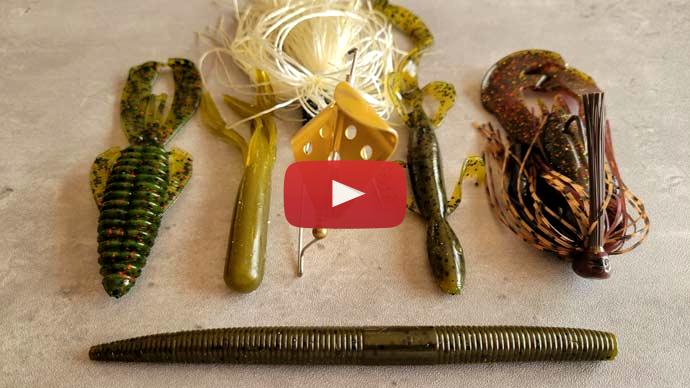
Now what I like to use in a. Rig is either a straight tail worm like a you know, a Missile Baits Magic Worm, maybe a six inch straight tail worm or maybe I'll use a lizard like a six inch Rage lizard that's got a lot of movement to it if the fish are a little more active. A 6 inch lizard works really well this time of year and another one I'd like to use is like a Missile Baits D Bomb. If you haven't seen any of those like this. Right Missile Baits, D Bomb, great baits. Got kind of a a bluegill. Kind of profile to it. It's got some action to it. Great bait to pull behind a Carolina rig.
The thing about the Carolina rig a lot of guys do is because they're using fluorocarbon with this is even with braid, they'll have braid as a mainline. I don't recommend that I want fluorocarbon because fluorocarbon is more is is more abrasion resistant and you're going to be dragging this through an awful lot of different forms of cover and braid and rock don't go together very well. Braid really frays a lot more in rock than fluorocarbon. So I'll use. Carbon line is my main line and then as the this is the important part, the leader, the part between your swivel and hook about 18 inches, 24 inches. Use Mono. A lot of guys don't do that. They just add more fluorocarbon on there.
Here's the problem. The thing with the Carolina rig, what makes it really potent is that as you lift and drop and lift and drop, it brings the bait up off the bottom and then it flutters back down and fluorocarbon line it. It sinks. It's not like weighted, but it absorbs water. It sinks and it'll bring that bait down faster. Whereas monofilament floats. It's buoyant. And so it will slow down the fall of that bait.
Additionally, I don't use a flipping hook at the end. This is another reason why I don't use braid, because it's not stretch edit at all. I'll use a regular wire hook. On the end of it, because it's lighter, it's less weight. A flipping hook's thicker stouter has more weight and that'll bring the bait down faster. So a light lighter wire hook paired with monofilament will help keep that bait up higher and help it slow its fall when you when you lift and drop with the Carolina rig. So kind of keep that in mind.
Another bait to use this time of year is a jig. I mean, you can use jig all year round, so this is no different, but there's a couple different styles of jigs that really shine this time of year. One of them is the Arkie style jig. That's this guy. It's sometimes called the casting jig, but you can see the head is somewhat pointed. And it's kind of flat. And you can see, you know, that the tie, the line ties up in the front and the hook sticks up. OK. A couple characteristics to it.
This is kind of your all around all-purpose jig and you can use that in rocks, in wood, even in weed. It will come through really well. I trimmed down this wire guide a little bit so it meets it. It's right to the end of the hook because the weeds aren't that thick right now, so you don't need a real long thick weed guard here.
And color wise, you just, you know, if you can clear water the Browns, the greens, the the watermelon, like this one, you can see it has pretty much every color in it. Works pretty well. Your black and blue jig is the perennial favorite. You can use that in any color water. And if you've got some stained water and turbidity in it, then something with some chart chartreuse in it, like this one, this black and chartreuse. Arkie style jig. Works really well.
And you can use that in, you know, you're kind of the trailer that you put on. It kind of depends on activity level, the fish, you've got a kind of a flapper style jig like the Rage Craw. Right. I mean, it's got a lot of action to it because of the edges of the craw. And that move makes them bait, just kick and move and make a lot of action. And that works really well when they're active and moving around and actively feeding. But if they're not, then you can use something like a chunk. You know, look at this Missile Baits chunk. It's just a little chunk. Trailer doesn't have as much action to it. It's smaller, doesn't move as much or something like this. I've got this from V&M baits. This is really not really much action at all. If the bass, the bite is really, really off, then something like that with a lot of action. So the Arkie style is something definitely would have on hand. I would use having you from 1/4 ounce to 1/2 ounce. Your 3/8 in the middle there would be the one you use most of the time for most depths.
Another one to have on hand is a football Jig. If you haven't seen one of those, it's called the football jig because guess what? The head of it is the shape of a football. Yeah. So the cool thing about this is you crawl this on the bottom, you just drag it and it wobbles, you know, kind of side to side, wobble back and forth. You get a craw trailer on the end of it. And it looks just like a crawdad crawling on the bottom. So this is really good for rocky areas where crawdads would be. Put it in where there's riprap or you've got gravel that's around the base of bridge pilings or sometimes along sea walls or around dock pilings. You know, this is a great area to throw a football jig this time of year. It'd definitely be having one of those. And again, the same colors I just mentioned as with the Arkie jig. Same thing with that.
Another one to use also is your ball head style jig right? This is a round ball. Oftentimes in the form of finesse jig. This is great for fishing points that's got a lot of rocks or stumps on it, a lot of open water area. These are you know, you put a smaller size jig on that Smallies love this, but I've caught plenty of largemouth on these type of jigs as well. Is this good open all-purpose kind of a open water type jig, however? Don't be afraid to throw in weeds too, it does have a weed guard on it. It's not all of them come with a weed guard, but get the ones with the weed guard and boy howdy, you can throw this in weeds and catch a lot of fish and weeds too. So it's a really versatile type of jig. I like it a lot during the colder months because you got a lot of control over it. The eye ties line ties up here on the top. Works great.
The other type of jigs to use are the shaky head jigs and you've got the round. You've got all kinds of stylish shaky heads, but the ones I really like the most are the round head style, the round ball type style and then the football style.
The football style is very much like the football jig. I'll put again a craw trailer on there or maybe a split tail grub. And crawl that along the bottom. And again, it wobbles and rocks back and forth and looks just like a little crawdad crawling on the bottom. It's a great little imitation, great craw imitator.
You can skip it up underneath docks too and crawl alongside docks. That hard bottom around docks can be really good. So that's that's where I would use this, that shaky head style.
The round would be pretty much for everything else. The roundhead shaky head, those I would put like a six inch worm on them for example, straight tail worm or I would throw. You can put a craw imitator on there, but sometimes a small creature bait on there or maybe a four inch lizard or a Rage hog, those type of things. Those smaller creature baits is what I put on the round ball and you crawl that around the weed edges and if the fish are, you know, they don't really want to bite right now, you've got maybe a front that's come through. We get so many of them come through in the springtime. This is a great bait to use a shaky head, throw it right on the inside weed lines or little pockets inside of weeds. Great little finesse type.
Approach to get those reluctant bass to bite. And you can fish it deeper too. Sometimes those fronts will push those bass back out deeper and using a round ball shaky head to get to them and work those deep rock piles and those humps and those deeper weed edges, it's a really good bait to use for the getting those bass.
Another rig you've got to have in your arsenal right now is a drop shot. This is used really for pinpoint areas, working an area really thoroughly, like a point or a rock pile or an area where you've caught fish before and with a faster moving and more active baits and you want to go back through and just pick your way through everything and pick it all apart and get the remaining fish out of it. So drop shot is designed for that. So it’s not really designed for covering a lot of water. You spend a lot of time fishing dead water that way. But a drop shot works really good, like a long bridge pilings. And those ledges, those steeper banks, those areas that you want to pinpoint and accurately just work work at real methodically,
A great bait to use right this time of year is like a four inch Missile Baits Magic Worm. I like this. Like that, it's wonderful. I love these colors that they come out with with Missile Baits. This works wonderful. I like using this on drop shots a lot and you just nose hook it. With a Gamakatsu drop shot hook and go to town. You know, put a small little tungsten sinker on it. You don't need something super heavy and spinning outfit. This is kind of deviation from all the other gear.
The other everything else is using a bait caster. Here you're using a spinning outfit. I like to use 6 LB. Seaguar Tatsu line, yeah, I go real light, Real light. Now, if you're not used to using that kind of light line, go to 8 LB or 10 LB. But 6 LB, I feel it gives a lot more natural action. Paired with nose hooking it, it just lets it flow a lot better. Fluorocarbon kind of sinks about the same rate as the bait, so it all acts naturally. Braid has some buoyancy to it, so it's going to make it. You know it'll float up and won't work. It won't have as much action to it. So that's kind of what I use and I use a 7 foot medium power. A spinning rod for that kind of type of setup.
OK. Now, another area to target, especially towards the end of the month when the water temperature is a bit warmer, you get those days when you get a lot of sunshine and it's going to warm up that upper layer of water. If you can find a weed bed where the weeds are still, they're starting to grow up, but you've got this gap between the tops of the weeds and the and the top of the water. That little upper layer, a lot of times a bass will go up in there and start cruising around, especially if the edge, the outside weed edge is drops off to deeper water or hard bottom. That's money. That's an area you really want to target.
And for that I will use vibrating jigs or spinner bait and just fan cast across the tops of this weed bed looking for random bass that are just out there roaming, sometimes they're out in the open. A lot of times when bass are out roaming out there and you target them, they just don't care. They don't want your bait at all. You'll cast out and either spook them or they'll just ignore it. But for some reason when you get that warming up and they're across those weed beds, a lot of times they'll they'll go after your bait. There's something different about it. And so definitely have those, those spinner baits and those vibrating jigs ready to go for that scenario.
So armed with all of that, you're going to catch a lot of fish in during the pre spawn. Hope that helps, but more tips and tricks like this visit bassresource.com.