Hey guys, Cliff Pirch here for bassresource.com. I want to give you 3 great techniques to fish in the summer. Now summertime, a lot of times great fishing, fish are feeding a lot. So there's way more than three things that you can be doing. But I'm just going to talk about 3 today because I want you to just have a few things to take with you and go catch some fish, have some fun.
So summertime is a great time for deep cranking. I really enjoy deep cranking. It's one of those things where you could fire up a school and make 5 casts and catch 5 of the biggest fish in the lake. It's just really a fun time and occasionally you just have that spectacular memorable day and deep cranking is just a great way to fire them up and get them.
So I've got it set up right here today. This is a Phenix X13 for my kind of my normal size deep crankbaits. This is a DT 16. Your Fat Free Shad, your 6XD, a lot of those normal old school, you know, big crankbaits, the X13 is going to be my go-to. Now if you're going with like bigger ones that, you know, modern day cranks, we've got some giant ones, you know 8XD's, 10XD's, these big giant crankbaits that are coming out, all all the hard bait companies have them. I'm going to bump up to the X14, the Phenix X14, it's got a little more body in the rod, still acts like a crank rod, but it'll sling those big baits with the right recoil that doesn't break your rod for one, and two, allows you to really make that bomb cast.
And that's an important thing when you're deep cranking. I want to make long casts. Don't just put a little bit of line on your reel. Make short casts. Make sure you are getting that bait as far from the boat as you can. And I'm, you know, I'm backing the reel all the way off and I want to sling that thing till I empty my reel. And the reason being is one, it's going to get it's going to get deepest that way when I've got the most line out. And two, it's going to spend the most time in that strike zone.
If you get it out there. Now if you make a short cast and wind it back, it's just kind of doing this, getting in the strike zone and then it's pulling and coming back up. You want to get out there where it gets down to the strike zone and it spends a whole bunch of time hunting through that. You know, whether you're fishing a shoal, a ledge, a shell bed, a rock pile. You know, out West it's there's a lot of rock piles, maybe an old Indian ruin hump, things like house foundations. I want to make sure that I get that bait down to depth with a long cast and keep it there as long as possible coming up and then and then I'm going to wind it up. You know when it gets close to me, but that way it just stays in the strike zone a long ways. You don't want to make short casts with that deep crankbait.
So guys, as far as my retrieve goes, I'm making that long cast and I like a really fast retrieve. You almost can't reel it too fast. It'll take some getting used to, you know, building that endurance up to go out and do that for very long. But winding that thing fast through those fish triggers them to bite and you almost can't wind it too fast.
So you know, this is like a 6.3 to 1 reel ratio. So you're not wearing yourself out trying to wind a super fast reel and you can go faster, but this is a good standard one to keep you from getting super worn out. But I'm winding it pretty darn hard. As I reel it, I might give it one or two pauses on the retrieve and maybe snap it on the on the way up, snap it and stop it, see if they're following and they'll just come get it. But generally a fast retrieve, one or two pauses on the way back, and those are good ways to trigger those fish.
The other good way is is hitting an object on the bottom, getting it to glance off one thing or another. Can trigger those bites as well, so a deep diving crankbait's going to be a fun way to catch them in the summer. And again, you get some big fish on them.
The next thing I'm going to have. I almost almost never go. There's not a season of the year that I don't have a drop shot rigged. And you know, that drop shot allows me to always fish a target or a fish that I see. You know, now we can use that forward facing sonar to just reach out there and see where the fish are at. So a drop shot is a great way to target specific fish and specific targets that have fish on them.
So I always keep a drop shot on my front deck. Summer, fall, winter, spring. But I'm talking about my drop shot in the summer. I'm going to throw it out to those fish. I'm looking for them on edges, deep breaks, points, shell beds, rock piles, things like that. A lot of the fish will tend to get offshore on those specific targets and a drop shot's a great way to target them.
I've got the new Cliffhanger on here. We've come out with a 6.5 inch because a lot of guys just like the six inch style drop shot worm. It'll come in all the great colors. This one's just a straight green pumpkin. Natural works almost anywhere in the country, but in the summertime and in the fall, a lot of times I'll throw in, you know, like that Polluted Dawn is a real bright pink color. Another one's cranberry. There's another one called Southwestie that's got some red flake and a purple belly, those real bright reds and purples in the summer. Those tend to work really good too.
I really like using that bright colored worm. A lot of times it gets their attention and they bite. So mess around a little bit with throwing your natural colors, your natural greens and throw some of those bold ones and just see. You know, a lot of times if you've got two or three guys in the boat, you can have a couple different colors on, you can figure out which are working best and sometimes you can get the school fired up by getting a bite.
You know so that you can go ahead and catch them on your crankbait that we were just talking about or you can follow up your crankbait bite and get those last couple of stragglers with your drop shots. So that's the Cliffhanger, guys, the Big Bite Baits Cliffhanger I'm going to have on my— as far as my bait goes on my drop shot— the new 6 1/2 inch worm.
So that's another one of my favorites. One of the most common newer techniques, and it's really not that new. I mean, 20 years ago we were doing that at Shasta. Guys were spotted bass fishing and a lot of Japanese guys brought that Neko rig technique out. But it's gotten really, really common now with the advent of the real specific forward facing sonar where you can live, you know, pick out those fish and targets.
The Neko rig has really become a deadly bait to use and I use it most seasons of the year. It's really a good bait to use just like my drop shot. So the reason I would use this more or less than the drop shot, I'm just going to experiment, guys. That drop shot will get down there generally a little bit faster, so it's a little more efficient than the Neko rig, but sometimes you might find one will get bit over the other.
And so I keep them both and especially in the summertime if I'm fishing a school of fish or hopping spots that have, you know, we're making a couple of casts, catching those 1–2–3 fish before they dissipate. And the drop shot, the crankbait, and the Neko rig is going to be 3 of my favorites to use.
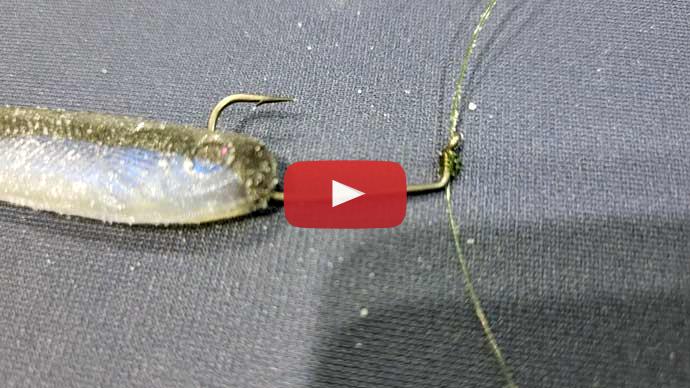
This one's a new worm called the Nekorama from Big Bite. It's designed just for Neko rigging. It's kind of a heavy soft plastic. Heavily salted and it's a big worm. It's like it's about a 7 inch worm. I'm using the Gamakatsu #2. This is the B10S Stinger. Now there's a lot of Neko rigging hooks out there, but in my experience, this is the very best way to get a good hookup and to land the fish.
I've tried them over the years. I've tried little nose hooks. I've tried straight shank hooks and this B10S Stinger from Gamakatsu, the number 2 has just become the most successful in fish hooking and landing. You know, historically a lot of times you might set the hook and that hook just comes right out. The fish gets your worm. And you don't get a hook in them. This hook really hooks them well.
And I like a #2 most of the time. It's a little bit gaudy. It looks, you know, it's kind of big on there, but it just catches them and I don't know why that Neko rig catches them so good, but it catches them really, really well.
I've got a nail weight in the front right here. I've threaded it in. I want to make sure it's nice and straight. I don't want to curve or bend that way it's spiraling or doing something funky. I want it to kind of just glide down and when it hits the bottom. I might just pulse it a little bit. A lot of times you can pulse it right there and talk that fish into biting. Or you can drag it a little bit if you're on a shoal or on a river that has a ledge. You know, it's a good drag bait as well. You know, it'll just kind of shake along and be a good natural offering.
I'm throwing it on the Phenix. This is the K2 7'6" medium light. Caught 1000 fish on it. Neko Rigging. I've experimented lots and lots and lots, and the K2 really has become my favorite Neko rig rod. And it's 7'6", so I can really bomb it. You know, I want to make a long cast. I can reach out and look, you know, 100 feet out with my sonar. I want to be able to reach what I see out there. So I like the 7'6" because I can really throw it. And this just has the right balance. The medium light has the right balance with a soft tip. But then enough backbone in the middle to really, you know, kind of fight a big fish and make sure you get a good hook in them.
I like it on a braided to fluorocarbon setup. You know, I've got some braided line backing and then maybe a 14 foot fluorocarbon leader, 10–12 LB test. Just depends on where you're at and what the water clarity will allow you to get away with. You know, the dingier the water, the bigger you can get away with basically. But generally that 10 to 15 LB range. And sometimes you might have to go down to 8 or, you know, pretty light for spotted bass or smallmouth. But that 10 to 15 LB range is generally the best. And if you get too big a line, you know, you're really slowing the fall of your bait down. You know, I'm trying to get it down there a lot of times. And so I wanted to get there pretty fast. You get too big a line, it's just not getting to the bottom.
So that's my Neko rig, guys. Again, there's a ton of techniques you can catch them on in the summer—spoons, jigs, crankbaits, big worms, Carolina rigs, you know, you name it. Minnow shaking now is one of the biggest things and there's really no seasonal limitation on shaking a minnow, that's always going to be in people's arsenal now. So that's another one to think about. Lots and lots of tricks to throw in the summer, but those would be 3 of my favorites to try and you'll catch a lot of fish on them. So good luck, guys, and I hope you get them good.