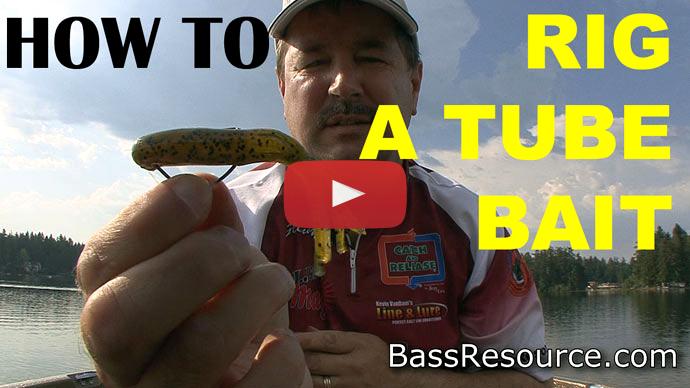
Hey everyone. I'm Pat Schlapper with bassresource.com. And today we're going to kind of breakdown my approach to fishing tubes in the summertime. And we're going to do 2 parts, largemouth and smallmouth. So the first part is going to be I'm going to talk about smallmouth.
And with smallmouth, I keep it pretty simple with the tube. I'm going to rig it basically on an insert head, which there's two different ones that I'm going to show you. This is a little guy. This is a little tiny mini tube. It's a Big Bite. It's a 2 1/2 inch tube. And a lot of times in the summer, there's a lot of juvenile crawfish down there and like, you know, freshly hatched perch fry, just real small forage that those fish are targeting and I really like to throw that little tube and with this tube I rig it with a little different head than a lot of people.
So this is your standard insert head where you slide it up in. It's a teardrop shape. The weight is distributed throughout, you know, about half of the shank of the hook. So what happens with this style head when you kind of snap it off the bottom is this going to give you a lot more erratic, almost like a spiraling action. Which is good in a lot of cases, but when I'm fishing real close to the bottom where it's mainly crawfish eaters, I like to put a football head in there.
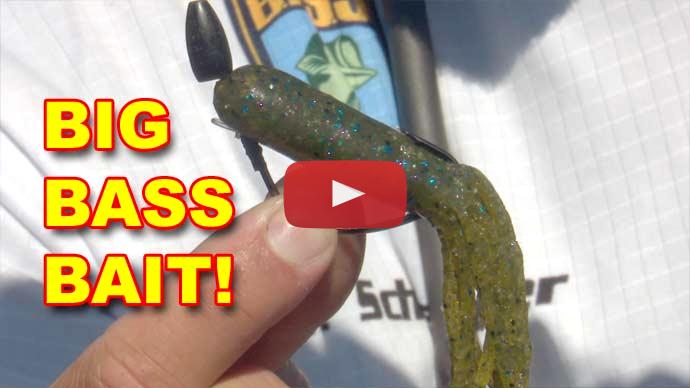
So with a football head, it does two things. The first thing is it gives it more of a kind of a Gobi profile where it gets fat up front and it slims down just a real natural look. So the that's the first thing it does. It just kind of gives that flared end on there. The second thing it does is it puts all that weight up at the front of the hook. So this this rig isn't going to spiral near as much as the traditional teardrop head. This is more going to fall straight down. And what that allows it for, it's just a little different action. And this I'm, I'm dragging on the bottom, that's what I'm doing.
So I think that football head just gives it a little more natural looks like just a crawdad scooting along the bottom, kicking it up like like a traditional big football jig you'd throw. So that's something not a lot of people do. That's kind of a niche thing that like up north where I'm from, we started to do. And I think it does make a difference in a lot of situations. They still will bite the teardrop head, but in the summer I really like that football hat. Or if we go to like the Saint Lawrence River, somewhere where there's a lot of gobies, I really feel like that flared end gets you a few extra bites.
So that's what I'm going to throw most of the time. Quarter oz or a 3/8 ounce head on the little 2 1/2 inch tube. I will throw the bigger tube too, but in the summer I'm going to be more concentrating a little bit deeper. I'm going to be in that 12 to 25 foot of water. Rock, sand and grass, Those are the three main things I'm going to be fishing for. smallmouth. If you can find a combination of all three, that's great.
Probably the best is going to be if you can find a rock area with open sand patches. A lot of people don't talk about that. Everybody thinks about rock for smallmouth, but where a lot of your big ones are or your concentrations of fish are will be in sand pockets within those rock areas. Whether it's on a, on a flat, on a deep hump, on a long point and in the way. I always try to explain to people when those those fish on rocks generally are eating crayfish. Generally not saying they won't eat something else if it comes by, but.
When those crayfish are in the rocks, they got to sit there and wait for them to come out of the little gap in the rocks and try to eat them. If one comes scooting across the sand patch, they're done. Because there's nowhere for them to hide. So those smallmouth will either sit on the sand or they'll just sit on the edges of the rock. When something comes scooting across, it gets eaten.
Same thing with grass. If there's a grass flat and there's a sand patch in there, that's where they're going to be. They're going to be on the edges of that sand on that sand pad. At least the concentrations of them generally are. So that's what I like to look for when I'm smallmouth fishing. Rock, sand, grass, any combination of the two. Really like sand amongst rock.
So that's my approach for smallmouth. Now for largemouth, there's a couple different ways. That'll that'll attack them. Different areas of the lake. As far as structure, I'm going to do a lot of a lot of craw tube, a lot of craw tube fishing. So for largemouth, this is an absolute staple up north. For whatever reason, and around the rest of the country, it hasn't really caught on.
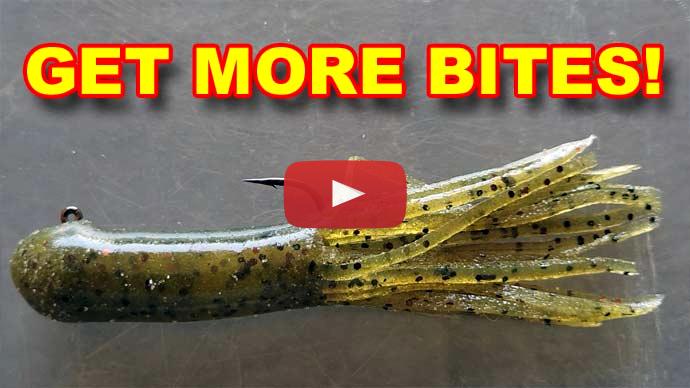
But you get up Wisconsin, Minnesota. You talk to people about fishing summer largemouth, 99% of them are going to say they use a craw tube. So it's a little bit bigger profile, you know, it still has the tube shape, but it has these big pinchers on there and this I like to fish. 22 or 25 LB fluorocarbon 5 ought hook typically you know heavy vegetation will have it pegged. Now open water I'll have it unpegged and I really like to fish this around grass.
In Wisconsin, Minnesota, we have a lot of that 12 to 15 foot grass lines, whether it's and we get a lot of cabbage, we get a lot of Coon tail and a lot of those bigger fish in the summer will move out to those edges of that grass. Thick patches. You kind of punch around the edges of it, cast it down the edges of the grass. A craw tube is just a big fish, big fish catcher so you can also skip around docks. Any visible cover. But I really like to fish it in the grass.
Now when the grass gets real thick then I'm going to go to a punching setup which a lot of people don't think about a tube for punch and say milfoil or Coon tail matted vegetation, but I do it a lot. And this I've got braid. I've got 60 LB Sunline FX-2 braid. I've got a 7 foot 6 inch. Medium, heavy, moderate, fast action St. Croix Legend Elite 8.1:1 reel. Something I can really pick up the line quick in.
This baby has got a three quarter or a 1 oz pegged sinker. Very important that it's pegged because I'm punching it into visible cover. So I'll go down those same areas where maybe I fish the edges with that craw tube. A lot of times up on the top they'll be matted up, Milfoil, Coon tail, whatever type of vegetation it is. And in those summer months when it gets really hot, those fish will really bury up in there. Not only for the shade in the cover, but a lot of times that's where a lot of the bluegills are. In the north, that's a lot of their primary forage fish that are on grass. It's bluegills.
So this I'll have that 4/0 Kahle hook and I'm just going to punch it through the vegetation and wait for them to wait for them to rip the rod out of my hand. So a lot of times people don't throw a tube, but it's perfect. For punching, because it's real slim, there's no appendages, it goes into the cover fast, it comes out fast. You'll find yourself wasting a lot less time picking stuff off of your bait because it's just so streamlined.
So those are my favorite ways to fish for largemouth and for smallmouth with tubes in the summer months.