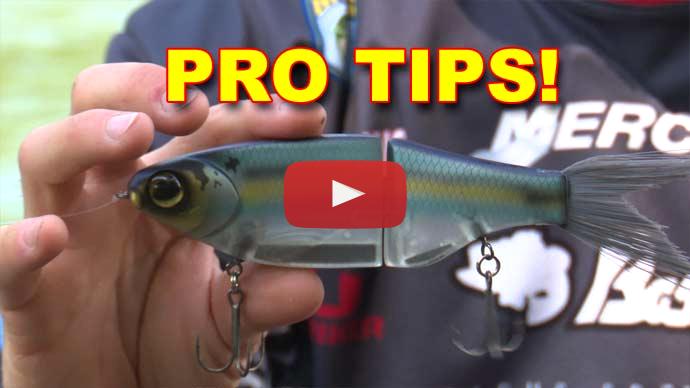
Hey, John Crews here with BassResource, and we're going to break down glide baits in the springtime for you. These are glide baits. What is a glide bait? Glide bait is a hard plastic lure that has a single joint in the middle to where the tail swings back and forth like that. Now, there are a ton of handmade options out there on the market. There are some production models out there like this SPRO Chad Shad.
We're going to kind of give you some general ideas on, and I classify these in three different sizes, this is a medium-size glide. Yes, it is 7-plus inches long to the tip of the tail, but I'm considering this a medium-size glide. There are smaller glides that are in that 5 to 6-inch range.
Then there are large glides which are in that 8 to 10-inch range. Each of those are kind of in a different category as far as I'm concerned, but in that early springtime period glide baits are a really good way to catch some big fish. Now what are we going to do with these glide baits?
First of all, we're going to talk about the setup on what we need to be throwing these on. With glide baits in that medium range, I usually use 18 to 20-pound Sunline FC Sniper. I like that Sniper. It has a little bit of stretch to it. It's a little bit forgiving because we're talking about baits that are 2 to 4 ounces with that middle size.
With the smaller glides, the 5 to 6-inch, I'm going to probably be using 16 or 18-pound Sunline Sniper, kind of that little bit lighter line allows that bait to be a little bit more free. Then on the larger glides, you're still only going to go up to 20-pound test. If you go bigger than that, say 25-pound test, you're going to start to inhibit your line and your action of the baits.
Even with a really big glide bait like a Deps 250, a big, big glide bait, that's going to have inhibiting action for that. So you don't want that. You want that glide bait to be free and natural and very erratic. We'll get to the action here in just a few minutes. As we're going to start fishing that glide bait, the line size is important. The rod and the reel are important as well.
I like a high-speed reel. This is a 150-size reel. This is a GS model from SEVIIN. A 150-size will work for your smaller and medium-size glide baits. When you go to that 8 to 10-inch, you might need to go up to a 300-size reel, a little bit bigger reel so that it can handle that 6 to 8 or even 10-ounce glide bait.
That's when you're getting serious. That's when you're getting heavy. And then the rod needs to have that action to where it's a heavier type action, as you can see right there. It's a heavier, but it's moderate. It's moderate, which means that that action bends throughout the rod. It's not just at the tip like you would a flippin' stick.
You don't really want to throw these baits on a flippin' stick. You want to have a swimbait style rod, which is a heavy action or extra heavy action on those larger baits, but with that more moderate action. That will help you cast the baits better. It'll just kind of pendulum back and swing. You're really just kind of tossing these baits out there because they're so big and heavy.
With that joint, that joint will turn it sideways and the bait will sometimes want to go this way or that way. Not the most accurate baits you'll ever cast. I can promise you that because of the nature of them. And they can catch the wind and kind of take off a few feet to the left or a few feet to the right, but just know that you're going to be tossing them.
And I'll also pitch my glide baits to the targets that I want to as well. You can pitch these baits because they are so heavy. You can pitch them to where you want them. As I mentioned earlier, high-speed reel. I like an 8 to 1 gear ratio. You can get away with a 7 to 1, but I don't like anything slower than that because a lot of the action that you're going to impart on that glide bait is with the reel, with the reel handle and the speed of the reel.
So you're going to be doing different reel bumps with that reel in order to make that bait go side to side. That's kind of how you want to start to fish it. In this early springtime period that we're talking about, we're going to be looking for where are these fish going to be pulling up to start spawning? The pre-spawn is about staging areas.
Those fish are going to be near the spawning areas. The next piece of cover, whether it's a rock pile, a point, a dock, a laydown, those fish will be staging going in. That's what we're going to target with that glide bait. The glide bait is, you want to think of it more as like a jerkbait, but on steroids because you're going to throw that bait out there near the cover and hopefully the fish will come out and eat the bait.
That's what you do with a jerkbait. You throw it, you have the erratic jerkbait, the fish come up and eat it and go back down. The same thing with the glide bait. So that's what you're going to look for in that pre-spawn period in the spring. As we move to the spawn, the glide bait can be a phenomenal way to catch spawners and especially those big females that are just really not quite locked on the beds or maybe they're locked on the beds and they don't want to see anything in a conventional lure manner.
You take a medium or a large-size glide, you pitch it past where those fish are spawning and start working that bait side to side. You can elicit that killer instinct in that bass to defend its bed, to defend its area and they will come out there and crush.
I've caught some really big bass on glide baits right during that spawn time period. And then at the end of the spring period, we're talking like that post-spawn period, there's fish that are going to be guarding fry. Those females are kind of like in that lazy time period where they really kind of don't want to eat. You can throw whatever small baits at them and they're just not even waking up.
They're not even doing anything. I've seen times when those glide baits make those fish come unglued. The bigger females, those bigger fry guarders, they see that glide bait darting back and forth anywhere around their fry.
You're going to have a percentage of those fish that come run out there and just absolutely crush a glide bait like this Chad Shad right here. That is kind of what you're going to be looking for throughout the springtime period with glide baits. I typically like my glide baits to be a little bit higher in the water column during that springtime period.
I think those fish are going to want to feel the sun. Sun does not scare me. I've had some really good days with cloudy conditions in the spring, but I've also had some really good days with the sun because I think that sun makes those fish rise up, especially in the post-pawn period. Those fry are nice and high in the water column. So those fish are up.
They're active up in that top part of the water column. And I think that's one of the reasons that the glide bait really can be handy that time of year. I'm not going to be waiting the glide baits like I might other times of the year. That's just me and typically what I do. So, especially glide baits, more in that early springtime period. You will definitely have yourself a lot of fun, catch some really big fish, and have some big followers because that is part of glide bait fishing too.
You will definitely get some followers. For every bite you get, you'll get probably one or two followers. That is just part of it. You're not going to catch every fish that you see run up behind your bait. That is just part of glide bait fishing. You have to be ready and used to that when that comes. Go out there, throw it next spring and you'll have a lot of fun with that glide bait.