

The phone rang in early April. Long-time client and friend, Gary Redwine from Dallas, expressed concern about his eight-year-old lake and its fishery, located just southeast of Dallas near Kaufman, Texas.
The conversation began with the topic of not being able to catch any big fish. After all, the lake was old enough to yield some sure-enough big Largemouth bass. Redwine said he and some of his buddies had caught bass bigger than four pounds... and that was two years ago.
As I listened to his mild lament, I was searching for clues.
His Number One concern early in the conversation was not seeing any bigger bass.
I met Gary Redwine way back, almost 30 years ago. He owned property in central Oklahoma, which included a pond. He'd been referred by a mutual friend and asked if I'd go with him to take a look at that pond. As an enticement, he offered to pick me up in his small Cessna, and we'd fly there.
Being somewhat unaccustomed to that way of travel, I was enticed.
When he reminded me of that trek recently, behind his wry smile, he said, "I can't believe you flew in a small plane with a stranger."
To this day, I'm not sure I've met a stranger, at least not in the pond management business.
But this day, today, we had a problem to solve on a different property.
Here's your first take-home point. Sometimes the "problem" isn't what we think it is. At first take, Gary was thinking that not having, 'er catching, big bass, was the problem. He had testimony from several friends and neighbors more than willing to help him evaluate the lake via crankbaits, spinnerbaits...and lately, weedless jigs and topwater baits.
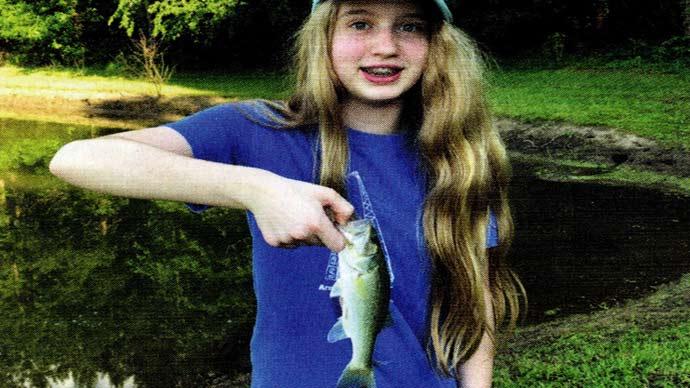
His friends had been telling him for the better part of a year that all they were catching were "dinks", bass from 10 to 14 inches long.
No big fish have been caught in the last two years.
If I've heard this story once, I've heard and seen it 14.2 bazillion times. That's a lot.
As I was digesting the information he was feeding me, I knew from experience that not catching big bass isn't the problem. First off, in my biologist mind, just because no one is catching them doesn't mean they don't exist. When a landowner tells me people are catching only small bass, that's a clue. What do big bass eat in a 15-acre lake like this one? Small bass. But another clue is only catching small bass. That's a sure clue: there probably aren't a lot of large bass, or they'd be eating more of those small critters, which would help cull them.
See that picture?
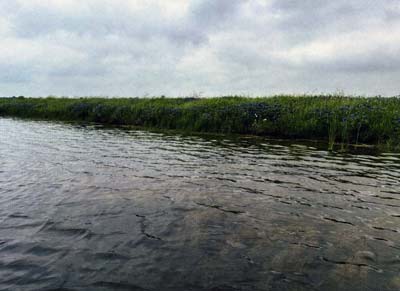
As we further talked, he said the last time he'd looked at the lake, it was getting "Choked with moss."
Hmmm...what does that mean? Choked?
I asked when that was. He said it was in November. Gary and his son, Holt, had taken on the chore of building their lake way back in 2016. I'd guided them a little bit with a habitat plan, and they were gung-ho about renting or buying the equipment and building the lake themselves with their ranch manager. My limited role back then was to encourage them to build good habitat with some of what nature had to offer in that Blackland prairie watershed covered with mesquite trees.
They did a good job building the dam and making some brush piles. They left the existing creek channel and built a peninsula to eliminate part of their shallow water.
Forage fish were stocked the following spring, then Largemouth bass a few months later.
The lake progressed. So did the family business.
The Redwine's were doing what we all do...focused on living life, not paying much attention to their lake.
Like many folks I meet, the Redwines are "project-oriented." They built a house on the property, dialed in on deer management, food plots, and a workshop.
They've got a local farmer helping bale hay and plant plots.
The lake was pretty much left to its resources. After year three, bass were spawning, and the lake was doing what almost all lakes do. It's fish became the consequence.
Bass had spawned, and the fishery was changing dynamics. That's what bass lakes do.
The Redwines had done a few things with the lake, aside from just enjoying it. They harvested a few bass over a couple of seasons.
Last fall, they started having a renewed interest. Now five small grandkids are roaming the Redwine lifestyle, and the lake is ready for some attention.
They didn't expect it might need a revival.
During that initial conversation, Gary told me that he and Holt had found a new pond management company and hired them to evaluate the lake. The results were disappointing to both of them. Sure enough, the lake had reached bass-crowded status, with most bass in the 10-13" range, ranging from 10-20% underweight. The consulting pond management pro recommended harvesting all the bass they could.
He also recommended stocking more than $20,000 worth of small baitfish, presumably after the majority of the bass were harvested from the lake.
His premise was that most of the existing bass had pretty much lost their best growth potential because they'd eaten the cupboards clean and had been status quo for a couple of years.
The data showed a fair number of adult bluegills, by the way.
When Gary was ready to yield that first phone conversation, I asked a few questions. First, I had to presume he had some good facts, although I was convinced he didn't have enough to make a good decision.
I asked, "Do you have river otters?" His answer was quick, "No...we don't."
When I ask questions, I don't always believe the answers, not because someone isn't being honest, far from that. They often simply don't know what they don't know.
He lacked confidence in the report and was quite put off by the recommendations.
He wanted to send the report to me for review and then for my opinion.
He did, I read it, and concluded that the data was likely correct. The assumptions were quite lacking, and I chalked it up to a lack of experience.
The fishery is a textbook "over-crowded" bass situation. The report recommendations were based on that textbook...whatever that means. I could tell there was something deeper to look at. The overcrowded bass were a symptom of the problem, the sneeze, not the disease.
After reading the report, I called Gary back. I asked him again, "Are you sure you don't have any river otters?" The data sure suggested it. He wasn't quite as confident as in the last conversation, but was qualifying his answer, "I've not seen any otters and no one has said anything about them to me."
Ah, that's a better answer.
My next line of questioning was about plants. He'd mentioned the lake was getting "choked" with "moss."
The report didn't really address that issue, although it mentioned it.
Gary Redwine needed some confidence and asked if I'd mind coming to take a look at the lake. This time, rather than entice me with a plane ride, he pitched a nice ribeye steak and maybe a fine Scotch.
I obliged.
The afternoon of our agreed date, I arrived slightly ahead of Gary and headed off to the lake. I could tell by the flat spots in the lake, with a gentle breeze, that he had far more aquatic plants than he actually knew. Bushy pondweed was manifesting at the surface right now, mid-April. North Texas had basically missed winter. There was one week of cold temperatures, certainly not enough to push water plants to their death, much less into dormancy.
From the window of my truck, I could already see that more than half of the lake was covered with bushy pondweed.
After our discussions and reading the report, I knew several questions needed answering before Gary could decide what to do. Were there otters? Were the aquatic plants an issue? Was the lake completely devoid of small baitfish as the report alleged?
I'd inquired if an electrofishing boat was available from the guys I usually work with. They were booked a month out, so I arranged to borrow a boat from another client who owns one for his ranch. He was happy to loan it for consideration in the future.
That boat arrived just before dark, and we took it out for a joy ride just to see what the lake looked like. I was a bit taken aback at the sheer volume of aquatic plant life. There was bushy pondweed (Southern Naiad) growing in water as deep as 12 feet. That's not normal. It covered at least 90% of the lake. We also saw coontail, American pondweed, and some Chara.
Gary was probably more shocked than I was. He hadn't kept up with the lake and was genuinely disappointed.
I was beginning to understand the scenario.
We decided not to crank up the electrofishing unit at that point; instead, we wanted to wait until morning. Besides, I wasn't sure we'd be able to navigate through that tangled mass of plants. It was massive.
Every few minutes of our little evening tour, I'd have to throw the motor into reverse to reject the mass of plants tied up in the prop.
Back at the hacienda, Gary fired up the grill. He'd invited several key neighbors and friends over to partake.
We had a blast. One man, 80-year-old firefighter George Taliferro, was asked if he'd seen any otters. "Oh, yeah, I've seen them several times." The other friend of Gary's, Justin, said, "Gary, we see them often."
Gary seemed genuinely surprised.
Otters tend to eat the biggest fish, especially in the winter months.
We had another strong clue.
Otters.
That property also has an old U.S.D.A. Soil Conservation Service flood control lake that sits squarely in the watershed that feeds Cedar Creek Lake. Otters use that watershed and its creeks. When a private lake has food, otters have zero regard for any "no trespassing" signs. They wreak havoc, doing what otters do.
I still needed answers about bluegills and other forage fish. I'd seen this scenario many, many times over my career as a fish-squeezer. Lakes with heavy infestations of plants typically have lots of tiny bluegills holed up in the plant masses, and bass simply can't access them.
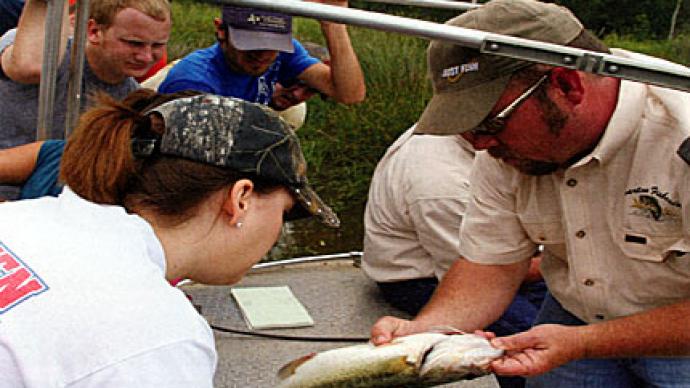
I needed peace with that, so we cranked up the electrofishing boat the next morning and did what we could to navigate through that massive underwater salad bar. We saw four different size classes of bluegills, with enough adult bluegills and redear sunfish to support a decent bass population.
Their numbers were, in fact, low. But there were enough adults to support the fishery.
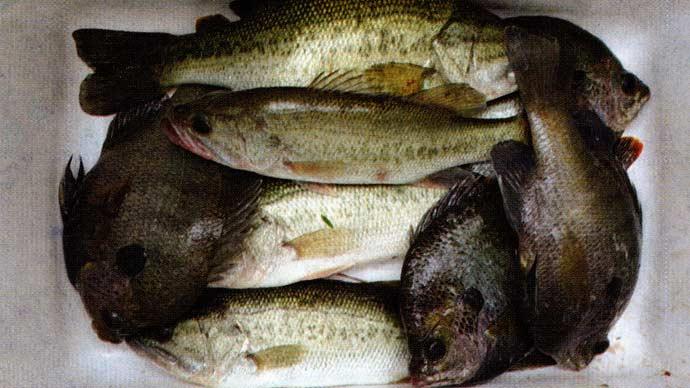
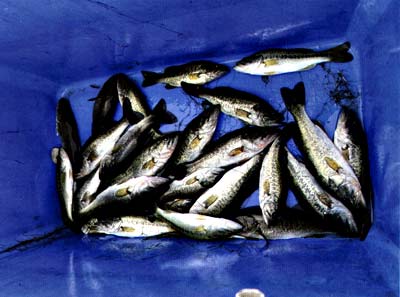
We also collected 32 bass, which were significantly underweight for their lengths.
This article is already way too long, but stay with me. This seasoned biologist, with 45 years under my belt, learned something from this little session on the water. I'd never really thought about it in this context, but it's interesting.
Those 32 bass needed to be removed from the lake. They were undernourished, in decline, and part of that overcrowded generation that was dominating the fishery.
I knew a guy who would love to have them to have some meat for the family. We loaded the boat, Gary got some ice for the bass, and I loaded up and headed for the house.
I was going to surprise my buddy with some protein, but he wasn't answering his phone. I tried him five times, but nothing.
Quick on my feet, I decided to haul the fish to my house, sharpen my fillet knives, and fillet the little cuties myself.
Being a biologist type, I had to make a few observations.
Of the 32 fish, 9 had crawfish in their stomachs. The rest had nothing, which I totally expected. But the most profound thing I saw was the ovaries of each female. By the way, 2/3 were females, which isn't the normal 50-50 split. More than half of those females—the eggs and their ovaries were mushy. The eggs weren't defined. In mid-April, in that part of Texas, eggs should be recognizable, mature, and ready to be spawned. Those bass were absorbing their eggs. As I reflected on the hour of electrofishing, we observed a mass of plants in the lake and saw zero—nada—not one baby bass. None. The remaining females had discernible eggs in their ovaries, but they weren't anywhere near maturity for spawning.
My conclusion at that moment? Those fish were so undernourished that they couldn't develop enough eggs to reproduce. As I peeled back that layer of thought, it hit me. With a lake so choked with plants, making the food chain under-productive and unavailable to its predators, nature was adjusting itself, rendering these fish incapable of perpetuation and adding more mouths to an already stressed circumstance.
Once again, I stood in awe of nature's ability to adjust. Why add more mouths to a lake that isn't in a position to support itself? That made total sense.
Those 32 bass, 10-13" in length, yielded just under five pounds of fillets destined for ceviche, an air fryer, or rolled in Louisiana Fish Fry and boiled at 350 degrees in peanut oil.
Here are my conclusions. The "problem" is the lake being 90% covered with plants. A secondary "problem" is the presence of river otters. Why grow big fish if otters are going to eat your efforts? Another conclusion: there's no need to buy thousands of dollars' worth of bluegills and minnows if the lake is left as is. Deal with the plants first. When that mass of plants dies, they will release their nutrients into the water. When that happens, there are two fundamental consequences: a heavy plankton bloom or lots of filamentous algae.
That means being prepared to anticipate trading problems. Trading away too much bushy pondweed, accumulated over three or four years, for the potential of a fateful algae bloom...or too much filamentous algae.
My recommendations were based on those conclusions. I recommended he:
- Use Fluridone to take out the aquatic plants over 60-90 days.
- Stock tilapia at 20 pounds per acre for two reasons.
- Convert impending algae to flesh to feed his fish.
- Since tilapia reproduce heavily, they can take pressure off his newly hatched bluegill babies.
- Apply for a permit for 150 triploid grass carp, expecting to stock 30-40, and see if they can maintain control after the herbicide treatment.
- Start an otter trapping program with local trappers, staying within the bounds of the law.
- Cull as many bass as possible, since I'm convinced the majority of his bass have lost their best growth potential.
So, what are your take-home points here? A lake, unattended, will adjust to its own devices, not necessarily yours. Second, when a lake is neglected, nature will allow itself to secure your bounty. Here, that meant otters...and probably cormorants. Third, the fishery is a consequence of what it's offered. This fishery adjusted to an overabundance of aquatic plant life, cute little otters doing what they do, and bass overeating the lunch line at their junior high school.
When a lake isn't managed, you might end up with the best lake on the planet...or you might end up with a little nightmare.
At least the ribeyes and the Scotch made for a fun evening...listening to the stories of some salt of the earth folks near Scurry, Texas.
I'm ready for some bass ceviche, courtesy of Gary Redwine.
Reprinted with permission from Pond Boss Magazine